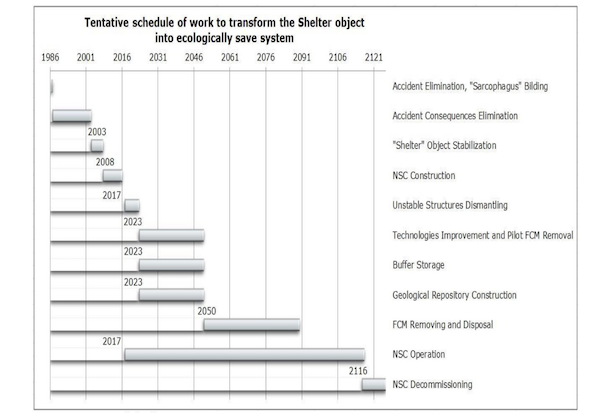
 Preliminary timeline for the transformation of the shelter into an environmentally safe system;
Greenpeace Luxembourg has reported that a recent report by Greenpeace Ukraine documents damage to the Chernobyl protective structure “New Safe Confinement” (NSC), warning of increased risks ahead of the 40th anniversary of the Chernobyl disaster.
According to the report, written by engineer Eric Schmieman, who was involved for many years in the planning and construction of the NSC in Chernobyl, the damage was caused last year by a Russian drone attack.
Inside the NSC are the remains of the destroyed reactor unit 4, as well as the protective structure built immediately after the disaster, known as the sarcophagus. This must be repaired or dismantled as soon as possible but it is currently inaccessible due to the damage to the NSC. Without urgent repairs to the protective shell, the risk of the sarcophagus collapsing increases.
On Thursday 9 April 2026, a Greenpeace investigation team held a press briefing with the director of the Chernobyl power plant to discuss risks to the NSC and plans for its restoration.
“In April 1986, Ukraine and the world experienced the worst nuclear disaster in history. Even today, decades later, radioactive dangers remain in Chernobyl, despite all efforts to contain and control this toxic legacy. These challenges are extremely complex. The Russian drone attack has now increased the risk that the sarcophagus could collapse before it can be carefully dismantled,” said Roger Spautz, nuclear expert at Greenpeace Luxembourg. “Further investigations and damage assessments are already under way, but under the conditions of war it is almost impossible to begin major technical work on site,” he continued.
Greenpeace Ukraine also staged a protest marking the 40th anniversary in Chernobyl against the Russian drone attack and called for maximum sanctions against Rosatom, as well as continued international support for Ukraine. “Greenpeace stands today with Ukraine and supports resistance against Russian criminal attacks, including in Chernobyl. The EU has rightly decided to protect Chernobyl and other Ukrainian nuclear power plants from Russian missile and drone attacks. However, this also means exerting real and increased pressure on Russia to end all nuclear trade and impose sanctions,” Roger Spautz added.
According to Greenpiece, Luxembourg also remains exposed to significant nuclear risk. The French nuclear power plant in Cattenom, located just a few kilometres from the border, represents a constant cross-border source of risk. Although the plant was originally designed for an operating period of 40 years, an extension of its lifespan is currently under consideration. This once again raises fundamental questions about long-term safety and responsibility towards people living in the border region.
The report also warned that long-term recovery efforts at Chernobyl could take decades. According to data, dismantling unstable structures and managing radioactive materials may extend well beyond 2035, with full waste disposal potentially continuing into the next century.
In this context, Greenpeace Luxembourg will host a webinar on Tuesday 28 April 2026 at 18:30 entitled “Risques et vulnérabilités de l'énergie nucléaire”. Speakers will include Roger Spautz, Pauline Boyer, campaigner for the energy transition at Greenpeace France, and Meris Sehovic, alderman of the City of Esch-sur-Alzette and member of the Alliance of Municipalities against Nuclear Energy.