 Nominal Minimum Wage Level (Euros per Hour);
Credit: WSI
Nominal Minimum Wage Level (Euros per Hour);
Credit: WSI
On Thursday 26 March 2026, Luxembourg’s Chamber of Employees (Chambre des Salariés - CSL) highlighted findings from a recent report by the Institute of Economic and Social Sciences (WSI), which compares minimum wage levels across Europe.
The report goes beyond the commonly used comparison of absolute minimum wage levels across countries and instead introduces a broader set of indicators allowing for a more comprehensive assessment of Luxembourg’s minimum wage.
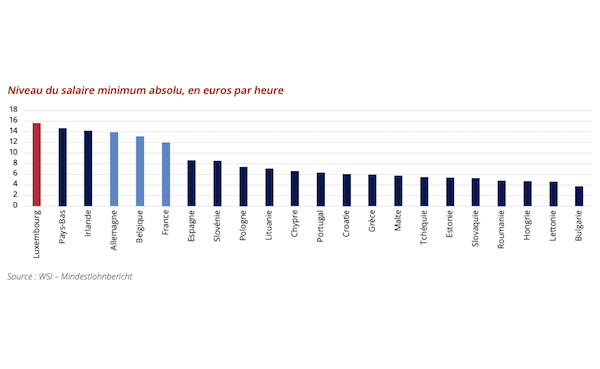
According to the CSL, Luxembourg continues to rank first in terms of the nominal hourly minimum wage, which stood at €15.63 as of 1 January 2026. The Netherlands (€14.71) and Ireland (€14.15) follow closely, while Luxembourg’s neighbouring countries Germany (€13.90), Belgium (€13.08) and France (€12.02) complete the group of highest-ranking countries. However, the CSL stressed that such comparisons remain limited, as they do not take into account significant differences in the cost of living.
Based on Eurostat data, the cost of living in Luxembourg is 47.8% higher than the European average, making it one of the most expensive countries in the European Union. When minimum wage levels are adjusted to reflect purchasing power, Luxembourg’s position changes considerably. In this comparison, Germany ranks first, followed by the Netherlands and Belgium. In these countries, minimum wages are respectively 5%, 3% and 1% higher than in Luxembourg when taking into account the cost of living, meaning that minimum wage earners are better able to meet their expenses. Luxembourg falls to fifth place, at a level comparable to France.
The CSL also highlighted developments over time, noting that the growth of the minimum wage in Luxembourg has been significantly slower than in most other EU countries. Since 2015, the nominal minimum wage has increased by 40.6%, placing Luxembourg only nineteenth in the European Union. This is well below the EU average increase of 121.7%, driven largely by Eastern European countries, and also behind growth recorded in Germany (63.5%), the Netherlands (61.3%) and Belgium (43.4%).
When taking inflation into account, the situation appears even less favourable. In real terms, Luxembourg ranks eighteenth, with a purchasing power increase of just 9.8% over the past decade. This is significantly below the EU average (55.2%), as well as levels observed in Spain (49.6%), Portugal (45.2%), Ireland (34.2%), Germany (23.1%) and the Netherlands (18.5%). Only Malta (8.3%), Belgium (5.2%) and France (0.4%) recorded weaker growth over the same period.
Another key indicator analysed by the CSL is the relationship between the minimum wage and other wages in the economy. This is commonly measured through ratios comparing the minimum wage to the median or average wage, known as Kaitz indices. According to benchmarks reflected in the European directive on adequate minimum wages, a minimum wage is considered adequate if it reaches at least 60% of the median wage or 50% of the average wage.
In Luxembourg, however, the minimum wage corresponds to 54.1% of the median wage and 42.8% of the average wage. Both figures fall below the thresholds set out in the directive, placing Luxembourg sixth and eighth respectively in European comparisons. This, according to the CSL, suggests that the minimum wage cannot be considered excessive when assessed against the country’s overall wage structure.
The CSL concluded that the perception of Luxembourg’s minimum wage as being particularly high should be reconsidered. “The frequently presented view of Luxembourg’s minimum wage as excessively high must be challenged. When taking into account the cost of living and wage structures, the analysis shows that Luxembourg is not among the countries where the minimum wage provides the highest level of purchasing power.”