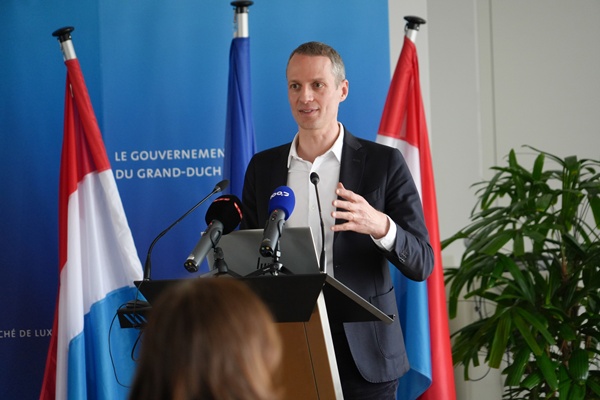
 Serge Wilmes, Luxembourg's Minister of the Environment, Climate and Biodiversity;
Credit: MECB
Serge Wilmes, Luxembourg's Minister of the Environment, Climate and Biodiversity;
Credit: MECB
On Wednesday 25 March 2026, the Environment Agency of Luxembourg's Ministry of the Environment, Climate and Biodiversity presented the findings of the seventh edition of the national household waste analysis.
The National Household Waste Analysis 2024/2025, conducted by the Environment Agency, has revealed that each inhabitant of Luxembourg produced an average of 154 kg of waste per year - a decrease of 9 kg compared to the 2021/2022 analysis. According to the authorities, this positive trend must be maintained and strengthened, particularly in light of economic and demographic changes. By properly sorting waste, 72% of the contents of black bins could be directed to appropriate treatment, they said.
For the latest analysis, the Environment Agency analysed 15.6 tonnes of mixed municipal household waste from fifteen municipalities, selected to constitute a representative sample of the entire country.
The analysis aims to study the current composition of household waste in Luxembourg and to draw conclusions about the behaviour of private households. In particular, it has made it possible to determine:
- the fractions that could be better sorted and recycled in future;
- areas requiring specific measures (e.g. improved communication with citizens, new incentives, optimised collection);
- the effects of changes in waste and resource management on household waste production.
Among the main findings:
- Decrease in the amount of mixed household waste: compared to the 2021/2022 analysis, the amount of household waste fell from approximately 163 kg to 154 kg (-5.4%) per capita. This gradual decrease is attributed to the continued development of separate collection and the associated information and management tools.
- Change in the share of packaging: the share of packaging in household waste reached 21.6% in 2024/2025, compared to 23.5% in 2021/2022. This decrease indicates that separate collection systems are being used more extensively.
- Problematic waste, waste electrical and electronic equipment (WEEE) and batteries: proportions remain very low and largely stable compared to 2021/2022. This reflects the continued effectiveness of take-back and collection systems at recycling centres and businesses, even though some sorting errors persist.
- Biological waste: this constitutes a significant portion of the waste found in general waste bins: approximately 37% by weight, or 57 kg per person per year. Of this, nearly 35% is avoidable food waste. The authorities recalled that organic waste should be placed in the compost bin to be transformed into compost or biogas.
- Paper bags: although the amount of paper and cardboard in mixed household waste decreased considerably since 2021/2022 (-29%), the number of paper bags increased sharply (+48%). Clean or slightly soiled paper bags should be placed in the paper recycling collection.
- Weight-based pricing reduces household waste: comparing municipalities without a system for identifying or weighing waste containers to those where bins are identified and weighed reveals a significant difference: with a weighing system, each resident produces approximately 27 kg less mixed household waste per year. Since the cost of disposal depends on weight, residents recycle more or throw away less.
- Differences between rural and urban areas: in cities, there is more biowaste (approximately 45 kg compared to 31 kg), paper/ cardboard (approximately 25 kg compared to 15 kg), as well as more packaging, plastics and hygiene products. The higher the population density, the less adherence to sorting guidelines, according to the authorities.
The Environment Agency clarified that mixed household waste refers to all mixed waste collected via black bins. It is incinerated at SIDOR or, after pretreatment, sent to the Flaxweiler landfill.
Samples from fifteen representative municipalities (four municipalities from SIDEC, three from SIGRE and eight from SIDOR) were analysed during two sorting campaigns (each lasting four weeks). Samples for collection were selected based on geographical criteria (waste management associations) and demographic criteria (characteristics of residential areas, population density), as well as criteria related to waste management (waste pricing system).
In total, 70 waste fractions were sorted and analysed: plastics, paper, metals, textiles, food waste and problematic substances such as hygiene and cosmetic products. Sorting was carried out manually, and the weight, volume, and, where applicable, the number of items were recorded.
Seasonal influences were taken into account through two sampling periods, one in winter and the other in summer. The collected data was then used to compile the analysis report.
The 2024/2025 dataset is available online at https://data.public.lu/en/datasets/waste-and-resources-municipal-waste/