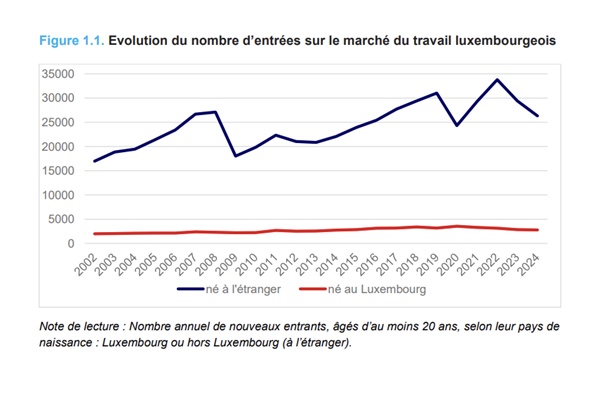
 Evolution of the number of entries into the Luxembourg labour market, 2002-2024;
Credit: LUXTALENT - LISTER / MECO
Evolution of the number of entries into the Luxembourg labour market, 2002-2024;
Credit: LUXTALENT - LISTER / MECO
On Tuesday 24 March 2026, Luxembourg's Ministry of the Economy and the Luxembourg Institute of Socio-Economic Research (LISER) presented the results of the first part of the "LUXTALENT" study on attracting and retaining talent in Luxembourg.
Following the signing of the "LUXTALENT" agreement in March 2025, LISER, at the request of the Ministry of the Economy, conducted a study on attracting and retaining newly arrived immigrants and cross-border workers in the Luxembourg labour market. The first part of the study analyses the inflow and outflow of newly arrived workers between 2002 and 2024. It reveals a growing, increasingly diverse and mobile international workforce.
Methodology
To analyse the inflow and outflow of newly arrived workers in the Luxembourg labour market during the 2002-2024 period, LISER adopted an innovative methodology based on flow analysis, rather than the generally used analysis of the total number of workers active in the labour market. According to LISER, this approach provides a better understanding of existing dynamics.
The analysis is based on administrative data from the General Inspectorate of Social Security (IGSS), covering all individuals affiliated with Luxembourg's social security system, including both residents and cross-border workers.
This first part highlights the attractiveness of the Luxembourg labour market for newly arrived foreign workers aged 20 and above, distinguishing them in particular by their origin, country of residence and sector of entry. The data are then also used to characterise mobility and departures from the labour market.
Key Findings
Growing importance of foreign workers
The study highlights the growing importance of foreign workers in Luxembourg. Between 2002 and 2024, the number of first-time entrants to the Luxembourg labour market who were born abroad increased significantly. In 2024, nearly 90% of first-time entrants were born outside Luxembourg. This trend is driven by both immigration and cross-border workers.
The workforce is also relatively young, with around 75% of first-time entrants between 2021 and 2024 aged under 39.
Increasing diversification of workforce origins
The study found that the profile of new foreign arrivals in the Luxembourg labour market is evolving. Workers from the three bordering countries (Germany, Belgium and France) now represent a smaller share of new arrivals than before, decreasing from 73% in 2002 to 46% in 2024.
In 2024, approximately 8,200 foreign workers moved to Luxembourg for the first time. Among these newcomers, the share of of non-European nationals has been increasing for several years. At the same time, some traditionally well-represented groups, such as Portuguese nationals, are becoming less represented among new immigrants, while increasing among cross-border workers.
Around 15,200 new cross-border workers entered the Luxembourg labour market for the first time in 2024. The share of newcomers from France continues to increase, while those from Germany and Belgium are declining. A substantial proportion of these new arrivals were born in a country different from their country of residence: in 2024, this applied to 62% of cross-border workers residing in Belgium, 42% in Germany and 38% in France.
Sectoral concentration by country of residence
The spatial distribution of newly arrived workers also evolved between 2002 and 2024, with a strengthening of sectoral concentration depending on the workers' country of residence, i.e. whether they are resident immigrant or cross-border workers.
New resident immigrant workers are increasingly concentrated in highly skilled sectors. In 2024, the sectors "Specialised, Scientific and Technical Activities" and "Financial and Insurance Activities" together accounted for 40% of new immigrant worker entries. Conversely, the share of manual labour among this group declined significantly, from an average of 66% between 2002 and 2005 to 29% between 2021 and 2024.
New cross-border workers remain proportionally more concentrated in sectors requiring fewer formal qualifications, particularly construction, transportation and warehousing, although highly skilled sectors are also gradually gaining importance.
High mobility of the foreign workforce
Retention analysis shows that Luxembourg's foreign workforce is highly mobile. This applies to both newly arrived immigrants and cross-border workers: around 30% of new arrivals leave Luxembourg within one year and approximately 50% leave within five years.
Next Steps
This second part of the study, due in summer 2026, will analyse Luxembourg's attractiveness as a destination country for newly arrived immigrants. It will identify the factors that led these new arrivals to come to Luxembourg, compare the country with other destinations and highlight factors that may encourage new arrivals to leave Luxembourg. This qualitative analysis is expected to complement the findings of the first part of the study.
All work carried out with LISER within the framework of the LUXTALENT project is part of the work of the High Committee for the Attraction, Retention and Development of Talent, chaired by Luxembourg's Minister of the Economy, SMEs, Energy and Tourism, Lex Delles. The findings are also intended to guide promotional efforts under the "Work in Luxembourg" brand, launched in early 2026.
The LUXTALENT study, "Attraction et rétention des talents au Luxembourg" - Part 1, can be downloaded here.