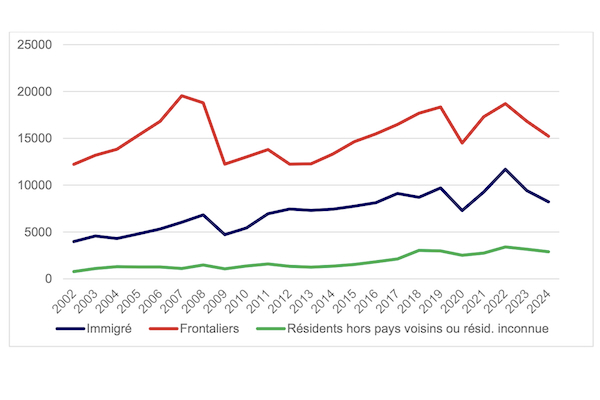
 Changes in the number of entries into the Luxembourg labour market by country of residence depending on the country of residence;
Credit: LISER
Changes in the number of entries into the Luxembourg labour market by country of residence depending on the country of residence;
Credit: LISER
On Monday 15 June 2026, Luxembourg’s Ministry of the Economy and Luxembourg Institute of Socio-Economic Research (LISER) published the results of the second part of the LISER study on the attraction and retention of newly arrived immigrant and cross-border workers in the Luxembourg labour market.
The study, undertaken following the signing of an agreement entitled “LUXTALENT” in March 2025, and carried out at the request of the Ministry of the Economy was divided into two parts.
The first part, the results of which were published on Monday 24 March 2026, analysed the inflows and outflows of newly arrived workers in the Luxembourg labour market over the period 2002–2024, based on administrative data from the General Inspectorate of Social Security (IGSS).
The second part draws on data from a survey conducted by LISER among 3,200 newly arrived immigrants of working age (eighteen–64) who arrived in Luxembourg in 2023. This approach provides a complementary perspective to the administrative data by offering a more detailed description of this population, including information on educational attainment, occupation, previous professional experience, language skills, motivations for choosing Luxembourg, alternative destinations considered, intended length of stay and factors that could motivate departure.
Main Findings
The principal findings and conclusions of the report reveal:
⁃ a highly qualified profile: Newly arrived immigrants in 2023 represent a highly educated population, with approximately 78% holding a university degree;
⁃ a marked sectoral concentration: Approximately 33% of economically active respondents reported working in financial services, 11% in professional and scientific services and 10% in information and communication technologies (ICT);
⁃ an asymmetric language skills profile: English is widely spoken, with approximately 88% of newcomers reporting proficiency. French is less widespread (48%), while German remains relatively uncommon (11%).
According to the report, approximately 45% of newcomers indicated that they had considered only Luxembourg as their destination country, with some differences between profiles. Highly qualified sectors, particularly finance and ICT, are the most exposed to international competition. 50% of finance professionals and 52% of ICT professionals considered alternative destinations to Luxembourg. Switzerland, Germany and the Netherlands are perceived as Luxembourg’s principal competitors.
A job offer (45%), quality of life (38%), personal networks (35%) and salary levels (32%) are the main motivations for settling in Luxembourg among newcomers overall. Employment opportunities are particularly important in highly qualified sectors, where international competition is stronger.
Aside from a significant reduction in income, housing costs (66%) are by far the principal factor that could encourage newcomers to leave Luxembourg, ahead of family distance (36%) and opportunities abroad (35%).
Perceived professional mobility reflects how newcomers assess changes in their professional situation since arriving in Luxembourg. Approximately 17% believe they occupy a position below their qualifications compared with their previous employment, while approximately 22% consider that they have obtained a more qualified position than before. These perceptions are correlated with educational attainment.
63% of newcomers expect their professional situation to improve, indicating a high level of confidence in their prospects in Luxembourg.
62% of newcomers state that they wish to remain in Luxembourg for longer than originally planned.
The ministry noted that all work carried out with LISER as part of the LUXTALENT project forms part of the activities of the High Committee for the Attraction, Retention and Development of Talent, chaired by the Minister for the Economy, SMEs, Energy and Tourism. The findings also help guide promotional activities under the “Work in Luxembourg” brand, which were launched at the beginning of 2026.
A consolidated version (in French) of the LUXTALENT study, “Talent Attraction and Retention in Luxembourg”, can be downloaded at: https://gouvernement.lu/dam-assets/images-documents/actualites/2026/06-juin/15-delles-rapport-liser/luxtalent-rapport-completl-20260320.pdf