Details:
The tradition of "Liichte goen" is one of Luxembourg's oldest customs. Celebrated annually on 2 February, this "Liichtmëssdag" (Candlemas) tradition dates back to the pre-Christian era.
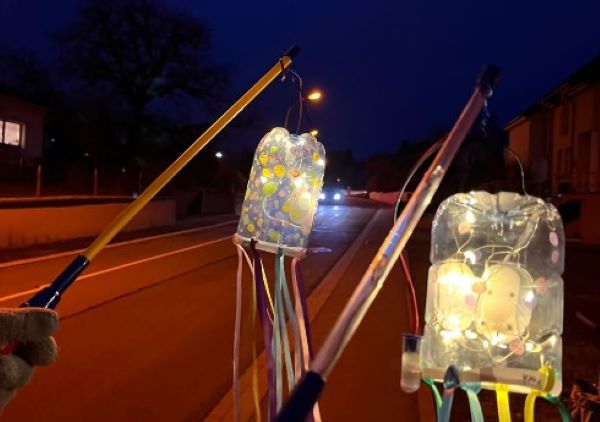
On this day, in the early evening, children of different cultures, ages and faiths gather to walk through their local neighbourhoods with their "liichtebengelcher" (colourful handmade lanterns), small light sticks and bags to carry the sweets or coins they receive. After splitting up into groups, they go from house to house singing traditional songs that have been passed down through generations.
The song "Léiwer Härgottsblieschen" refers to the early Christian bishop and martyr Saint Blaise ("Herrgottsblieschen"), one of the Fourteen Holy Helpers in Roman Catholicism, whose feast day is celebrated one day after, on 3 February. The song's lyrics reflect a tradition in which children bring light, blessings and cheer in exchange for edible goods.
Although some lyrics may sound religious today, the tradition blends elements from both pagan (pre-Christian) and Christian practices. Its earliest roots lie in Imbolc, the ancient Celtic festival celebrated on 1 February that celebrated "purification" and the return of light after a long winter. With the spread of Christianity, the church adopted the practice, adding candlelit processions and linking it to the Feast of the Presentation of the Lord on 2 February. The result is the mixed symbolism that still characterises the celebration today.
The song's text appears in Edmond de la Fontaine's book Luxemburger Kinderreime, published in 1884. Early nineteenth-century works on folk ethnology also describe this long-established tradition.
Song lyrics:
“Léiwer Härgottsblieschen,” (Dear Little Lord’s Flowers,)
“Gitt ons Speck an Ierbessen” (Give us bacon and peas)
“Ee Pond, zwee Pond,” (One pound, two pounds,)
“Dat anert Joer da gitt der gesond,” (Next year you will be healthy,)
“Da gitt der gesond.” (You will be healthy.)
“Loosst déi jonk Leit liewen” (Let the young people live)
“Loosst déi al Leit stierwen,” (Let the old people die,)
“an déi al derniewent” (and the old ones beside them)
“Kommt der net bal,” (If you do not come soon,)
“D'Féiss ginn ons kal.” (Our feet will get cold.)
“Kommt Der net gläich,” (If you do not come right away,)
“Da gi mer op d'Schläich.” (We will sneak off.)
“Kommt der net geschwënn,” (If you do not come quickly,)
“D'Féiss ginn ons dënn.” (Our feet will grow thin.)
“Kommt Der net gewëss,” (If you do not come for sure,)
“Da kritt Der e Schouss voll Nëss.” (You will get a lap full of nuts.)
As one might expect, children today are more likely to hope for chocolate, sweets and cookies than for bacon and peas.
Other songs that fill the streets during the celebration include "Mir Kanner komme Liichten a gi vun Haus zu Haus" ("We children come to bring light and go from house to house"), the title of which speaks for itself.
The tradition is held annually across the country but without any central ceremony, placing the main focus on the contribution coming from households that welcome children and prepare small treats. Although some municipalities have organised celebrations in past years, such as small receptions at Luxembourg City Hall or lantern gatherings in Esch-sur-Alzette, these events remain local and low-key. For the 2026 celebration, the custom is again expected to take place mostly at community level, with children visiting neighbourhoods in the early evening.
Today, many children already have plenty of sweets at home, so they take part mainly to keep the tradition alive. The activity provides a change of routine as children go out with friends, carry lanterns and sing at people's doors.
Venue: Luxembourg
Organiser: n/a
Price: n/a
Reservations: n/a