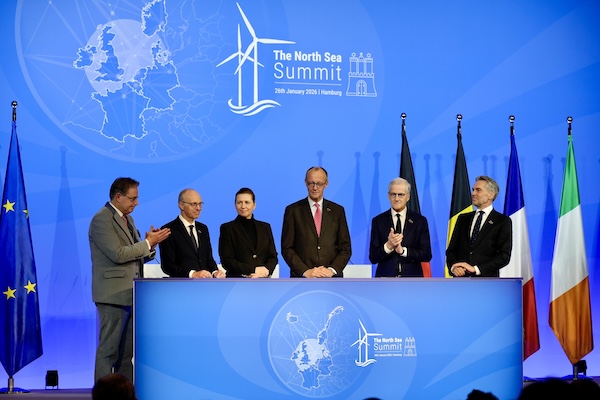
 (L-R) Bart De Wever, Belgian Prime Minister; Luc Frieden, Luxembourg Prime Minister; Mette Frederiksen, Danish Prime Minister; Friedrich Merz, German Chancellor; Jonas Gahr Støre, Norweigan Prime Minister; Dick Schoof, Dutch Prime Minister;
Credit: ME
(L-R) Bart De Wever, Belgian Prime Minister; Luc Frieden, Luxembourg Prime Minister; Mette Frederiksen, Danish Prime Minister; Friedrich Merz, German Chancellor; Jonas Gahr Støre, Norweigan Prime Minister; Dick Schoof, Dutch Prime Minister;
Credit: ME
On Monday 26 January 2026, Luxembourg Prime Minister Luc Frieden and Minister for the Economy, SMEs, Energy and Tourism, Lex Delles, represented Luxembourg at the third North Sea Summit in Hamburg.
The high-level meeting brought together heads of state and government, energy ministers and representatives from Belgium, Denmark, France, Great Britain, Ireland, Luxembourg, the Netherlands, Norway and Iceland.
According to the Luxembourg Ministry of State and Ministry of Economy, discussions focused on strengthening cooperation in the development of offshore wind energy in the North Sea and on coordinating European energy infrastructure.
The ministries noted that although Luxembourg is not a North Sea coastal state, it is directly affected by decisions taken in this context. As a highly industrialised economy and a net importer of energy, the country has a strategic interest in supporting a coordinated approach aimed at strengthening interconnections, diversifying energy sources and accelerating the transition towards a sustainable, competitive and resilient energy system.
Beyond climate and industrial challenges, the summit highlighted a shared vision for Europe’s energy future: not a patchwork of offshore wind farms each supplying a single country, but an integrated network of interconnected parks capable of delivering electricity and renewable hydrogen to several states simultaneously. This approach seeks to optimise production, enhance the flexibility of the European energy system and support the emergence of a cross-border clean electricity market.
Against a backdrop marked by an increase in acts of sabotage and hybrid threats targeting critical infrastructure in the North Sea, participants also underlined the importance of enhanced cooperation on security. Protecting these strategic installations has become a key pillar of the energy transition, underpinning Europe’s energy resilience and sovereignty.
The ministries reported that on the occasion of the summit, Prime Minister Frieden signed a joint political declaration reaffirming Luxembourg’s commitment to actively contributing to the development of renewable energy in Europe and to supporting regional cooperation projects in the North Sea.
Prime Minister Frieden stated: “In an unstable geopolitical context, our sovereignty and security depend on strengthened cooperation in the field of energy. Luxembourg firmly supports the creation of a truly integrated and cross-border European energy market based on renewable energies, the only sustainable path to guaranteeing our energy independence and Europe’s resilience.”
Also, during the summit, Minister Delles signed the Hamburg Declaration of Energy Ministers, a joint declaration of intent on developing cooperation projects with the states participating in the summit. The declaration aims to accelerate the implementation of cross-border projects in renewable energy and energy infrastructure.
During a bilateral meeting, Minister Delles and his Danish counterpart, Lars Aagaard, Minister for Climate, Energy and Utilities, signed a bilateral treaty to intensify cooperation in the development of renewable energy up to 2030.
According to the ministries, this partnership builds on a previous bilateral agreement and a principal agreement on statistical transfers of renewable energy, reflecting a strong political will to promote joint projects. The treaty provides for increased statistical transfers to meet national renewable energy targets by 2030. This cooperation entails a financial contribution of approximately €50.6 million for the minimum volume envisaged (3,500 GWh), rising to up to €165.44 million if the maximum volume (11,300 GWh) is reached, for the period from 2025 to 2030.
Minister Delles said: “Offshore wind energy is essential to achieving Europe’s climate objectives. Even without access to the sea, Luxembourg has long been committed to cooperation in the North Sea and plays a catalytic role through its financial contributions. This collaboration makes clean and affordable energy accessible to landlocked countries as well, supporting in particular our energy-intensive industrial sectors while continuing to develop renewables at national level.”
Moreover, the ministries reported that Prime Minister Frieden and Minister Delles were accompanied by a delegation of Luxembourg companies active in the energy, engineering and infrastructure sectors: ArcelorMittal/Sotel, Creos, Jan De Nul, the Port of Mertert and GeoXYZ. The ministries remarked that the presence of these industrial players highlighted Luxembourg’s interest in the economic, technological and energy opportunities linked to the development of renewable energy in the North Sea.