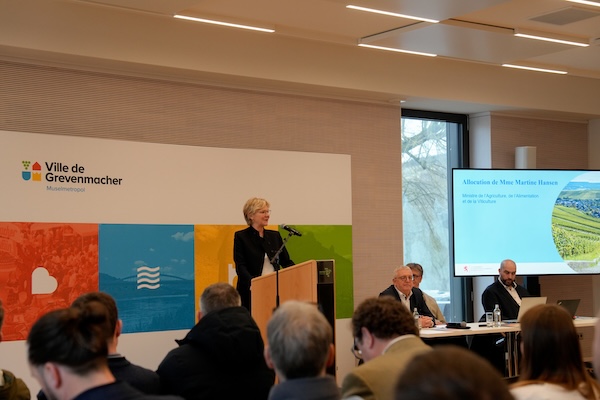
 Martine Hansen, Luxembourg’s Minister of Agriculture, Food and Viticulture;
Credit: MECO
Martine Hansen, Luxembourg’s Minister of Agriculture, Food and Viticulture;
Credit: MECO
On Thursday 12 February 2026, Luxembourg’s Minister of the Economy, SMEs, Energy and Tourism, Lex Delles, and Minister of Agriculture, Food and Viticulture, Martine Hansen, presented the action plan for the development of wine tourism in Luxembourg at the Machera Cultural Centre in Grevenmacher.
The plan forms part of the national sustainable tourism strategy “Mënschen, Regiounen an Ekonomie − Tourismusstrategie Lëtzebuerg” and aims to position Luxembourg as a must-visit wine tourism destination by promoting its viticultural heritage, the Moselle landscapes and the expertise of local winegrowers.
At European level, wine tourism is experiencing sustained growth, driven by demand for authentic, high-quality and personalised experiences. It has become a major economic lever for wine-producing regions, generating direct revenue for wineries as well as indirect benefits for accommodation, catering and services.
The ministries noted that recent studies confirm several structural trends, as well as strong customer loyalty within the wine tourism segment, which contributes significantly to operating revenues. Growing interest in experiences combining wine, gastronomy, nature and culture, together with the increasing role of storytelling and events, enhances destination attractiveness.
The action plan is based on three development axes, reflecting the full experience of visitors, producers and local horeca (hotel, restaurant and catering) actors:
entdecken – discover: access to the region, landscapes and wine heritage;
schmaachen – taste: sensory experiences centred on wine and gastronomy;
genéissen – enjoy: conviviality, hospitality and immersion in the local way of life.
During the design phase, developed in collaboration with partners from the wine, tourism and horeca sectors, each axis resulted in twelve projects:
- Creation of a general assistance desk to support the implementation of wine tourism infrastructure projects;
- Call for projects for the development of tourist lodgings in unusual locations or buildings in the region;
- Development of wine tourism activities linked to the operation of the Wäinhaus;
- Development of the “Musel Bike-Trail” offer, proposing cycling routes between wineries and vineyard landscapes;
- Dedicated communication strategy and plan to promote the national wine tourism offer;
- Creation of the “Wine & Hike” offer combining walking, nature and tasting in the Moselle region;
- Seasonal programme of thematic wine tourism activities linking terroir and culture;
- “Musel Wënzer Picnic” product concept combining picnics with discovery of Moselle wines;
- Promotion of the wine tourism offer through the Luxembourg House network in Luxembourg City;
- Seasonal horeca concept “Wine & Dine”, inspired by “Resto Days”, highlighting food and wine pairings;
- Organisation of “Terroirs & Grape Varieties of the Moselle” tastings for the general public;
- “Discovery of Nature and Viticulture” training courses for tourist guides.
The action plan provides a structured basis for the development of Luxembourg wine tourism, while allowing the flexibility needed for gradual adaptation of measures. In the medium and long term, it aims to strengthen the attractiveness of the Moselle region, diversify the local economy, promote Luxembourg wines and crémants and encourage high-quality, sustainable tourism.
Minister Delles stated: “Wine tourism in Luxembourg fully embodies the spirit of the country, combining craftsmanship, landscapes, gastronomy and culture, not to mention the passion of our winegrowers. This action plan is based on a clear vision: to make the wine sector a comprehensive experience and a driver of regional and sustainable development. The success of this ambition relies on a collective, sustainable and inspiring approach.”
Minister Hansen added: “Wine tourism represents a major opportunity for our winegrowers to introduce their wines and crémants to new customers. It makes it possible to create an experience around the product, enhance its value and sustainably bring producers and consumers closer together.”