 Credit: Police Lëtzebuerg
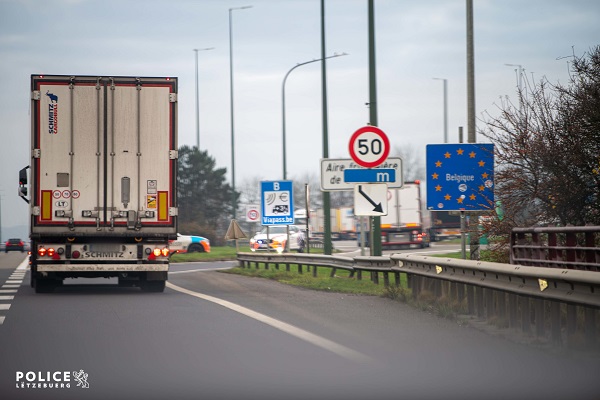
As part of the Luxembourg Presidency of the Benelux Union, the Grand Ducal Police carried out the first implementation exercise of the Belgian-Luxembourg cross-border alert plan on Wednesday 17 December 2025.
Signed on 14 May 2024 by representatives of the Grand Ducal Police, the Belgian Federal Police and the governors of the Belgian provinces of Luxembourg and Liège, the memoranda of understanding for the Belgian-Luxembourg border alert plan entered into force on 1 July 2024. The aim is to make the borders virtually impermeable in the event of a high-intensity incident, while enabling the rapid mobilisation of a coordinated operational force involving field teams along the Belgian-Luxembourg border.
The protocols comprise a set of provisions designed to coordinate Belgian and Luxembourgish operational responses to major or high-intensity events - regardless of their origin - that could seriously disrupt public order on one or both sides of the border, such as:
- events threatening human lives or cause serious physical harm (terrorist attacks, robberies, aircraft or train accidents, etc.);
- events compromising the safety or free movement of people and goods (protests, unrest, blockades, etc.);
- events posing a risk to the environment (CBRN incidents, natural disasters, technological risks, etc.).
The Belgian-Luxembourg plan follows similar protocols signed between the Grand Duchy of Luxembourg and eastern France at the end of 2021, which entered into force on 1 January 2022.
According to the Grand Ducal Police, the exercise was conducted in collaboration with Belgian law enforcement authorities and aimed to test the border security measures under realistic conditions. A simulated armoured truck robbery was carried out in Luxembourg, after which the perpetrators fled in a vehicle (at the legal speed limit) and attempted to cross the Belgian-Luxembourg border several times before heading towards the north of the Grand Duchy.
On the Luxembourg side, the police operations department and the CIN national intervention centre were responsible for coordinating and overseeing the exercise, which took place between 08:30 and 12:00.
The Grand Ducal Police said the exercise made it possible to test the reactions of the various Luxembourg and Belgian services, including alert dissemination, the occupation of control posts, the mobilisation of resources and cooperation with foreign authorities.