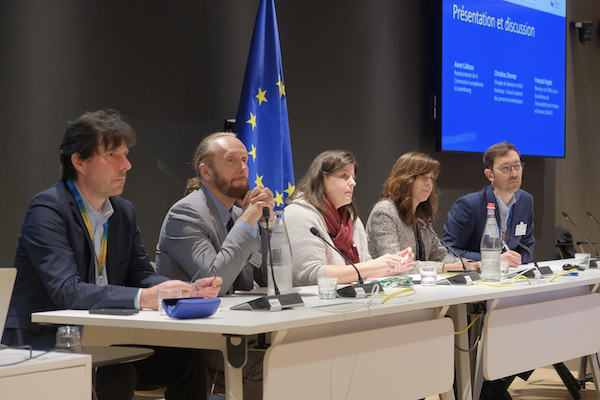
 (L-R) Christoph Schröder, European Parliament Liaison Office; François Engels, Director of OSAPS; Christine Zimmer, Director of Info-Handicap; Anne Calteux, European Commission in Luxembourg; Thomas Segrétain, European Consumer Centre Luxembourg;
Credit: Steven Miller, Chronicle.lu
(L-R) Christoph Schröder, European Parliament Liaison Office; François Engels, Director of OSAPS; Christine Zimmer, Director of Info-Handicap; Anne Calteux, European Commission in Luxembourg; Thomas Segrétain, European Consumer Centre Luxembourg;
Credit: Steven Miller, Chronicle.lu
On Thursday 15 January 2026, the European Commission hosted a seminar on consumer rights and accessibility at the Europa Experience in Luxembourg-Kirchberg.
The seminar, undertaken in the context of European efforts to strengthen the rights of people with disabilities, was presented by Thomas Segrétain, Director of the European Consumer Centre Luxembourg, and featured contributions from Anne Calteux, Representative of the European Commission in Luxembourg, Christine Zimmer, Director of Info-Handicap, François Engels, Director of the Office for the Surveillance of Product and Service Accessibility (OSAPS), and Christoph Schröder, Head of the European Parliament Liaison Office in Luxembourg.
The session began with an introductory video message from Marc Angel, Quaestor of the European Parliament, who emphasised the importance of accessibility and the rights of consumers with disabilities at the European level. He said: “For too many, a disability means having fewer choices as consumers. A truly functioning single market is one that works for everyone, not just for the most agile. Not just for those who never have to think twice about accessibility. Everyone means everyone.”
He added: “My message today is simple. Accessibility is not an optional feature. It is a fundamental right. It is a condition for equality, for autonomy and for dignity. It is also a condition for trust in the European project. And I firmly believe that accessibility is not a burden and it is not a cost. It is an investment. An investment in participation, in equal opportunities and in a stronger and more democratic union.”
Thomas Segrétain then introduced the panel of speakers to the attendees and asked Christine Zimmer to describe what is meant by “disability”. She responded: “We can all find ourselves at some point in a situation of disability because we had a ski accident, but once we are healed, we no longer suffer from the disability. So, it is really a disability that remains as long as it has survived throughout life. We are talking about people who have a visual disability, who have a physical, auditory, intellectual, invisible disability.”
Thomas Segrétain asked the panel to provide an overview of the situation of consumers under such circumstances.
Anne Calteux said: “In the European Union, there are still 450 million citizens, of which 87 million are people who suffer from a disability as defined by Christine. […] So, first, we want an inclusive society, respecting the rights of everyone. We must ensure that people living with a disability can also be part of this inclusive society. Secondly, now you hear a lot about competitiveness, increased productivity but we can only achieve this by also ensuring the participation of people living with a disability because we need everyone to participate in these efforts. We need to create conditions that allow these people living with a disability to fully play their role in our society.”
François Engels spoke of the advantages and disadvantages of living with a disability in an age of digital development. He first noted the ease with which products can be ordered online and delivered directly, removing the necessity to move to be able to shop. He then highlighted that despite such advantages there are still barriers in the form of digital interfaces, which can actually block access due to not being configured for disabled users.
Thomas Segrétain then raised the topic of the European Accessibility Act and asked the panel members to describe its impact and status.
Anne Calteux remarked: “We can already see that the situation is not the same in all Member States and that there are many challenges in terms of transposition. In particular, when it comes to technical complexity, the cost of operations is still high but there is also a problem of coordination between authorities and economic actors. In any case, for us, the European Accessibility Act is very important because it is part of our general strategy to increase productivity and to have a more egalitarian and inclusive society.”
François Engels added: “We really see that economic operators have taken this to heart. Now, it's up to us to follow these steps to see if it's not just beautiful words that want to mislead us. But when we look at the measures that banks will take in the coming months, I would say that we are on the right track.”
Christine Zimmer remarked: “After we saw Luxembourg transpose the law, the day after it entered into force, the majority of people concerned by the law, the majority of companies concerned by the law, were not even aware that they would have to be conformant. […] There are companies that were taken by surprise in discussions with people on the left and on the right. For us, this is a very big problem that still persists today.”
The panel then went on to discuss the challenges encountered by economic actors, SMEs and the challenges they faced in adapting to the new accessibility requirements. They then participated in a brief question and answer session with members of the audience before closing were provided by Christoph Schröder.