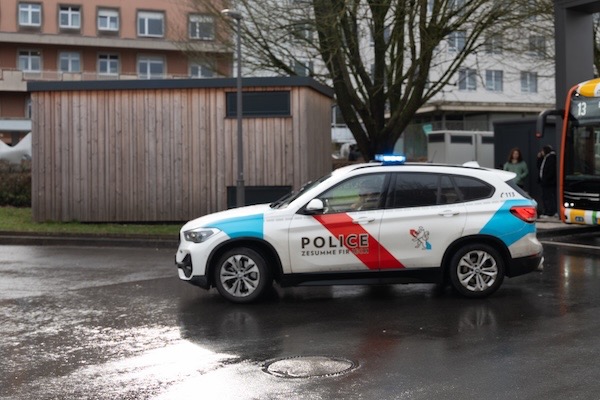
 Credit: Ali Sahib, Chronicle.lu
On Wednesday 21 January 2026, the Grand Ducal Police revealed that in 2025 five weeks of coordinated checks and enforcement operations were carried out, involving a total of 8,400 operational officers in Belgium, the Netherlands, France and Luxembourg.
According to the Luxembourg police, the joint mobilisation, undertaken as part of the “Hazeldonk” cooperation, resulted in the seizure of €1,125,801 in cash, along with quantities of cocaine, marijuana, cannabis resin (hashish), heroin, ketamine, MDMA, amphetamines, ecstasy (XTC), synthetic cannabinoids and nitrous oxide.
The operations also saw 273 arrests, with 129 vehicles seized and 388 drivers found to be under the influence of drugs.
The “Hazeldonk” cooperation between Belgium, the Netherlands, France and Luxembourg has existed since 2006 and aims to combat organised cross-border drug distribution networks. The joint control operations cover road, rail and air traffic and are named after a Dutch village on the Belgian border, located on one of the main routes used by European drug traffickers.
The police noted that the operations in 2025 highlighted a number of key trends. These included:
• large sums of money transported by criminal networks;
• atypical profiles used for transport (families with children, elderly persons, taxi drivers);
• a significant increase in the use of international rail transport by criminal networks;
• increasing professionalisation of concealment and transport methods.
The Grand Ducal Police said that the Operational Action Plan (OAP) of the Hazeldonk partnership, which expired at the end of 2024, was evaluated and reflects a strengthened strategy for the 2025–2028 period. The priority remains the fight against organised drug distribution networks operating across the borders of France, Belgium, Luxembourg and the Netherlands.