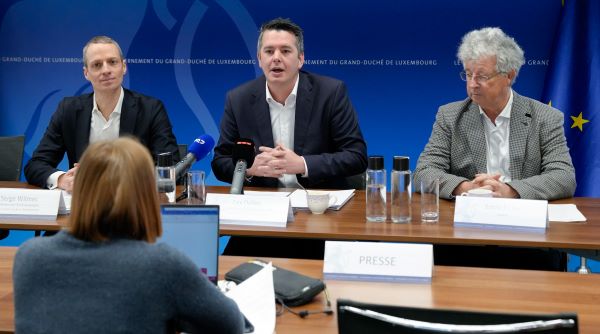
 (L-R) Luxembourg Minister of the Environment, Climate and Biodiversity, Serge Wilmes; Lex Delles, Luxembourg’s Minister of the Economy, SMEs, Energy and Tourism; Emile Eicher, President of Syvicol;
Credit: MECO
(L-R) Luxembourg Minister of the Environment, Climate and Biodiversity, Serge Wilmes; Lex Delles, Luxembourg’s Minister of the Economy, SMEs, Energy and Tourism; Emile Eicher, President of Syvicol;
Credit: MECO
On Tuesday 3 February 2026, Luxembourg’s Minister of the Economy, SMEs, Energy and Tourism, Lex Delles, and the Minister of the Environment, Climate and Biodiversity, Serge Wilmes, presented a first assessment of the first wave of the “Smart City” call for projects at a press conference in Luxembourg.
The ministers presented the assessment in the presence of President of Syvicol, Emile Eicher, with the aim to support municipalities in their ecological and digital transition.
Launched in 2025, the “Smart City” call for projects aims to encourage the development of innovative solutions in the fields of smart mobility, smart energy and intelligent resource management. The initiative seeks to promote a more rational use of resources and energy through digitalisation, with financial support provided in particular by the ministry of the Environment, Climate and Biodiversity through its various funds.
A total of fifteen projects entered the first wave of the call, with evaluators selecting five, including three projects in the field of mobility, one project focusing on resource management and one project in the field of energy. In addition, the authorities presented six projects that met the eligibility criteria for the Climate and Energy Fund, confirming their financing through a results-based agreement.
According to the ministries, the Climate and Energy Fund could not subsidise four projects, but evaluators considered them relevant and forwarded them to the Environmental Protection Fund and the Water Management Fund. The Environmental Protection Fund approved two of the submitted projects, while the Water Management Fund will examine the remaining two projects at its next session in March 2026.
The evaluators assessed the projects on the basis of several criteria: the quality of the application; relevance; innovation or novelty within the municipality; social and environmental impact; the quality and ambition of the key performance indicators to be monitored over time; the “data” component, including generation; management; open data; sharing; cybersecurity and data interoperability; the potential for replicability; as well as the sustainability, implementation and monitoring of the project.
A jury composed of representatives from both ministries, together with Klima-Agence, carried out the pre-selection. The jury documented its deliberations and transmitted its opinions to the project leaders.
The ministers presented this first assessment at the press conference to inspire municipalities and to encourage them to submit projects under the second wave of the call, which is currently under way.
The application deadline for the ongoing call is set for Sunday 15 March 2026.
The ministries noted that these smart cities represent an essential pillar of the ecological transition of our society, by promoting more “efficient management of resources and energy through concrete and replicable digital solutions”.
Minister Delles underlined: “Smart Cities represent the future. In Luxembourg, innovative solutions already exist and demonstrate the know-how and creativity of municipalities. I am convinced that this call for projects will offer municipalities new levers to accelerate their ecological transition. Smart digital solutions are not an end in themselves, but a powerful tool to better manage our resources and energy in a more efficient, sustainable way and in the service of quality of life throughout the country.”
Minister Wilmes recalled: “Municipalities are key players in the ecological transition and must be able to rely on strong public support to turn their ambitions into reality. Through the funding provided by the ministry of the Environment, Climate and Biodiversity, we are investing in a targeted manner in innovative Smart City projects that deliver concrete results for the climate, resources and citizens’ quality of life. These projects, rooted in local realities and with strong replicability potential, represent an essential lever to sustainably accelerate the ecological transition across the entire territory.”