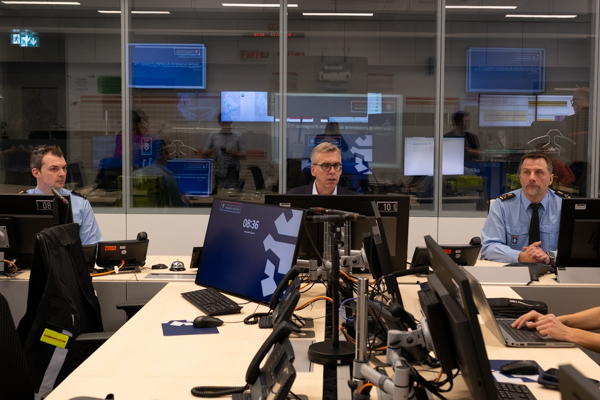
 (L-R) Jan Niebelschütz, Head of Operational Command at CGDIS; Léon Gloden, Luxembourg's Minister for Home Affairs; Jérôme Gloden, Head of Service CSU-112 / CGO at CGDIS;
Credit: Ali Sahib, Chronicle.lu
(L-R) Jan Niebelschütz, Head of Operational Command at CGDIS; Léon Gloden, Luxembourg's Minister for Home Affairs; Jérôme Gloden, Head of Service CSU-112 / CGO at CGDIS;
Credit: Ali Sahib, Chronicle.lu
On the occasion of European 112 Day, marked on Wednesday 11 February 2026, Luxembourg's Minister for Home Affairs, Léon Gloden, visited the CSU-112 emergency call centre.
During a press briefing, Minister Gloden shared his experience of spending a shift at the centre, where he closely observed the daily work of operators and gained insight into their essential role in the emergency response chain and in strengthening the country's resilience in emergency situations.
"I participated in a shift at the call centre. 112 is more than just a number; 112 represents our guardian angels in emergencies," the minister said. He also described 112 as "a reassuring voice" for people in distress and thanked the more than 7,000 firefighters and all staff of the Grand Ducal Fire and Rescue Corps (CGDIS) for their commitment and professionalism.
Moreover, Minister Gloden underlined the importance of 112 at European level. Introduced as the single European emergency number in 1991, 112 facilitates rapid emergency response across the EU. The minister noted that European 112 Day aims to raise awareness of the number's existence and remind the public that it is reserved strictly for emergencies (alongside 113 for police emergencies in Luxembourg). He stressed that anyone calling 112 unnecessarily blocks a line that could otherwise be used by someone in a genuine emergency.
CSU-112 officials subsequently presented the service's key figures and outlined the modernisation tools deployed in recent years to improve emergency call handling.
Jérôme Gloden, Head of Service of CSU-112 / CGO at CGDIS, reported that the centre received 258,000 genuine emergency calls in 2025, i.e. an average of 706 per day. These calls resulted in approximately 76,000 emergency interventions (around 206 per day). In 70.6% of calls, there was no response at the scene. He noted that the average waiting time before a call is answered is five seconds.
The centre recorded 3,415 eCalls - automatically triggered by vehicles in the event of an accident. These systems automatically transmit location data, helping to speed up emergency response.
Jérôme Gloden also highlighted operational aspects of the service, which operates around the clock. All operators are trained firefighters and have access to continuous professional development.
Jan Niebelschütz, Head of Operational Command at CGDIS, outlined ongoing modernisation efforts aimed at improving accessibility, efficiency and resilience. Among the tools presented was the Emergency Eye feature, in use since September 2025. With the caller's consent, this system allows CSU-112 operators to receive real-time video footage from a smartphone and use an instant messaging function. This improves situational assessment and accessibility for people with disabilities. The tool is currently used two to three times per day, depending on the situation. A demonstration video of the Emergency Eye feature is available below (via YouTube).
Artificial intelligence (AI) is also being explored as a support tool, for example to assist with live translation or background noise reduction during calls. However, it does not replace human decision-making.
Efforts are also underway to optimise dispatch times and improve operator ergonomics through updated digital systems.
Another ongoing project is the Staying Alive application, which launched last October. Since then, more than 3,000 people have registered to help save lives in the event of a cardiac arrest. "Every second counts," said Jan Niebelschütz. There were 224 alerts via the system in 2025 and 47 so far in 2026.