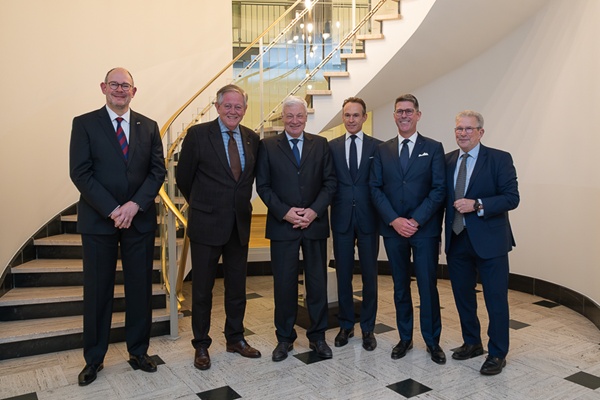
 Council of State New Year Reception, 13 January 2026;
Credit: Ali Sahib, Chronicle.lu
Council of State New Year Reception, 13 January 2026;
Credit: Ali Sahib, Chronicle.lu
Chronicle.lu has compiled a new series of articles dedicated to Luxembourg’s national institutions.
This series focuses exclusively on domestic bodies and does not include European Union (EU) institutions, which will be the subject of a separate series.
The next article in the series focuses on the Council of State (Conseil d'État).
The Council of State acts as a consultative body in the legislative process. It gives its opinion on all bills submitted by the Luxembourg Government or the Chamber of Deputies (Chambre des Députés - parliament), as well as draft regulations. Its role is advisory: it can recommend changes or highlight concerns, but it cannot impose decisions on the government or parliament.
Before any government bill is submitted to the Chamber of Deputies, the government must request the opinion of the Council of State. To mitigate some of the limitations of Luxembourg's unicameral system, the Council of State has a "right of suspensive veto" for legislative matters, during which it temporarily steps beyond its purely consultative function. In principle, all government and parliamentary bills are subject to two successive votes by the Chamber on the law as a whole, with a mandatory interval of at least three months between the first and second votes. The Chamber may exempt itself from the second vote with the agreement of the Council, which often occurs in practice.
The Council of State is composed of 21 councillors, of whom at least eleven must hold a higher education degree in law. Members are appointed and may be dismissed by the Grand Duke, based on proposals from the government, the Chamber of Deputies or the Council itself. Councillors must be at least 30 years old, Luxembourg nationals and residents, and the Council's composition aims to ensure gender balance. Members serve a twelve-year term, unless dismissed earlier.
The current President of the Council of State is Marc Thewes. The Council also includes two vice-presidents and eighteen other members, many of whom hold other political positions, such as serving as deputies (MPs) or in government roles.
The Hereditary Grand Duke (or Hereditary Grand Duchess) may also be appointed to the Council of State as soon as the title has been conferred.
JM/JCA