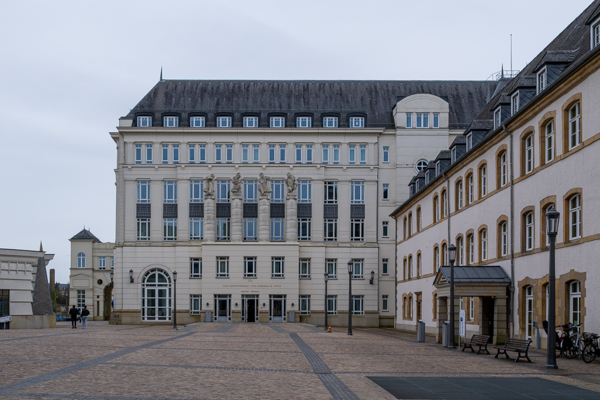
 Cité Judiciaire on Plateau du Saint-Esprit, Luxembourg City, February 2026;
Credit: Ali Sahib, Chronicle.lu
Cité Judiciaire on Plateau du Saint-Esprit, Luxembourg City, February 2026;
Credit: Ali Sahib, Chronicle.lu
Chronicle.lu has compiled a new series of articles dedicated to Luxembourg's national institutions.
This series focuses exclusively on domestic bodies and does not include European Union (EU) institutions, which will be the subject of a separate series.
The next article in the series focuses on the judiciary of Luxembourg.
The courts and tribunals exercise judicial power. The Constitution guarantees their independence in performing their functions, by limiting their sphere of activity, determining their competence and setting out procedural guarantees.
Luxembourg has a Constitutional Court and two jurisdictions: a judicial branch handling civil, penal and political rights disputes; and an administrative branch ruling on disputes with the authorities.
Constitutional Court
The Constitutional Court (Cour Constitutionnelle) serves as the main body for the protection of the Constitution and is composed of nine members: the president of the Supreme Court of Justice, the president of the Administrative Court, two advisors to the Court of Cassation and five magistrates appointed by the Grand Duke, on the joint proposal of the Supreme Court of Justice and the Administrative Court. On 22 September 2025, Luxembourg's Minister of Justice, Elisabeth Margue, swore in six new members. The current President of the Constitutional Court is Thierry Hoscheit (since October 2023).
The Court rules on the compliance of laws with the Constitution. Before a judicial or administrative order is issued, a party may raise a question regarding the compliance of a law with the Constitution. If deemed necessary, they may bring the matter to the Constitutional Court. Its decisions cannot be appealed.
Judicial Branch
Magistrate's Courts
The magistrate's courts (Justices de Paix or "justices of the peace") form the first level of the judicial hierarchy. There are three such courts in Luxembourg, with seats in Luxembourg City, Esch-sur-Alzette and Diekirch. They handle less important civil and commercial cases, including payment orders and landlord-tenant disputes. The magistrate's courts mainly act as conciliators in civil and commercial matters, attempting to find a peaceful solution to disputes. They also serve as police courts for minor criminal matters. Labour courts sitting at magistrate's courts address labour-related disputes (e.g. those concerning employment and apprenticeship contracts).
District Courts
Luxembourg is divided into two judicial districts, Luxembourg City and Diekirch, each with its own district court (tribunal d'arrondissement). These courts handle civil and commercial matters unless legally assigned to another jurisdiction. In criminal matters, the district courts can serve as correctional or criminal chambers depending on the severity of the criminal offence. Child and youth protection cases are handled by the Juvenile and Guardianship Court.
Supreme Court of Justice
At the top of the judicial hierarchy in Luxembourg is the Supreme Court of Justice (Cour Supérieure de Justice), based in Luxembourg City. It comprises the Court of Cassation (Cour de Cassation), the Court of Appeal (Cour d'Appel) and the Public Prosecutor's Office (Parquet Général). The current President of the Supreme Court of Justice is Thierry Hoscheit, who also serves as President of the Constitutional Court.
The Supreme Court meets in general assembly to rule on internal matters, including conflicts of allocation of cases and disciplinary actions against magistrates. It also hears charges brought by the Chamber of Deputies (parliament) against government members.
The Court of Cassation has jurisdiction over Court of Appeal rulings and final judgments from district courts and conciliation judges. The Court of Cassation does not retry cases; it is tasked with ensuring a consistent application of the law by courts and tribunals. It is composed of a president and five permanent judges, according to official sources.
The Court of Appeal has jurisdiction over decisions from district courts in civil, commercial, criminal and correctional matters, in addition to cases from labour tribunals. It is organised into specialised civil, social, commercial and criminal chambers, each composed of three professional judges (a presiding judge and two judges or counsellors).
The Public Prosecutor's Office is headed by the Prosecutor General (Procureur Général d'État) at the courts and tribunals and includes Advocates-General, who carry out their duties under the authority of Luxembourg's Minister of Justice. Public prosecutors represent the public in court, ensure that the law is correctly applied and that judgments are enforced. Their tasks include investigating crimes and offences, acting on complaints and denunciations from victims or the police, and determining whether to initiate criminal proceedings. Public prosecutors work closely with the criminal police, who record criminal law violations, collect evidence and seek perpetrators.
In addition to the Public Prosecutor's Office at the Supreme Court of Justice, two State Public Prosecutors and their deputies form the district prosecutors' offices at the District Courts.
Administrative Branch
Administrative Tribunal
The Administrative Tribunal (Tribunal Administratif), based in Luxembourg City, rules on appeals submitted against administrative decisions for which no other appeal is permissible under law and against regulatory administrative acts, regardless of the authority by which they are issued. In principle, it also hears appeals related to direct taxes and municipal taxes and duties. Appeals against its judgments may be lodged before the Administrative Court.
Administrative Court
Supreme administrative jurisdiction lies with the Administrative Court (Cour Administrative), also located in Luxembourg City. Unless otherwise provided by law, an appeal may be lodged before this court against Administrative Tribunal judgments in cases seeking the annulment of administrative or regulatory acts. The Administrative Court rules on appeals dealing with the substance of the case. The state is represented before this court by a representative or a lawyer. The current President of the Administrative Court is Francis Delaporte, who also serves as Vice President of the Constitutional Court.
JM/JCA