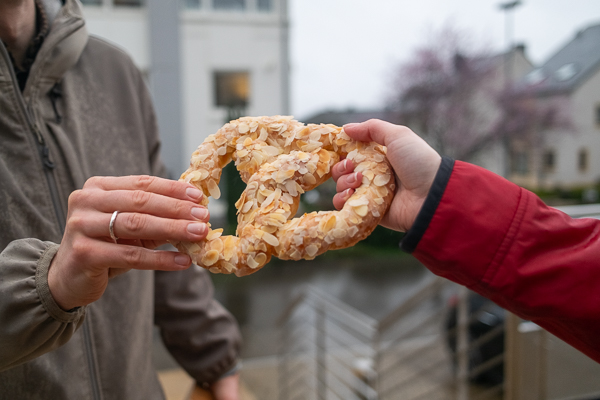
 Credit: Ali Sahib, Chronicle.lu
This year, “Bretzelsonndeg” (Pretzel Sunday) falls on Sunday 15 March 2026, marking the fourth Sunday of Lent and a day to reveal romantic interest to loved ones.
Lent, a 40-day period of prayer, fasting and almsgiving, began on Ash Wednesday 18 February this year and will end at sundown on Holy Thursday 2 April.
Pretzel Sunday in Luxembourg carries its own symbolism, originating from medieval legend or shaped by religious practice, depending on one's approach. Nowadays, people mainly associate the day with a romantic tradition and the seasonal pastry sold in bakeries across the country.
On “Bretzelsonndeg”, gifting a pretzel serves as a way to show romantic interest in someone. Traditionally, a man gives a puff pastry pretzel with sugar icing and almonds to a woman. To show that she got the message and shares mutual interest, she gives back an egg (nowadays, a chocolate egg) on Easter Day, which falls on Sunday 5 April this year.
In leap years, the tradition reverses roles. Women make the first step, handing a pretzel to the one they chose, and men respond with either an egg or a basket. Some locals say that in those years bakeries tend to reduce production due to lower demand.
If she returns an empty basket, she shows that the feelings are not mutual. The Luxembourgish expression “de Kuerf kréien” (to get the basket, meaning to be rejected) reflects this tradition. German uses a similar idiom, “einen Korb bekommen“. Some explanations link this metaphor to medieval courtship customs. According to one interpretation, a man could visit a woman by climbing or being lifted in a basket to her window. If she rejected him, she would send the basket back down empty, which symbolised refusal.
Pretzels are widely known in Luxembourg, although the “Bretzelsonndeg” version differs from the common salty pretzels. While the origins of the tradition vary, this pastry remains central in every version. Its role in the celebration has given rise to several theories explaining how it became linked to the custom.
One of them involves the winter chase-away festival, Buergbrennen, developed in the 18th century. According to legend, girls threw wood into the bonfire and called out the name of a boy they liked. If he felt the same, he later offered her a pretzel.
Another explanation, linking the Christian tradition, suggests avoiding meat, eggs and milk products for the lent season. In medieval Europe monks created a simple dough from flour, water and salt following Lenten fasting rules, creating a pretzel, which then became associated with Lent. Some say that the pretzel shape with the knot and three holes symbolises the Holy Trinity or the crossed arms of a child in prayer.
Other theories trace the pretzel back even further, linking it to Celtic traditions from the Iron Age or interpreting the shape as lovers standing arm in arm. The word pretzel itself derives from the Latin “brachium” (arm).
Although most pastries sold in bakeries today no longer follow the simple recipe once used by monks, those observing Lent may still enjoy them. The fourth Sunday of Lent, known as Laetare Sunday, according to church liturgy, marks a brief easing in the strictness of the Lenten fast, meaning that eating a Luxembourg pretzel would generally be considered acceptable.
The simplest way to take part in Bretzelsonndeg is to visit a nearby bakery and buy a pretzel to offer to a loved one. For those who prefer to plan in advance, some towns and villages across Luxembourg organise pretzel sales through local associations. In many cases, residents can order the pastries ahead of time and have them delivered to their homes. The proceeds from these initiatives often support community activities or projects.