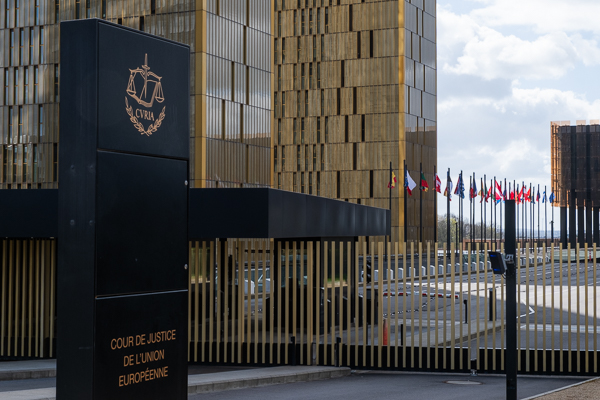
 Court of Justice of the European Union in Luxembourg-Kirchberg;
Credit: Ali Sahib, Chronicle.lu
Court of Justice of the European Union in Luxembourg-Kirchberg;
Credit: Ali Sahib, Chronicle.lu
Chronicle.lu has compiled a new series of articles dedicated to European institutions, bodies and agencies with a presence in Luxembourg.
Standing alongside Brussels in Belgium and Strasbourg in France, Luxembourg City is one of the European Union's three official seats. A founding member of the European Union (EU), Luxembourg is known internationally as a business and financial hub and hosts several major EU institutions and other bodies.
Based mainly in Luxembourg-Kirchberg, these institutions shape European law, finance and democratic processes and employ around 15,000 international professionals.
Throughout this series, Chronicle.lu will introduce the main European institutions, bodies and agencies in Luxembourg and explain how they work. This article focuses on the Court of Justice of the European Union (CJEU).
The Court of Justice was established in 1952 as one of four institutions of the newly created European Coal and Steel Community (ECSC) - a predecessor of the European Union. At that time, the Court had just four procedural languages: German, French, Italian and Dutch; today it has 24. In 1958, the institution became the Court of Justice of the European Communities (EEC), later renamed the Court of Justice of the European Union (CJEU) under the Treaty of Lisbon in 2009.
The CJEU plays a central role in the EU's legal system. It ensures that EU law is interpreted and applied consistently across all member states and that that EU countries and institutions comply with EU law. The Court settles disputes between national governments and EU institutions and, in certain circumstances, allows individuals, companies and organisations to bring cases before it if they believe their rights under EU law have been infringed.
The CJEU delivers rulings in a number of key areas. One of its main functions is to interpret EU law through preliminary rulings. National courts may refer questions to the CJEU when they are uncertain about the interpretation or validity of EU legislation, ensuring uniform application across all member states.
The Court also enforces EU law through infringement proceedings. These cases are brought against EU countries that fail to comply with their legal obligations. If a member state is found to be in breach of EU law, it must take corrective action or risk financial penalties.
In addition, the CJEU can annul EU legal acts that violate EU treaties or fundamental rights. Such actions may be brought by EU institutions, member states or, in certain cases, individuals and companies directly affected. The Court also handles cases where EU institutions fail to act when required, as well as actions for damages brought by individuals or companies who claim harm caused by EU institutions or their staff.
The CJEU is composed of two courts: the Court of Justice, also known as the European Court of Justice (ECJ), and the General Court. The ECJ includes one judge from each EU country, supported by eleven advocates general, who provide independent legal opinions on cases. It mainly deals with preliminary rulings from national courts, certain annulment actions and appeals.
The General Court includes two judges from each EU country and primarily handles cases brought by individuals, companies and, in some instances, member states. These cases often relate to competition law, state aid, trade, agriculture and intellectual property.
Judges and advocates general are appointed by agreement between EU member states for renewable six-year terms. Each court also elects its own president for a renewable three-year term.
Cases before the Court generally follow two stages: a written phase and, where necessary, an oral hearing. During the written stage, all parties submit their observations, which are reviewed and summarised before the Court decides how the case will proceed. If a hearing is held, lawyers present their arguments in a public session, after which the judges deliberate and deliver their judgment.
The scale of the CJEU's work reflects its central role within the EU. In 2025, the ECJ and the General Court resolved a total of 2,301 cases, while 2,489 cases remained pending at the end of the year. The average duration of proceedings stood at just over eighteen months. Cases covered a wide range of areas, including competition law, intellectual property, taxation and environmental matters.
The CJEU also plays an important role in protecting the rights of individuals and businesses. In certain cases, individuals and companies may challenge EU decisions directly before the General Court if they are directly affected. Alternatively, cases may be brought through national courts, which can refer questions to the CJEU.
In terms of its internal structure, women account for 61% of the Court's officials and other staff, with balanced representation also visible in management positions.
The Court of Justice is based in Luxembourg-Kirchberg, where its distinctive modern complex has become one of the most recognisable EU buildings in the country. The site reflects Luxembourg's long-standing role as a centre for European institutions and continues to attract legal professionals and experts from across the EU.
As one of the EU's main judicial bodies, the CJEU remains a cornerstone of the European legal order, ensuring that EU law is applied consistently and that the rights and obligations of member states, institutions and citizens are upheld.
IK/JCA