 BCC Chairman Andrew Notter introduces the event;
Credit: Jazmin Campbell, Chronicle.lu
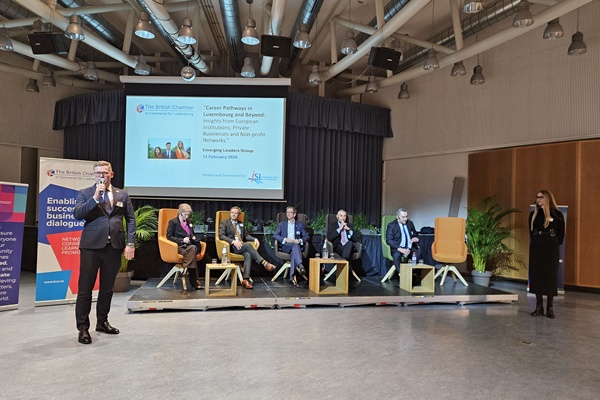
BCC Chairman Andrew Notter introduces the event;
Credit: Jazmin Campbell, Chronicle.lu
On Thursday 12 February 2026, the British Chamber of Commerce for Luxembourg's (BCC) Emerging Leaders Group held an event titled "Career Pathways in Luxembourg and Beyond: Insights from European institutions, private businesses and non-profit networks" at the International School of Luxembourg (ISL) in Luxembourg-Merl.
There were about 80 registered participants, with the evening bringing together young professionals, students and mentors to explore career development from three perspectives: European institutions, private business and non-profit networks.
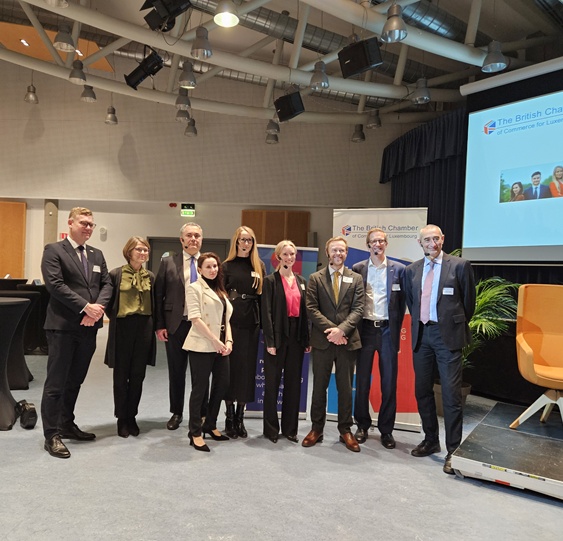
BCC Chairman Andrew Notter opened the event, after which Yulia Kulakova, Vice-Chair of the BCC Emerging Leaders Group, moderated a panel discussion featuring: Alexandra Slack, Executive Career Coach, former dual-qualified lawyer and President of Ladies in Law Luxembourg Association (LILLA); Claudio Zucca, Managerial Advisor at the European Investment Bank (EIB); Emanuele Baldacci, Director of HR Services at the European Commission; Iain Fish, Director of ISL; and Peter Brown, Luxembourg Managing Director of ZEDRA Group.
Introducing the discussion, Yulia Kulakova noted that this was the second event organised by the new Emerging Leaders Group and emphasised that modern careers are rarely linear, with cross-sector opportunities increasingly accessible.
The panellists highlighted the importance of self-awareness, patience and adaptability in early career decisions. Alexandra Slack discussed both external barriers, such as social norms, and internal barriers, including limiting beliefs. She encouraged young professionals to clarify what they want and why, stressing that committing to a choice enables progress. Iain Fish noted that schools try to focus on competencies that prepare students for the workplace - and an uncertain world - encouraging them to be creative problem-solvers who are adaptable but also "highly reflective and self-aware".
Emanuele Baldacci observed that organisations such as the European Commission have evolved in response to external shocks, increasing demand for specialised skills. Claudio Zucca spoke of the need to navigate complexity patiently and efficiently, particularly in large organisations.
Several speakers underscored the value of stepping outside one's comfort zone. Iain Fish encouraged participants to seize opportunities and take risks, noting that these may open new doors later and are often a learning experience. Others agreed.
Peter Brown emphasised the importance of building a broad foundation of transferable skills, while Claudio Zucca advised participants not to fear mistakes - these may turn out to be the right choices.
Addressing transferable skills from a cross-sectoral perspective, the panel agreed that such skills remain essential. Alexandra Slack reflected on the risk of developing an overly narrow professional profile and noted how involvement in professional associations, for example, can broaden one's skill set. She agreed with Peter Brown's earlier remarks on the value of breadth.
Speakers compared public and private sector environments, noting some differences in priorities and career development approaches. Peter Brown noted that, while private companies may focus on short-term results, public institutions often take a longer-term view. Relationship-building, collaboration and the ability to manage complexity were identified as key skills valued across sectors.
From an education perspective, Iain Fish acknowledged the need for schools to better prepare students for workplace realities by focusing on creativity, problem-solving, adaptability and collaboration, rather than solely on measurable academic outcomes. He spoke of the importance of open-minded young people with strong ethical values and a sense of justice who are able and willing to contribute to an organisation and society.
On the topic of leadership, the panellists described career growth as a continuum in which hard (technical) and soft (interpersonal) skills evolve together. This depends on one's career stage, as leadership roles increasingly require relationship-building and the ability to support teams. Iain Fish agreed with fellow panellists that it is important to find people who are the "right fit" for an organisation's team and ethos but added that they also need those who "challenge the status quo", helping the organisation progress.
In the Q&A session that followed, panellists answered questions on transferable skills and the impact of artificial intelligence (AI). Asked whether transferable skills are still valued across sectors, in light of recent "plug-and-play" hiring trends, Peter Brown said such skills were "absolutely" still valued, although it was important to educate leaders on the long-term benefits of hiring "good people" and mentoring them. Emanuele Baldacci said, in his experience, it depends on the organisation, although "plug-and-play" hiring is not normally applied at entry level, rather for more specialised, advanced roles in certain sectors.
On AI, speakers acknowledged that AI will likely transform many professions but also reinforces the importance of adaptability. Iain Fish explained that ISL encourages students to engage critically with AI as "a partner for learning", while Emanuele Baldacci noted that AI is already reshaping workflows within large institutions. The consensus was that embracing technological change will create new opportunities.
In closing, each panellist shared a key takeaway and practical advice. Participants were encouraged to cultivate curiosity, pursue work that brings personal fulfilment, take calculated risks, trust both emotional and rational judgement, remain open-minded and view mistakes as learning opportunities.
Yulia Kulakova also informed attendees that registrations are open until Sunday 15 February 2026 for the BCC Emerging Leaders Mentorship Pilot Programme, which is seeking both mentors and mentees.
The evening concluded with a networking reception over drinks and finger food - including mini "Gromperekichelcher" (traditional Luxembourgish deep-fried potato cakes).