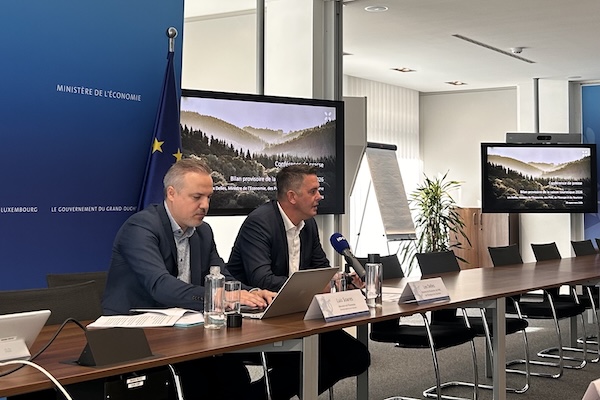
 (L-R) Luis Soares, General Directorate for Tourism advisor; Luxembourg’s Minister of the Economy, SMEs, Energy and Tourism Lex Delles;
Credit: Elza Osmane, Chronicle.lu
(L-R) Luis Soares, General Directorate for Tourism advisor; Luxembourg’s Minister of the Economy, SMEs, Energy and Tourism Lex Delles;
Credit: Elza Osmane, Chronicle.lu
On Monday 28 September 2026, Luxembourg’s Ministry of the Economy held a press conference, presenting the provisional results of the 2026 tourism season and outlined developments in the sector.
Luxembourg’s Minister of the Economy, SMEs, Energy and Tourism Lex Delles outlined the results, describing them as positive. Discussing the wider impact of the sector, he said that “every euro invested in tourism is a euro invested in the quality of life of residents”.
According to provisional STATEC figures, Luxembourg recorded around 950,000 arrivals between January and July 2026, up 3% compared with the same period in 2025. Overnight stays reached approximately 2.25 million, representing an increase of 6%.
Results varied between accommodation types. Hotels recorded around 1.1 million overnight stays, down 3%, while camping continued to perform strongly, with overnight stays increasing by 13% and arrivals, at around 230,000, rising by 9%. Minister Delles linked the growth partly to an increasing interest in outdoor and nature-based tourism, noting that camping now includes a much broader range of accommodation than traditional tents.
Looking at the longer-term development, overnight stays in 2025 were 2.2% lower than in 2024 but remained 20.4% above their 2019 level.
Visitor satisfaction remained high. According to Luxembourg for Tourism (LFT) surveys, 97% of visitors would recommend Luxembourg as a destination, while 90% said their stay had exceeded their expectations and 90% indicated that they would consider returning. Moreover, 78% of residents considered tourism an asset for Luxembourg, while 43% said it had a positive impact on their quality of life.
Among the country's most visited tourist attractions between January and August 2026, Parc Merveilleux ranked first with 219,693 visitors, despite recording a 6% year-on-year decrease. It was followed by Vianden Castle, the Bock and Pétrusse Casemates and the Mullerthal Trail.
Minister Delles also highlighted continued investment in tourism infrastructure. The current five-year programme for 2023-2027 has a budget of €70 million, of which close to €40 million has already been mobilised. A subsequent five-year programme is currently being prepared to continue investment from 2028.
Another priority for 2026 has been the development of oenotourism in the Moselle region. The ministry said it has worked with tourism and wine-sector stakeholders on an action plan aimed at strengthening the region's attractiveness, including the “Wine & Hike” project, which combines hiking, wine, gastronomy and the region's landscape and identity.
Professionalisation and digitalisation were also highlighted. The recently launched Tourism Academy attracted more than 200 registrations for around 100 available places, while its training offer is expected to expand. According to figures presented at the press conference, 52% of tourists use social media for travel inspiration, while around 12% already use artificial intelligence (AI) to help organise their trips.
Minister Delles also stressed the importance of accurate and centralised tourism data as travellers increasingly rely on digital tools and AI to choose destinations and plan their stays.
Concluding the presentation, Minister Delles emphasised that the sector’s development relied not only on infrastructure and investment but also on the people contributing to the visitor experience across the country.