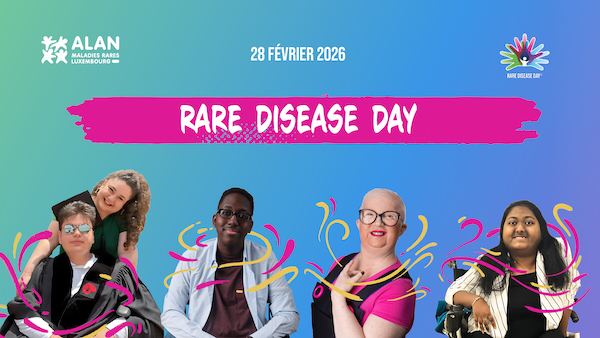
On Friday 27 February 2026, Luxembourg’s Ministry of Health and Social Security issued a press release ahead of International Rare Disease Day, which takes place each year on the last day of February.
Saturday 28 February 2026 marks the 19th Rare Disease Day, a day celebrated in more than 100 countries to raise awareness about rare diseases and their impact on the lives of those affected.
Ahead of the day, the Ministry of Health and Social Security noted the major challenges rare diseases represent for those affected and their families and highlights the actions undertaken in Luxembourg to improve their recognition and care. In Luxembourg, around 30,000 people live with a rare disease. The average time taken to reach a correct diagnosis is estimated at five years, illustrating the complexity of these conditions and the need to strengthen referral and care pathways.
A disease is described as rare when it affects fewer than 5 in 10,000 people. Around 7,000 different rare diseases have been identified, nearly 72% of which are of genetic origin. Often serious, chronic and disabling, they begin in most cases in childhood and, in 95% of situations, have no curative treatment. Early diagnosis and appropriate care are therefore essential.
Luxembourg’s first National Rare Disease Plan (PNMR1), implemented between 2018 and 2023 by the Directorate of Health, made it possible to establish a lasting structure for the field, notably through the creation of a National Rare Disease Guidance and Coordination Unit, the development of a referral guide, the expansion of specialised support services, the launch of the National Rare Disease Infoline and the integration of Luxembourg into the European Reference Networks. Moreover, this plan also enabled the introduction of screening for severe congenital heart defects at birth. These achievements provide a solid foundation for continuing action.
The Ministry of Health and Social Security highlighted that the second National Rare Disease Plan (2025–2029) aims to strengthen access to diagnosis and care, improve the healthcare pathway of those concerned and support awareness-raising, training and research. It places particular emphasis on the expansion of screening, access to genetic diagnosis and the creation of a national rare disease registry.
The ministry also noted the central role ALAN – Maladies Rares Luxembourg plays in supporting patients and their families, notably through its consultation service which provides psychological counselling, as well as administrative and social support.
As part of International Rare Disease Day, ALAN and its partners are carrying out various awareness-raising initiatives: the illumination of buildings across the country, information stands in hospitals and a literary evening giving a voice and stage to people affected by a rare disease.
On the evening of Friday 27 February, the association will host “Rare Voices”, an evening giving voice and stage to people affected by a rare disease. In the presence of Martine Deprez, Luxembourg Minister of Health and Social Security, guests Nathalie Scheer, Jean-Francis Covi, Lara Post, Samuel Coljon, Carine Hentz, Hannah Hommel, Corinne Thill and Benny Michaels will use creative writing to explore the theme of resilience and create a space for encounter and empathy. The poems, short stories, children’s stories and theatrical scenes presented during the evening will then form the central element of an online awareness campaign.
Furthermore, to raise wider public awareness and send a strong signal of solidarity, several landmark buildings will be illuminated in the colours of Rare Disease Day during the last week of February.
The ministry stressed that neonatal screening, coordinated by the National Health Laboratory, is a key pillar of early detection. All newborns are currently screened for seven rare diseases. Since the introduction of screening for spinal muscular atrophy in 2024 under PNMR1, three children have been able to benefit from appropriate early treatment. Screening for severe combined immunodeficiency was added on 1 January 2026 and the programme will continue to evolve, with additional diseases to be incorporated during the course of 2026.
Moreover, the ministry highlighted the National Rare Disease Hub, coordinated by the Luxembourg Hospital Centre, which serves as a national coordination point for rare diseases. It connects Luxembourg healthcare professionals with the European Reference Networks (ERN), European networks bringing together centres of expertise specialising in rare and complex diseases. According to the ministry, this cooperation provided access to highly specialised medical expertise at European level and promoted knowledge-sharing as well as improved coordination of care. In 2025, 721 new patients with rare diseases presented and 4,692 consultations related to rare diseases were carried out.