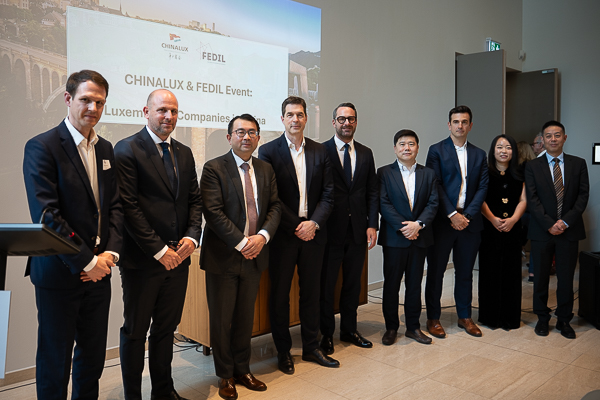
 (L-R): Paul Elvinger, Cebi; Christophe Timmermans, SolarCleano; Ambassador Hua Ning; Yves Germeaux, FEDIL; Jacques Bortuzzo, ChinaLux; N/A; Nathan Fossard, Ceratizit; Jingya Tian, ChinaLux; N/A;
Credit: Ali Sahib, Chronicle.lu
(L-R): Paul Elvinger, Cebi; Christophe Timmermans, SolarCleano; Ambassador Hua Ning; Yves Germeaux, FEDIL; Jacques Bortuzzo, ChinaLux; N/A; Nathan Fossard, Ceratizit; Jingya Tian, ChinaLux; N/A;
Credit: Ali Sahib, Chronicle.lu
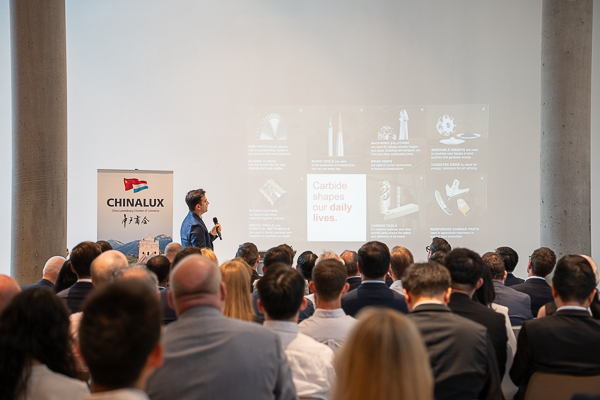
On Monday 1 June 2026, around 140 people attended the China Luxembourg Chamber of Commerce (ChinaLux) event on "Luxembourg Companies in China" at the Bank of China in Luxembourg city centre, with standing room only for some latecomers.
Organised in partnership with FEDIL, the event focussed on the growing presence of Luxembourg companies in China across various industries, with discussions centred on future cooperation between Luxembourg and China in advanced manufacturing, sustainability and industrial innovation.
Jacques Bortuzzo, President of ChinaLux, welcomed everyone and started by comparing Luxembourg and China in terms of size, emphasising an unknown environment and unknown variables, and stressing that small companies can do well there, also pointing out that China has evolved greatly in recent years.
Yves Germeaux, Head of Trade and International Relations at FEDIL, delivered a welcome address and stated he regularly meets companies that travel the world which is becoming more complex. He stressed that openness and dialogue are very important, with different companies having different priorities and strategies.
Hua Ning, Chinese Ambassador to Luxembourg, introduced the topic and talked first about China's business environment. He mentioned world changes, uncertainties and challenges, both by the Chinese and European business communities. He stressed that competition nowadays is "quite fierce" in both China and Europe, and referenced over capacities and subsidies, as well as sharing his concerns over what he described as EU over-regulation.
He also mentioned the issue of rises in energy prices and encouraged growth in the clean / green energy sector, mentioning that many Chinese companies are offering such solutions. He also called for an increase in competitiveness by reducing production costs, as well as addressing the cost of innovation, two areas where Chinese companies offer competitive solutions. He also mentioned European companies having successful track records in the Chinese market, e.g. BMW cars as well as various SMEs.
A total of three separate presentations were then made about Luxembourg companies active in China:
Up first was Nathan Fossard, Director of Business Development, M&A at Ceratizit, who explained that the company is a leader in cutting tools with 30+ production sites and 7,000 employees worldwide, with significant investment in sustainability. The company globally has an annual turnover of €1.5 billion, with its products used in different industry sectors. The group has 2,000 employees in China at nine different plants, mainly in Shanghai in a joint venture with a local partner.
Then Paul Elvinger, Member of the Executive Board at Cebi, said that it is headquartered in Steinsel, a designer and developer of electro-mechanical components, producing around one million parts daily throughout the world at its nine different plants at which they employ around seven thousand staff. Why did they go to China? He explained that some of their main European customers, e.g. Volkswagen and Fiat, invited them to join join ventures in China, as well as to establish a local supply chain. It was also a strategic opportunity to have a step on the Chinese market. He then went on to explain that they stayed in China as local car manufacturers asked them to produce high quality parts, based on their own specifications, which now represents about 45% of their Chinese turnover. He commented on the speed of development, comparing a duration of 12-14 months in China compared to around 3 years in Europe, between concept to production. He also explained that when they moved to China 20 years ago, China was a "technological follower", whereas now China is a "technological leader”.
And lastly, Christophe Timmermans, founder and CEO of SolarCleano, explained that the company started in 2018 and produces robots to clear solar panel, etc. He explained that 100% of the company's activity is export, with 50% outside Europe, with automation of solar panel cleaning necessary. He screened a short video which showed the robots in action, and mentioned that some clients are based in China and Mongolia. He stated that China is the world's leader in solar energy and its market is currently growing at 42% (compared to Germany which is currently growing at 8%). He talked about the Chinese embassy in Luxembourg "playing a major role" in the company developing its footprint in China.
To conclude the event, Jingya Tian, Vice President of ChinaLux, moderated a short Q&A session before the attendees were able to network over a cocktail reception.
ED
(Caption: ChinaLux event "Luxembourg Companies in China"; Credit: Ali Sahib, Chronicle.lu)