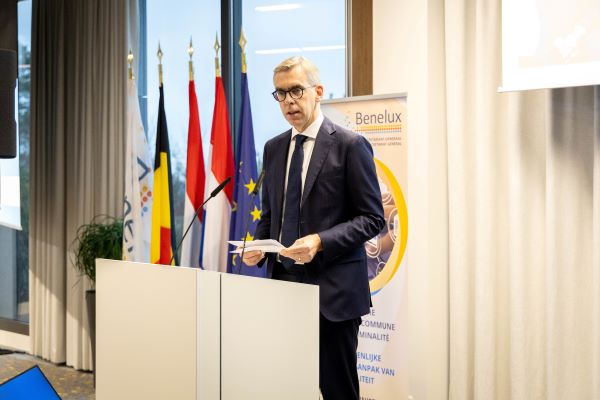
 Léon Gloden, Luxembourg’s Minister for Home Affairs;
Credit: MAIN
Léon Gloden, Luxembourg’s Minister for Home Affairs;
Credit: MAIN
On Thursday 11 December 2025, Luxembourg’s Ministry of Home Affairs presented the outcomes of a Benelux conference dedicated to the administrative approach to combating organised crime.
The event took place from Wednesday 10 to Thursday 11 December 2025, forming a part of Luxembourg's Presidency of the Benelux Union. It was organised by Luxembourg’s Minister for Home Affairs, Léon Gloden, in collaboration with the Secretariat General of the Benelux Union.
The conference had two objectives: to learn from the experiences of countries already using the administrative approach to combat organised crime; and to explore how cooperation in the fight against organised crime, particularly in the area of prevention, can be made more effective.
"Our goal is to always be one step ahead of criminals," declared Minister Gloden, continuing: "Criminal networks use sophisticated methods, often resorting to corruption and legal economic structures to establish a lasting presence. The administrative approach is a powerful tool for protecting our institutions, our economy and our citizens. The presence of numerous national and international stakeholders at our conference demonstrates the commitment to exploring all avenues to effectively combat organised crime."
In this context, the minister highlighted five significant drug seizures carried out in Luxembourg in 2025 as part of cooperation between the police, customs and judicial authorities.
According to the ministry, these events show that Luxembourg is not immune to large-scale drug trafficking, which can serve as a transit zone and expose the country to risks of economic infiltration. Thereby, Luxembourg has strengthened its measures by introducing a local police unit, submitting a bill on automatic licence plate recognition to facilitate cross-border cooperation and participating in the Ports Alliance to secure logistics hubs.
Gilles Roth, Luxembourg’s Minister of Finance, reiterated: "Crime is organised. States must be too. The administrative approach strengthens our security. This is exactly what our citizens expect from responsible policy. Once again, the Benelux region is demonstrating a pioneering spirit in the fight against crime."
During the conference, Minister Gloden also emphasised that repression alone is no longer sufficient. The administrative approach makes it possible to block criminals' access to resources, control access to public procurement and disrupt networks before they commit further offences.
At the European level, the EU encourages this approach in its ProtectEU strategy, and the Benelux Treaty on Police Cooperation provides for the exchange of information to strengthen administrative prevention and public safety.
Frans Weekers, Secretary General of the Benelux Union, stated: "The Benelux Police Treaty allows partners to join forces in the cross-border fight against organised crime. We need close cooperation and information sharing between the police, the public prosecutor's office, inspection services, tax and customs services, as well as mayors and local authorities. This gives new impetus to the joint fight against organised crime. Let's fight crime together!"
According to the ministry, the presence of numerous local and national stakeholders from the three Benelux member countries, together with experts from the United Nations Office on Drugs and Crime in Italy and Europol, underlined the importance of global mobilisation and strengthened cooperation to effectively and jointly combat organised crime.
To conclude, Ine van Wymersch, Belgium's National Drug Commissioner, commented: "The administrative approach is essential to a comprehensive strategy for combating organised crime. If we compare criminal organisations to an iceberg, the visible part above the waterline [shows] shootings, drug shipments… Another part, invisible, lies beneath the surface: money laundering, intimidation and corruption. Too often, our fight is limited to direct action: attacking the iceberg head-on by arresting suspects and seizing drugs is the classic work of law enforcement. To achieve lasting results and melt the iceberg at its core, an indirect approach is also necessary - raising the temperature of the water. The administrative approach is a key element of this strategy. A proactive licensing policy helps raise the temperature. By closing down illegal businesses, we reduce the size of the iceberg. With the administrative approach, we create a climate where organised crime, the iceberg, can no longer grow or thrive."
EO