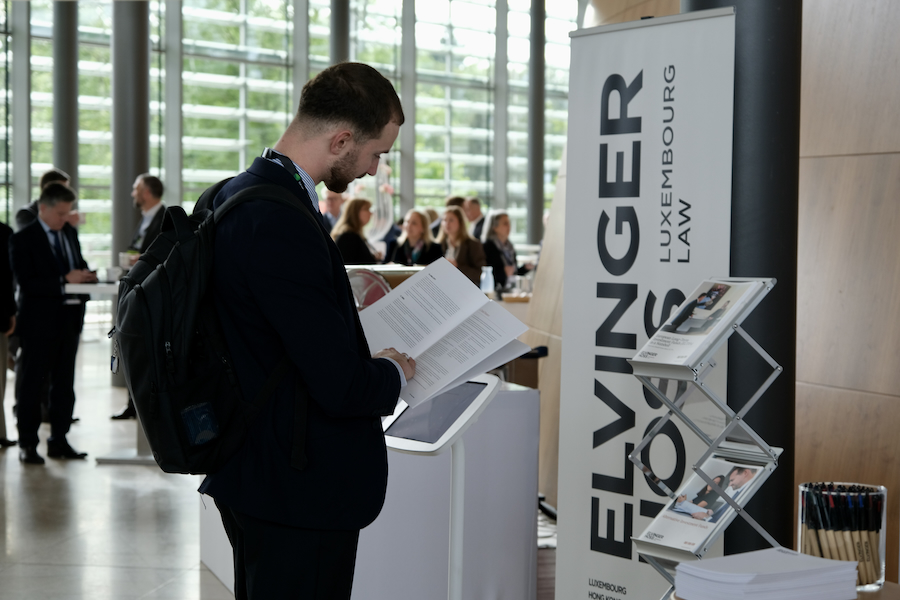
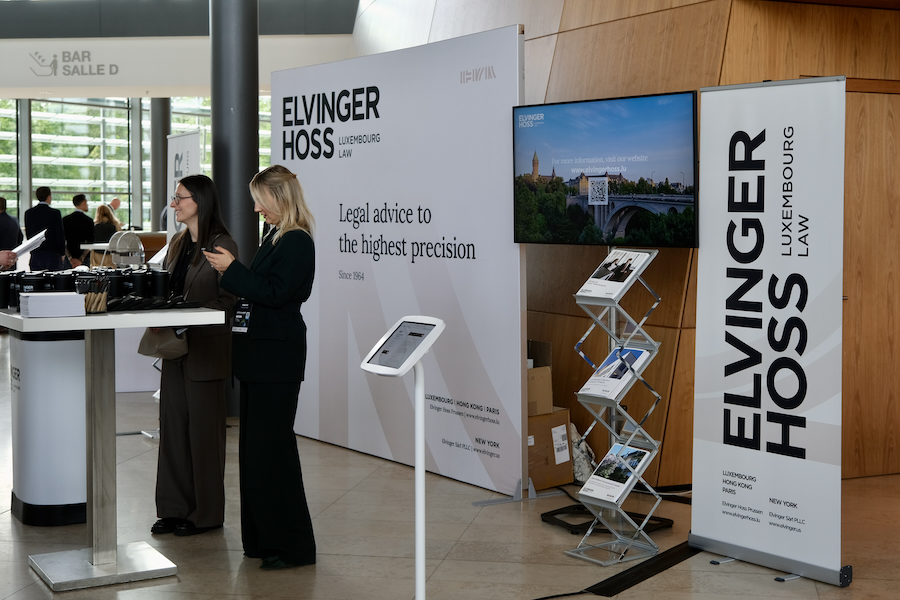
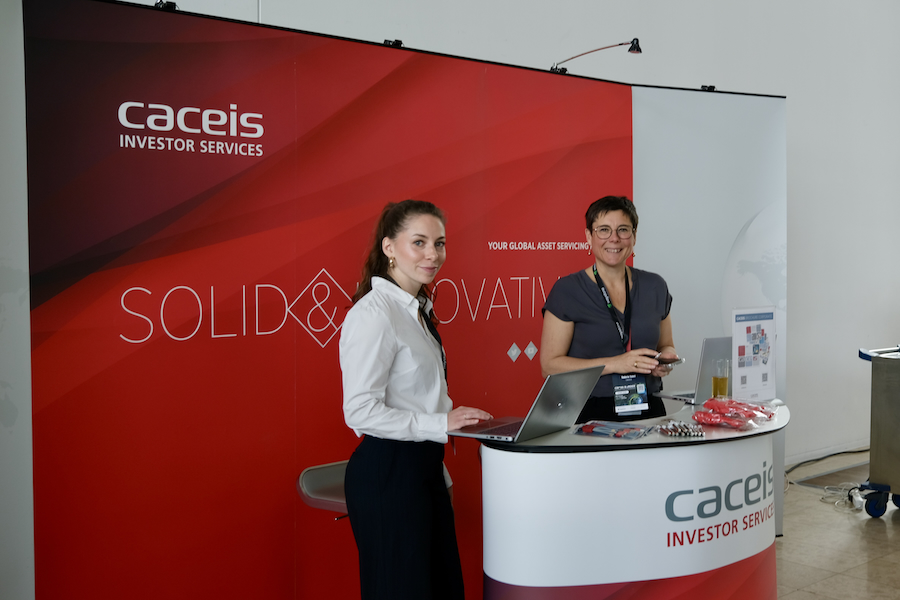
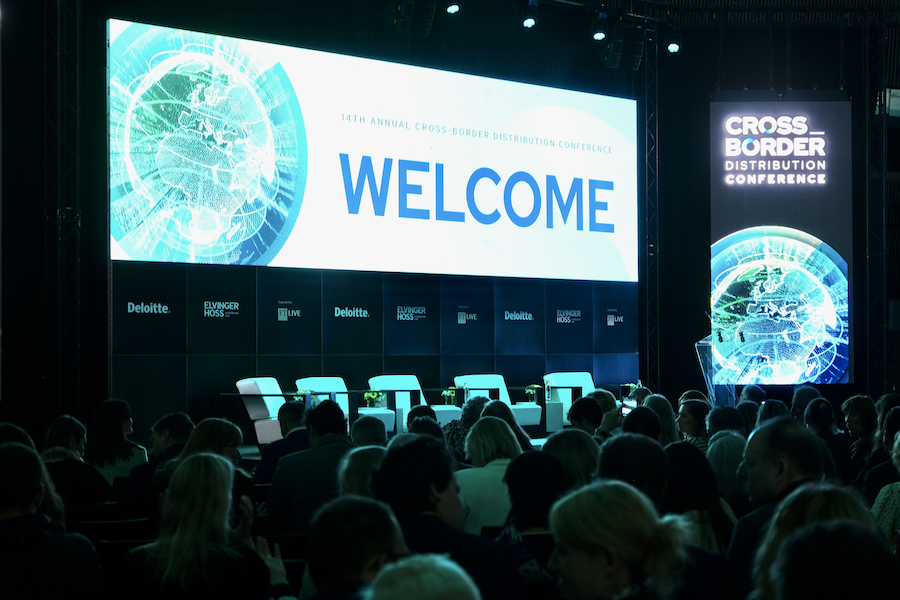
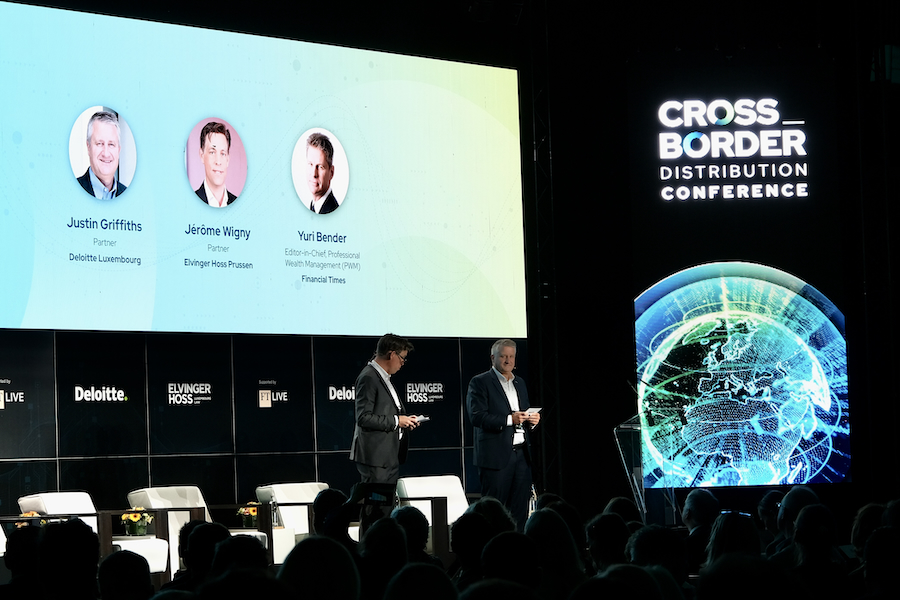
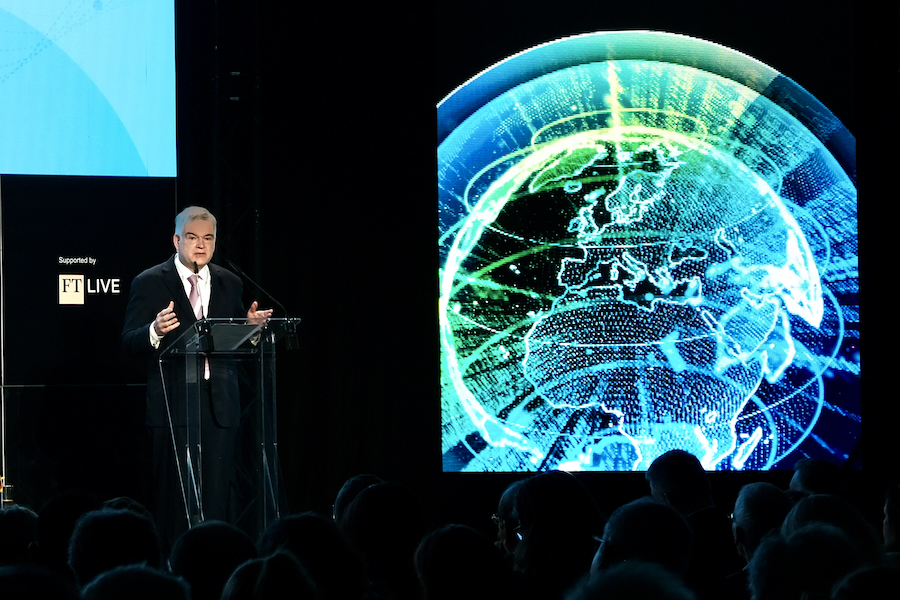
 14th Annual Cross-Border Distribution Conference at the European Convention Centre in Luxembourg-Kirchberg;
Credit: Steven Miller, Chronicle.lu
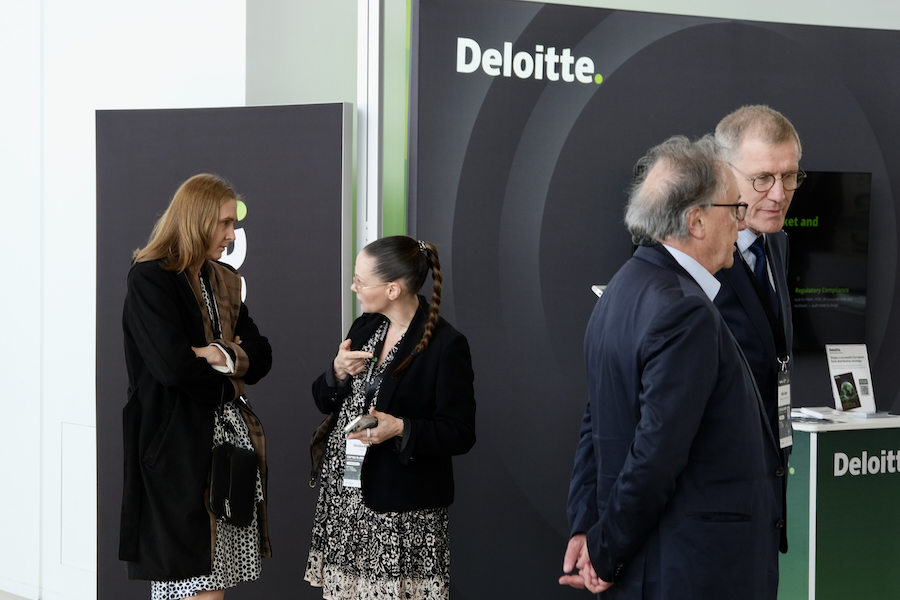
14th Annual Cross-Border Distribution Conference at the European Convention Centre in Luxembourg-Kirchberg;
Credit: Steven Miller, Chronicle.lu
On Tuesday 19 May 2026, the 14th Annual Cross-Border Distribution Conference took place at the European Convention Centre in Luxembourg-Kirchberg, under the theme of “Shaping the Future in a Redrawn Global Landscape”.
The event, organised by Deloitte Luxembourg and Elvinger Hoss Prussen and supported by Financial Times Live, featured discussions from regulators, leading asset managers and industry experts on subjects such as global market forces, continuing security threats in Europe, artificial intelligence (AI), the consolidation of private equity management and Europe’s evolving tax landscape.
The conference was opened by Justin Griffiths, Partner at Deloitte Luxembourg, and Jérôme Wigny, Partner at Elvinger Hoss Prussen, who welcomed the attendees and guests, before detailing the conference programme, which would take place against a background of “geopolitical tension, fragmented markets, continued regulatory pressure and Europe’s ‘lingering problem’ with competitiveness.”
Yuri Bender, Editor-in-Chief, Professional Wealth Management (PWM) at the Financial Times, then introduced the conference opening speaker, Claude Marx, Director General of the Commission de Surveillance du Secteur Financier (CSSF), who detailed the CSSF's current priorities in the areas of banking and fund management.
He remarked: “The CSSF's priorities this year in two of the four business lines that we supervise, banking and funds. And both, of course, are relevant here, because half of the banking business in Luxembourg is depository banking activity. These priorities are broadly aligned with EU priorities.”
In the area of banking supervision, Claude Marx highlighted the priorities of digital and operational resilience, with a special focus on fund global implementation, strengthening of ICT governance, cyber testing and AI risk oversight; credit quality and real estate vulnerabilities; Anti-Money Laundering (AML), Countering the Financing of Terrorism (CFT) and financial integrity; and liquidity, funding structure and inter-group channels.
In the area of fund management, he said priorities lay in the areas of the liquidity risk; contagion; asset valuation, focusing on valuation and governance and the management of conflicts of interest; fund disclosures; and IT risks.
Claude Marx also highlighted three key themes for the CSSF in the areas of fund tokenisation, harmonisation and AI. In relation to tokenisation and the use of blockchain technology he said: “Luxembourg has a unique framework that is starting to be recognised beyond its borders.”
On the growing influence of AI within the industry he noted: “AI is transforming our economies, our societies, our institutions and our workforce. And AI is transforming finance. This is undoubtedly a revolution, not an evolution,” adding, “We can now be in the driver's seat and take advantage of the opportunities offered by AI and managing the risks appropriately, or we can be in the passenger's seat, which is very risky…The choice is ours.”
Claude Marx also touched on the potential use of quantum computing within the industry to optimise algorithms, power stochastic modelling applications for asset and risk management, credit rating and fraud detection, and quantum-enabled blockchain technologies. He also highlighted the issues relating to the technology in the form of slow development timescales, despite considerable investment in the field, the need for proper regulation and governance, and ensuring sufficient training at all levels is undertaken to ensure the talent pool is robust for when these technologies take hold.
There then followed a panel discussion moderated by Yuri Bender, Editor-in-Chief, Professional Wealth Management (PWM) at the Financial Times, which featured contributions from Peter Chase (German Marshall Fund), Delphine Di Pizio-Tiger (Indosuez Wealth Management), Adrian Mulryan (Invesco Ireland) and Pervaiz Panjwani (Waystone), which focused on escalating geopolitical fragmentation, the volatile economic environment and the long-term strength of the dollar, as well as the implications of these subjects on European fund management.
The conference continued throughout the day with a series of keynote speeches and panel discussions, including a fireside chat with General Sir Adrian Bradshaw, Former Deputy Supreme Allied Commander Europe of NATO, with closing remarks provided by Yuri Bender, Justin Griffiths and Jérôme Wigny.
The event concluded with a cocktail and networking session.