 Credit: Ievgenii Karanov, Chronicle.lu
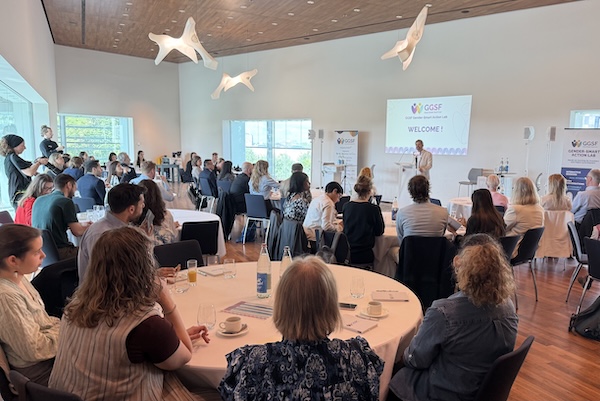
On Tuesday 9 June 2026, the Global Gender-Smart Fund (GGSF) hosted its Gender-Smart Action Lab at the European Convention Center Luxembourg in Kirchberg, bringing together around 70 participants to discuss gender finance and access to capital for women entrepreneurs.
The programme featured keynote speeches, an interactive gender statistics session, testimonies from financial institutions and borrowers, a panel discussion on gender finance, a workshop focused on designing gender-focused investment funds and a series of table debates examining practical actions that can be taken to advance women's financial inclusion.
Opening the event, Etienne de Belloy, Associate Director at Innpact and GGSF, questioned why discussions on gender finance remain necessary in 2026, arguing that significant barriers continue to exist despite growing awareness of the issue. He noted that women account for more than half of the world's population and that investing in women benefits both individuals and society as a whole.
“We know that today there is a $1.7 trillion gap for women clients. We know that financial institutions are missing out on annual global revenues of $700 billion by not meeting the needs of women globally,” he said.
Etienne de Belloy also highlighted the underrepresentation of women within the investment sector, noting that only 11% of investment professionals in emerging markets are women. Emphasising the practical nature of the Gender-Smart Action Lab, he added that the event had been designed as “not a traditional conference”, with workshops, discussions and collaborative sessions intended to generate concrete ideas and actions to advance gender equality.
Delivering the first keynote address, Yuriko Backes, Luxembourg's Minister for Gender Equality and Diversity, described gender equality as not only a moral and social imperative, but also an economic one. “Gender diversity boosts organisational performance. It enhances profitability and we also know from numerous studies that it reduces a company's carbon footprint,” she said, arguing that greater inclusion makes both societies and economies more resilient and competitive.
Minister Backes highlighted Luxembourg's efforts to advance gender finance in recent years, citing initiatives such as the launch of the world's first gender bond by the Luxembourg Stock Exchange, the Women in Finance Charter and the Gender Finance Task Force. She noted that the task force continues to promote greater representation of women in finance while also improving access to financial services tailored to women's needs.
Reflecting on the broader work of her ministry, she pointed to programmes aimed at advancing workplace equality, including the Positive Actions Programme, in which more than 120 companies have participated, as well as three national action plans covering gender equality, LGBTIQ+ rights and the fight against gender-based violence.
Stressing that progress requires concrete action rather than declarations, Minister Backes concluded: “True transformation can never be achieved alone. It must be the result of a collective effort of people and institutions working together with a common vision.”
Mary Ellen Iskenderian, CEO of Women's World Banking, argued that gender finance should be viewed as an economic opportunity rather than solely a social issue: “Financial systems still fail to reflect how women actually live, work, save, borrow, invest and manage risk. And that failure isn't some kind of social problem. It's a capital allocation problem.”
She noted that women-owned small and medium-sized enterprises account for around one-third of formal SMEs worldwide, yet remain significantly underfinanced. Mary Ellen Iskenderian also highlighted the role of the Global Gender-Smart Fund in supporting financial service providers through both investment and technical assistance, while pointing to evidence that greater female representation within financial institutions can improve outcomes.
Citing data from Women's World Banking, she said organisations with more women at all levels tend to serve more women clients more effectively. She also identified several barriers limiting women's access to finance, including financing gaps, products designed around the “default male customer”, insufficient gender-disaggregated data and biases within traditional credit assessment systems, urging investors and financial institutions to make gender data “non-negotiable”, link capital to operational change and strengthen women's representation in leadership roles.
The event also featured an investors' panel exploring the role of capital providers in advancing gender finance. Participants included Anne Müllejans, Senior Manager Debt Funds at DEG, Alexandra Spasov, Funds Solution Analyst and Thematic Research Specialist at Quintet Private Bank, Jakub Bogdan, responsible for Debt Capital Market Origination and Syndication at SFI Markets, and Marijn Wiersma, Managing Director of 2X Global. Additional discussions brought together representatives of financial institutions, including Katherine Brown, Impact Manager at Advans International.
The Gender-Smart Action Lab concluded with a keynote address by Fatou Ndiaye, Chief Audacity Officer, international speaker and UN expert, while participants also took part in workshops and roundtable debates focused on practical measures to improve financial inclusion and gender equality before gathering for networking drinks.