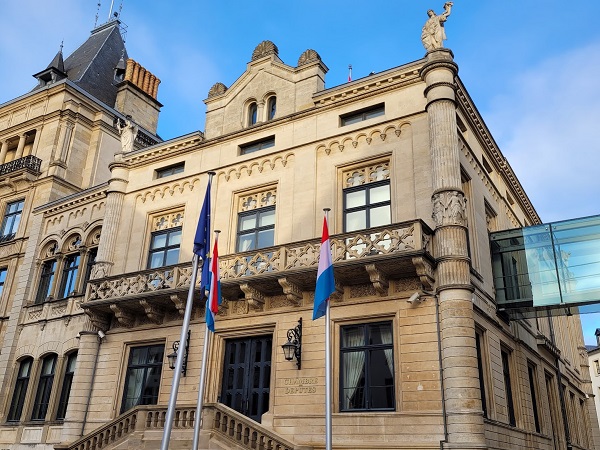
 Chamber of Deputies;
Credit: Jazmin Campbell
Chamber of Deputies;
Credit: Jazmin Campbell
On Thursday 10 February 2022, the Chamber of Deputies (Luxembourg's Parliament) passed a new law relating to national cultural heritage.
The new law passed with 54 votes in favour and six abstentions (from Alternative Democratic Reform Party / ADR and Pirate Party MPs).
According to Luxembourg's Ministry of Culture, the adoption of this bill, which aims to create a legal framework for national cultural heritage and to modernise rules relating to conservation and protection, is an important step towards the protection and enhancement of the country's cultural heritage.
This law introduces provisions targeting both architectural and archaeological heritage and movable and intangible heritage. As Luxembourg's Minister of Culture, Sam Tanson, explained, this involves protecting cultural heritage as a major element of sustainable development and cultural diversity and enhancing cultural heritage through its identification, study, safeguarding and protection, as well as strengthening social cohesion by encouraging a sense of shared responsibility towards the common living space.
The new law modernises the legal provisions relating to cultural heritage by introducing more coherence and legal certainty in the protection of cultural heritage and also implements the provisions of international texts ratified by Luxembourg, as well as European texts on the subject.
The law distributes its provisions on four aspects of cultural heritage, namely archaeological, architectural, movable and intangible heritage.
Archaeological heritage
Moreover, the new cultural heritage law introduces the principle of preventive archaeology, according to which construction projects located in an archaeological observation zone must, under certain conditions, be submitted beforehand to the Minister of Culture for an archaeological evaluation. The archaeological assessment procedure is expected to allow developers greater predictability in the context of planned work, since it replaces the emergency archaeological operations that previously had to be carried out in the event of a fortuitous archaeological discovery.
Architectural heritage
Several changes have been made regarding architectural heritage. Firstly, the new law introduces an inventory of architectural heritage listing with precision and with appropriate documentation the immovable property forming part of said heritage. Secondly, the legal text establishes the criteria on the basis of which a building is registered on the inventory of architectural heritage and on the basis of which a building is classified as national cultural heritage or integrated into a protected sector of national interest. The ranking procedure itself has been adapted for greater consistency and consideration of public opinion. Architectural heritage will be protected on the basis of the aforementioned inventory by means of Grand-Ducal regulations which replace the former ministerial and Council of Government decrees. The text also further strengthens the legal security of owners by providing for the abolition of additional inventory.
A transitional regime will be put in place during the period of drawing up and finalising the architectural heritage inventory.
Movable heritage
The law introduces a new procedure for classifying cultural property, as well as a modern circulation regime which implements international and European legal texts and which replaces the current rules, which have become, according to the Ministry of Culture, "incomplete and obsolete". The text includes areas hitherto not covered by national legislation, such as state and restitution guarantees.
Intangible heritage
Finally, the law confers legal consecration on intangible heritage (traditions, know-how, etc.) in the form of establishing an inventory and measures aimed at ensuring it is safeguarded.
With the parliamentary adoption of this new law, certain institutions are also granted the status of cultural institute of the State. Consequently, the national centre for archaeological research (Centre national de recherche archéologique - CNRA) will become the national institute for archaeological research (Institut national de recherches archéologiques - INRA) and the national sites and monuments service (Service des sites et monuments nationaux - SSMN) will become the national institute for architectural heritage (Institut national pour le patrimoine architectural - INPA).
Information meetings
Following the vote on the cultural heritage law, the Ministry of Culture is organising four meetings aimed at presenting this new law. During these meetings, the public will have the opportunity to ask their questions to the experts present.
A meeting for the southern Luxembourg region will take place at Artikuss concert hall in Soleuvre on 2 March 2022 at 19:00.
A meeting for the eastern region will take place at the event hall (salle des fêtes) of Maacher Lycée in Grevenmacher on 14 March 2022 at 19:00.
A meeting for the northern region will take place at CAPE cultural centre in Ettelbruck on 15 March 2022 at 19:00.
A meeting for the centre region will take place at Neumünster Abbey in Luxembourg-Grund on 22 March 2022 at 19:00.
These events will take place under the CovidCheck regime. Anyone interested in attending one of these events is asked to register via email: pr@mc.etat.lu (indicating the number of people and the desired location).