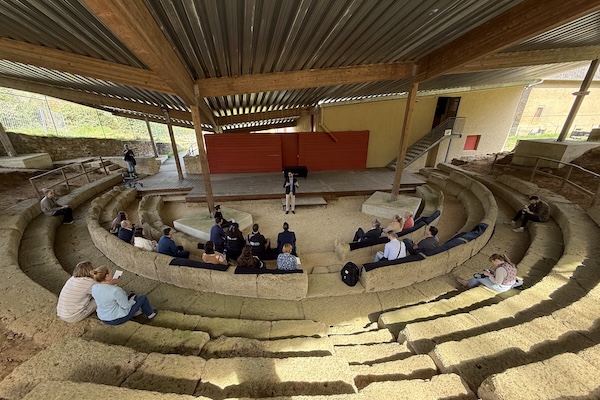
 Dalheim Gallo-Roman theatre;
Credit: Ievgenii Karanov, Chronicle.lu
Dalheim Gallo-Roman theatre;
Credit: Ievgenii Karanov, Chronicle.lu
On Thursday 9 April 2026, the Regional Archaeological Centre in Dalheim hosted a visit focused on international research cooperation, including a meeting with archaeology students from the University of Cologne working on a Gallo-Roman collection and an update on the development of the Ricciacum site, attended by Luxembourg’s Minister of Culture, Eric Thill.
The visit was also attended by the Mayor of Dalheim, Romain Kill, Alderman Peggy Olinger and members of the municipal council, as well as the Director of the National Institute for Archaeological Research (INRA), David Weis, who guided the guests throughout the visit.
The programme began with a meeting between the minister and archaeology students from the University of Cologne, who are taking part in a seminar organised in collaboration with INRA. Supervised by Peter Henrich, Head of Research Coordination at the Rhineland Regional Museum in Trier, the students are working on the scientific study of artefacts discovered over recent decades at the Schandel site by Romain Jacoby. During a presentation of selected finds, students and researchers explained how objects spanning the Roman period to more recent centuries illustrate long-term continuity in material culture, with one student noting that items which may initially appear as “metal scrap” become meaningful through analysis and comparison.
Minister Thill highlighted the importance of INRA’s scientific collaborators, in particular Romain Jacoby, as well as international partnerships in archaeological research for promoting Luxembourg’s historical heritage, noting that such initiatives also contribute to training future specialists and enhancing understanding of the Gallo-Roman occupation of the territory.
The group then moved on to the Gallo-Roman theatre at the Ricciacum site, where Nena Sand, head of the Regional Archaeological Centre in Dalheim (INRA), outlined its historical significance as a multifunctional space used not only for performances but also for political and social gatherings, with a capacity of several thousand people, reflecting its role as an important regional centre in Roman times.
INRA, in consultation with the Ministry of Culture and in cooperation with the Centre des monuments du Grand-Duché de Luxembourg (CML), is pursuing a strategy aimed at strengthening research, improving infrastructure and enhancing the site’s tourism appeal. Priorities include the development of cultural mediation, the creation of new visitor routes and plans for a future visitor centre.
The Mayor of Dalheim, Romain Kill, also outlined ongoing development plans for the site, noting that the project is supported through cooperation with national institutions, including funding of €228,000 over the next three years, complemented by additional European and local contributions, with the aim of further enhancing the site’s cultural and tourism potential.
Minister Thill also underlined the importance of making archaeological heritage more accessible to the public, stressing the need to balance research, preservation and tourism development. He highlighted ongoing efforts to improve infrastructure, strengthen cooperation with national and international partners and support long-term projects aimed at enhancing the visibility and educational value of sites such as Dalheim, while also thanking those involved for their continued commitment.
The programme also included a stop at the Dalheim eagle monument, where Nena Sand explained the strategic importance of the site along the ancient Roman road network, notably the route linking the Mediterranean region to Trier. She highlighted how the settlement developed as a key crossroads and regional centre, supported by archaeological evidence from excavations and geophysical surveys.
Speaking to Chronicle.lu, INRA Director David Weis highlighted the importance of international partnerships in advancing archaeological research in Luxembourg, noting that the institute, established in 2022, collaborates with several universities due to the absence of a dedicated archaeology faculty in the country. “We’ve launched partnerships with several universities to advance archaeological research here in Luxembourg,” he said, adding that current work with students from the University of Cologne involves analysing thousands of artefacts discovered over decades by a local volunteer.
Davis Weis also emphasised the significance of the Dalheim site, describing the Gallo-Roman theatre as one of the best-preserved in Northern Europe and part of what was once the largest Roman settlement in Luxembourg. He noted that its location at a crossroads of major Roman routes contributed to the development of a diverse community, with people arriving “from all across the Roman Empire”.
Looking ahead, he underlined efforts to make the site more accessible to the public, including extended opening hours and future plans to better connect different parts of the archaeological area. “We just want to get more people to discover this heritage because it is quite exceptional,” he said, adding that improving access and public understanding remains a key priority for INRA.
The ministerial visit also marked the official launch of the 2026 tourist season for the Dalheim theatre, which is now open to the public with extended opening hours. Since 2025, the site has been open from the end of April to the end of October at weekends and daily from 10:00 to 18:00 between 15 July and 15 September.