 Credit: STATEC
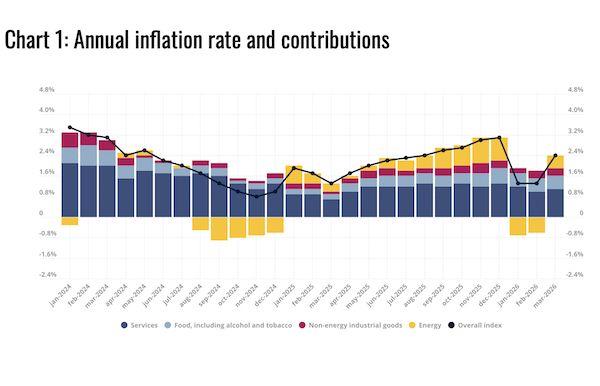
On Wednesday 8 April 2026, Luxembourg's statistical institute, STATEC, confirmed that annual inflation increased from 1.3% in February to 2.4% in March 2026.
According to STATEC, the increase was driven primarily by a sharp rise in energy prices, following recent disruptions linked to the closure of the Strait of Hormuz amid the war in Iran.
Energy prices rose significantly in March, increasing by 12.2% compared to February, while annual growth reached 6.1%, compared to -7.7% in February. The increase was particularly marked for heating oil, which rose by 37.3% month-on-month and 33.2% year-on-year. Fuel prices also recorded a sharp increase of 15.6% in one month, the highest monthly rise ever observed in the consumer price index. Diesel prices rose by 22.2% over the month, while petrol increased by 10.7%. Gas and electricity prices remained stable.
Food prices (including alcohol and tobacco) increased by 2.7% year-on-year. Notable increases were recorded for fresh meat (+5.6%), vegetables (+3.6%) and coffee (+11.5%), while prices for vegetable oil (-4.7%) and pasta (-3.1%) declined. On a monthly basis, food prices rose slightly by 0.2%, while alcoholic beverages decreased by 1.6%, mainly due to promotions on wine, spirits and beer. On an annual basis, alcohol prices fell by 0.7%.
Service prices increased by 2.5% year-on-year, compared to 2.2% in February. This was mainly driven by higher prices for package holidays and childcare services. Banking fees also increased (+8.0% year-on-year and +6.7% month-on-month), while promotions on bundled telecommunications services weighed on the overall services component, according to STATEC.
The non-energy industrial goods component recorded the lowest annual increase (+1.0%). The strongest annual rise was observed for jewellery and watches (+8.5%), while prices for cleaning and household maintenance products increased by 5.3% compared to March 2025. Furniture prices declined by 1.4% on a monthly basis due to promotions.
The annual inflation rate rose to 2.4% in March, compared to 1.3% in February. The general index excluding energy increased from 2.0% to 2.1%. The general index for March, expressed on a base of 100 in 2025, stood at 101.39 points. The half-yearly average of the index linked to the base date of 1 January 1948 rose from 1034.45 to 1035.12 points. The next indexation will be triggered when the value of 1038.79 is reached, with the next wage indexation expected in the second quarter of 2026.