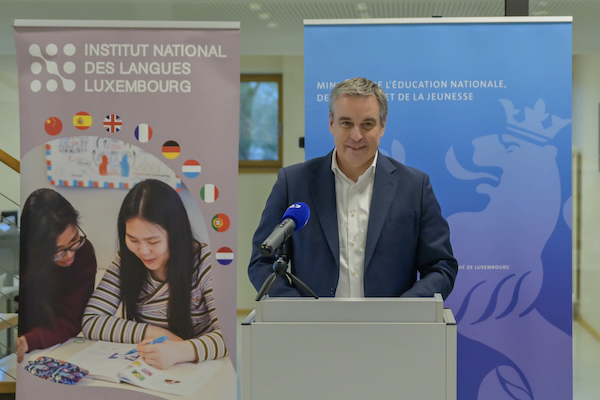
 Claude Meisch, Luxembourg Minister of Education, Children and Youth;
Credit: MENEJ
Claude Meisch, Luxembourg Minister of Education, Children and Youth;
Credit: MENEJ
On Wednesday 14 January 2026, Luxembourg Minister of Education, Children and Youth, Claude Meisch, and the Director of the Luxembourg National Language Institute (INLL), Maisy Gorza, presented the Moving Languages concept during a press conference.
In its press release, Luxembourg’s Ministry of Education, Children and Youth described the Moving Languages concept as “an innovative, immersive method for learning Luxembourgish and French”.
The ministry highlighted that where interest in Luxembourgish is growing, demand for courses at the INLL is particularly high, with many learners wishing to quickly acquire oral skills in Luxembourgish to communicate effectively in their daily and professional lives. It is in this context that the INLL, in collaboration with the Adult Education Service (SFA), developed the national Moving Languages project.
According to the ministry, Moving Languages is inspired by the LieLa (Liechtenstein Languages) method and is based on an active, immersive methodology that uses movement and engages all five senses. The intensive eight-week programme, taught entirely in the target language from day one, allows adults with no prior knowledge to reach an A2 oral level through fifteen hours of lessons per week, focused on listening and speaking skills. A certificate of participation is awarded at the end of the course.
Following the launch of the first pilot courses in February 2025, Moving Languages courses in Luxembourgish and French were officially integrated into the INLL’s offerings in September 2025.
The ministry emphasised that the programme has been deemed a success: autumn sessions are fully booked with 30 participants per session and feedback has been highly positive, confirming the relevance and effectiveness of this method in promoting broader use and mastery of the Luxembourgish language.
The ministry reported that since the start of the 2025/2026 school year, the SFA has also offered Moving Languages French courses to its learners who are applicants for or beneficiaries of international protection (DPI/BPI). During the 2025/2026 school year, up to 180 learners benefit from this module, which forms part of the linguistic integration programme.
Moreover, the ministry detailed that a further step in the development and long-term establishment of this innovative language-learning approach is marked by a training programme for future Moving Languages instructors. Building on the lessons from the pilot phase, the project has now entered a consolidation stage: evaluation and adjustments will continue during implementation to gradually expand the offer and make it accessible to all interested participants.
Details of the “Moving Languages” programme are available in the following video: https://youtu.be/RSS1d--UkQI.