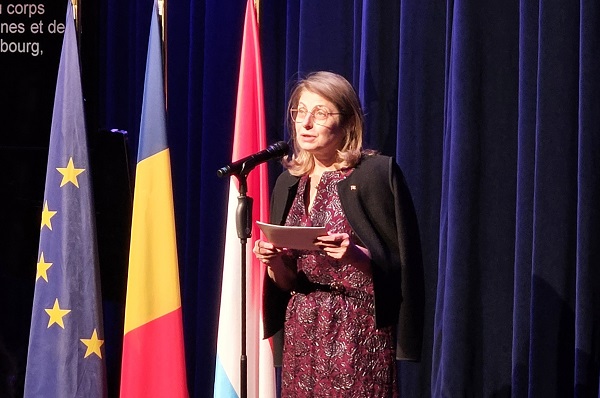
 Alexandrina-Livia Rusu, Ambassador of Romania to Luxembourg;
Credit: Jazmin Campbell, Chronicle.lu
Alexandrina-Livia Rusu, Ambassador of Romania to Luxembourg;
Credit: Jazmin Campbell, Chronicle.lu
On Tuesday 2 December 2025, the Mierscher Theater in Mersch hosted a special performance of The Little Prince (Micul Prinț) to mark both Romania's national day (Great Union Day, 1 December) and 115 years of bilateral diplomatic ties between Luxembourg and Romania (5 December).
Starring Oana Pellea and Lari Giorgescu, the play was created in 2024 to honour the 80th anniversary of the death of French author Antoine de Saint-Exupéry. This special production, featuring unique staging, was performed beautifully in Romanian with French surtitles, and received a standing ovation.
The evening opened with a speech by the Romanian Ambassador to Luxembourg, Alexandrina-Livia Rusu, and concluded with a cocktail reception.
115 Years of Bilateral Diplomatic Ties
Celebrations began earlier in the year with the exhibition "On the Thread of Shared Traditions", hosted at Vianden Castle from January to April and based on the historic links between Luxembourg and the Saxon communities of Transylvania, Romania.
In mid-September 2025, a parliamentary delegation from Luxembourg visited Bucharest. Later that month, Romania’s Deputy Prime Minister and Minister of Defence, Liviu-Ionuț Moșteanu, paid a working visit to Luxembourg.
In this anniversary context, Chronicle.lu spoke with Ambassador Alexandrina-Livia Rusu about bilateral relations.
Chronicle.lu: How would you describe the evolution of relations between Romania and Luxembourg over the past 115 years?
Ambassador Rusu: Over the past 115 years, the tie between our two countries has progressed from early diplomatic exchanges and a period of disconnection during the Cold War to a strong, multilateral partnership within the European Union and NATO, and a shared vision for multilateralism.
Formal diplomatic relations were established on 5 December 1910, with the appointment of the first extraordinary envoy, Trandafir G. Djuvara, residing in Brussels, by King Carol I of Romania to Grand Duke Guillaume IV of Luxembourg. […] The motivation for this appointment resides in the family connection between the Romanian royal family and the Luxembourg dynasty, as the wife of King Carol I of Romania, Queen Elisabeth, was the first cousin of Grand Duke Guillaume IV of Luxembourg. […] These ties were strengthened in 1948 with the marriage of Princess Anne of Bourbon-Parma to King Michael of Romania, Queen Anne being the first cousin of Grand Duke Jean of Luxembourg.
Nevertheless, historic links predate formal relations. These connections started with migrants from the Luxembourg area who, alongside those from Flanders or Lower Rhine regions, settled in the 12th-13th centuries in the Sibiu and Sighișoara area and in the 18th century in the Romanian Banat. This migration deeply influenced the cultural and urban identity of the Transylvanian cities, such as Sibiu. Some centuries later, before World War II, Luxembourgish citizens, including engineers and governesses, immigrated to Romania for work.
Coming back to formal relations, it was in 1966 that diplomatic relations were upgraded to the ambassadorial level. However, Luxembourg's integration into Western European structures contrasted with Romania's communist regime, so the two countries were directed to divergent paths within their respective ideological blocs.
The fall of communism in 1989 opened the door for a new, closer relationship. Romania appointed its first resident ambassador to Luxembourg in 1990, signalling a true diplomatic re-engagement. From that point on, Luxembourg emerged as a key advocate for Romania's integration into Euro-Atlantic structures.
The most powerful sign of this new era came on 25 April 2005, when Romania signed its EU Accession Treaty in Luxembourg during its EU Council Presidency. A symbolic culmination of Romania’s journey westward, the moment represented a full-circle return to the European community.
In a unique cultural nod, the two countries later shared the title of European Capital of Culture, with Luxembourg City and the Romanian city of Sibiu holding the designation in 2007.
Today, the relationship continues to deepen, moving beyond symbolic gestures to concrete cooperation. Economic collaboration was promoted through activities such as the Luxembourg economic mission to Romania (2024) or Luxembourg Internet Days 2024 where Romania was the main guest, which showed the strong potential for an even deeper interaction in many sectors, with mutually beneficial results.
On the security front, Luxembourg's military presence in Romania as part of NATO's collective defence efforts underscores a high level of trust and partnership.
As Romania and Luxembourg look towards the future, the foundation laid over the last 115 years points to a relationship built not only on shared history but also on a joint vision for a prosperous and integrated Europe.
Chronicle.lu: What do you see as the main areas of cooperation between the two countries today?
Ambassador Rusu: We intend to continue with the same determination to develop our relations on all levels, but especially in the political, economic, cultural, educational and defence areas, with numerous actions to capitalise on the bilateral potential for cooperation.
As regards political relations, cooperation between Romania and Luxembourg has been an example of stability and mutual respect. In a world marked by global challenges and rapid change, it is essential to continue an open dialogue based on democratic values, solidarity and respect for international law. Only through close political cooperation, solidarity and unity can we respond effectively to contemporary crises, whether in the areas of security, climate or human rights.
In the economic sphere, the partnership between our countries has enormous potential. Last year's economic mission to Romania was a good opportunity to highlight the potential for cooperation and the many opportunities for interaction between the two countries, not only in sectors such as trade and investment, but also in cutting-edge areas with high added value (e.g. innovation, information technology, cybersecurity, space exploration…). It also emerged that the investment environment, driven by a rapidly expanding technological ecosystem and its strategic geographical location, makes Romania an ideal partner for Luxembourg companies wishing to expand their operations in Eastern Europe.
The cultural dimension […] is equally important, as culture has the power to unite people across borders, to promote mutual respect and understanding. We aim to intensify cultural exchanges, educational programmes and cooperation between universities and artistic institutions, actions that over time can strengthen the ties between young people in our countries and cultivate a generation that understands the value of diversity and intercultural dialogue.
In the area of defence, relations between the two countries have been revitalised, as evidenced by ministerial visits and the presence of Luxembourgish military personnel in the NATO Battle Group deployed in Cincu. The recent visit of the Romanian Vice Prime Minister and Minister of Defence to Luxembourg [...] highlighted the willingness of the two countries to contribute to strengthening bilateral relations.
In conclusion, the ties between our countries represent a strategic investment in the future. Let us therefore continue together on the path of strengthening our solid partnership, based on friendship, respect and trust. Through joint efforts in the political, economic and cultural spheres, this friendship can always be a good example of cooperation.
Chronicle.lu: What role do you see for public diplomacy in strengthening this partnership going forward?
Ambassador Rusu: Public diplomacy has become increasingly vital in our interconnected world and at a time when we are confronted with an immense cascade of information. At the very least, public diplomacy is a form of communication: of our values, of cultures, of identities or experiences. It is thus a way of building bridges and extending the understanding of who we are. In the new information environment that surrounds us, active and targeted institutional communication also becomes essential to share the facts. We use it increasingly to create and maintain the connection with the citizens and to protect and uphold the values that define us. As we may become surrounded by artificial content in the not-so-distant future, the need to share trustful information will quite possibly gain in importance.
The popularity of events that bring together diverse experiences, memories and histories of peoples from across Europe, such as international art festivals, whether film, music, theatre, dance or international bazaars, is a testament to the deep need that we have to connect and communicate with one another. I was very impressed and touched by the openness and interest that I found in so many of [Luxembourg's] cultural establishments to work together to offer the general public authentic cultural content. And as they say that “the journey is the destination”, getting to meet and work together with Luxembourgish people was in itself such an inspiring and enriching cultural experience. We are also very lucky to have an active Romanian community living in Luxembourg, who acts as a bridge between the two countries.
Chronicle.lu: How do you see economic, cultural and political ties evolving in the next decade(s)? What are the main opportunities for deepening cooperation?
Ambassador Rusu: I hope that our relationship will deepen significantly in the coming years, going beyond the traditional EU partnership and reaching specific cooperation in fast-growing sectors. While our current ties are strong, the potential for growth is far from being fully exploited. The evolution will be driven by strategic economic alignment, continued cultural and human exchange, and reinforced political dialogue, especially within the EU and NATO.
We seek to continue our dialogue along the priorities within the EU framework, especially concerning core European values and regional security. We advocate for a cohesive, solidarity-oriented Europe, based on the rule of law and democratic principles, which are cornerstones of the European project.
[Regarding] Luxembourg and Romania's future within NATO, this will be shaped by shared strategic interests, particularly regarding regional security and defence, which has been strengthened by recent agreements, like the joint letter of intent signed in September 2025 by our defence ministers. Both countries' future relations will likely focus on deepening cooperation on defence capabilities, reinforcing the EU's Eastern flank and maintaining a united stance against common threats.
While opportunities abound, the path forward is not without challenges. Attracting more direct Luxembourgish investment to Romania, navigating a future EU and maintaining momentum in bilateral fora will require sustained effort. However, with renewed diplomatic vigour and a shared European and Euro-Atlantic vision, I think Romania and Luxembourg are well-positioned to strengthen even more their partnership in the coming years.
Chronicle.lu: How might celebrations, such as the one on 2 December, help renew and inspire the two countries' shared commitment for the future?
Ambassador Rusu: Cultural events, like those associated with Romania's National Day celebrated on 1 December and the 115th diplomatic anniversary we mark on 5 December, are invaluable for renewing and inspiring the special link between our countries. They shift the focus from formal diplomacy to human connection, deepening mutual understanding and laying a stronger foundation for future cooperation. These activities provide a platform for the Romanian diaspora to celebrate their heritage, traditions and national identity. It reinforces a sense of community for the Romanian population in Luxembourg, now over 1.2% of the country's residents. In the meantime, by being open to the public, they allow Luxembourgish citizens to engage directly with Romanian culture, breaking down stereotypes and fostering new cross-cultural connections.
[Events] centred on shared cultural touchstones, for example the “Conference on Brâncuși and Steichen relationship” connect the two nations through their common contribution to a joint European cultural identity. Anniversary events, such as the exhibition “On the thread of shared traditions” [at] Vianden Castle, honour the historical bonds between the two nations, providing context and meaning to the modern relationship. By looking back at their past, Romania and Luxembourg can shape a shared, prosperous future.
This 2 December event at Mierscher Theater, the play The Little Prince by Antoine de Saint-Exupery, featuring the Romanian star Oana Pellea and Lari Giorgescu, has a special significance in the cultural landscape. It comes at a time when we need social cohesion, unity and we need to remind ourselves of the values we hold important. Thus, this cultural element brings back to the public's attention one of the most profound stories about love, friendship, innocence and the meaning of life, reinterpreted with rare sensitivity and depth. The play is not a simple adaptation, but a theatrical meditation on human nature, inviting the audience to rediscover simple but essential values: joy, empathy and love, which should hold an important place among the values that form the foundation of our future.
Anniversary occasions provide also an opportunity for government officials to reaffirm their joint commitments in key areas. Commemorating milestones together reinforces the democratic values and shared European identity that unite our two countries.