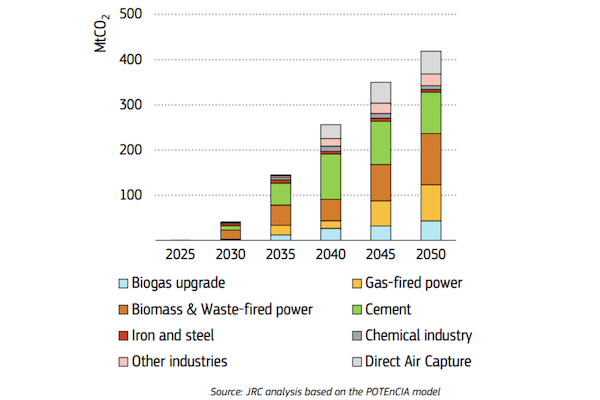
 Projected CO2 capture by source in the EU, 2025-2050;
Credit: Joint Research Centre (JRC)
Projected CO2 capture by source in the EU, 2025-2050;
Credit: Joint Research Centre (JRC)
On Wednesday 3 December 2025, Luxembourg’s Ministry of the Environment, Climate and Biodiversity and Ministry of the Economy outlined a new national framework to speed up the deployment of carbon capture, utilisation and storage (CCUS) and carbon dioxide removal (CDR) solutions in a bid to strengthen the country’s commitment to climate neutrality.
The announcement was made during the first meeting of the Taskforce CCUS & CDR, a national platform dedicated to the coordination and monitoring of the deployment of CCUS and CDR technologies in the Grand Duchy.
According to the ministries, the framework is designed to support Luxembourg’s 2050 climate objectives and to prepare the country for forthcoming European obligations and said it recognised that the country cannot meet its long-term climate targets through emissions reductions alone.
The national climate strategy calls for a combination of mitigation measures, behavioural change and the gradual introduction of technologies such as industrial carbon capture and engineered removals. The framework therefore aims to give clarity to businesses, research institutions and investors as they plan their future activities.
The ministries highlighted that Luxembourg has limited space for deep geological storage or large industrial CCUS projects and said that the government plans to position the country as an enabler of cross-border solutions with the intention to integrate into European CO₂ pipeline networks, shipping routes and regional storage hubs. They said that this approach reflects the belief that Luxembourg can serve as a connector in the wider European climate architecture.
The government’s framework sets out 5 policy pillars. First, the government intends to create a supportive regulatory environment. Officials plan to update legal definitions, establish national criteria for high-quality removals and set out rules for transporting captured CO₂ across borders. Luxembourg also aims to support the development of certification standards that align with the EU’s Carbon Removal Certification Framework.
Second, the government wants to stimulate early projects. Industry in Luxembourg, especially steel, waste management and construction materials, continues to produce emissions that remain technically difficult to avoid. The ministries intend to work closely with operators to identify pilot projects, encourage innovation and support testing of novel capture technologies. Luxembourg’s research institutions already contribute to this work and the framework aims to deepen cooperation between public laboratories and the private sector.
Third, the government intends to improve access to financing. Officials recognise that CCUS and CDR investments remain costly and often require public assistance in their early stages. Luxembourg therefore plans to use EU funds, the Climate and Energy Fund and targeted state-aid mechanisms to support early deployment. The country also intends to examine the potential of long-term contracting tools including carbon-removal purchase agreements to give project developers financial security.
A fourth pillar focuses on infrastructure. Luxembourg will not construct storage sites but intends to secure access to European routes. The government plans to coordinate with neighbouring countries to establish cross-border connections. Authorities also want to improve national CO₂-stream monitoring and develop digital systems that track volumes that companies capture and transport.
Moreover, the government plans to build public understanding. The ministries emphasise that CCUS and CDR will not replace emissions-reduction efforts but will complement them. Officials intend to launch awareness campaigns and create opportunities for public dialogue to ensure that citizens understand how the technologies work and why they matter for Luxembourg’s climate strategy.
The ministries said the framework also highlighted the importance of nature-based carbon removals. Luxembourg wants to strengthen forest management, soil restoration and agricultural practices that increase carbon sequestration and see these actions as essential complements to engineered removals while ensuring that all approaches meet strict quality and monitoring criteria.
The ministries added that with this framework, Luxembourg signalled its intention to play an active role in Europe’s emerging carbon-management ecosystem. The government views CCUS and CDR not only as climate tools but also as opportunities for industrial transformation and technological leadership and, as EU regulations evolve, Luxembourg aims to ensure that its economy adapts, innovates and benefits from the transition.