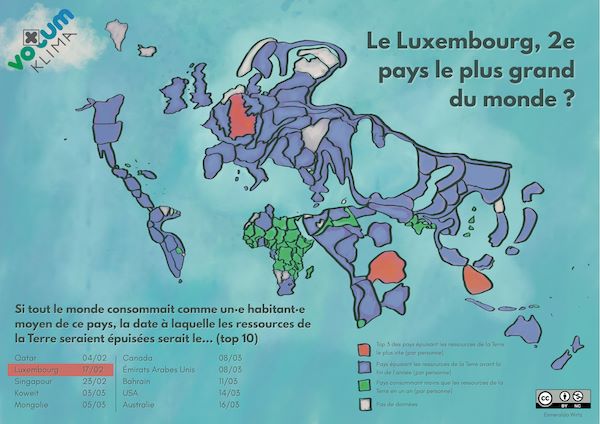
 World map showing countries resized according to their per-capita ecological footprint;
Credit: © Esmeralda Wirtz
World map showing countries resized according to their per-capita ecological footprint;
Credit: © Esmeralda Wirtz
On Monday 16 February 2026, the Luxembourg-based Votum Klima platform unveiled a new world map in which countries are represented according to their ecological footprint, showing Luxembourg as the second “largest” country on the planet behind Qatar.
The platform released the findings ahead of Earth Overshoot Day 2026, which falls on Tuesday 17 February in Luxembourg. Votum Klima used the occasion to call for political change to move away from what it described as a model that “violates planetary boundaries and human rights”.
Votum Klima said that Luxembourg will exhaust all its natural resources for the year on this date. According to the methodology of the Global Footprint Network, the country will spend the rest of the year living on ecological credit paid by ecosystems, future generations and vulnerable populations elsewhere in the world.
Votum Klima presented a global map developed by Esmeralda Wirtz from Amnesty International Luxembourg (one of the platform’s members), depicting each country according to its per-capita ecological footprint.
According to the data, Luxembourg, with a territory of 2,586 km², appeared as a “red giant” that visually dominates Europe and ranks second worldwide. By contrast, countries such as India or much of sub-Saharan Africa appeared significantly smaller and in green, indicating lower consumption levels within planetary limits, Votum Klima said.
If the entire world population lived like Luxembourg residents, 6.88 planet Earths would be needed to sustain that lifestyle, which is beyond the already unsustainable European average of 3.14 Earths, stated Votum Klima. The platform added that this visualisation reveals the disproportionate scale and injustices of resource consumption resulting from political and economic choices.
A study by the Higher Council for Sustainable Development (CSDD), published in 2023 and conducted in collaboration with the Luxembourg Institute of Science and Technology (LIST), identified the most impactful sectors, including: fuel tourism; food; manufactured goods; household consumption; construction; the services industry; and air freight. Data shows that this model promotes overconsumption of energy and raw materials, dependence on fossil fuels and a financial system disconnected from planetary limits, with consequences that include resource grabbing, violations of local communities’ rights and worsening North-South inequalities.
Voltum Klima underlined that this ecological deficit exists because of depleted resource stocks and accumulated CO₂ in the atmosphere. The platform warned that ecological overshoot cannot continue indefinitely and questioned whether society would end it through deliberate action or face catastrophe “by design or disaster”. It added that continuing on this path means externalising environmental and social impacts to other countries while weakening social cohesion in Luxembourg. Voltum Klima stressed that the ecological crisis links directly to a human rights crisis and said the transition can succeed only if it remains “fair, inclusive and democratic”.
The platform called on the government and economic actors to change course without delay. It referred to a recent speech at Harvard, in which Luxembourg’s Prime Minister Luc Frieden praised the merits of “European economies that pursue growth while respecting social and ecological limits”. Yet the Overshoot Day results, according to Votum Klima, shows that Luxembourg does not respect those ecological limits.
Instead of declaring 2026 the “Luxembourg year of competitiveness”, Voltum Klima argued that “political leaders must commit to a structural reduction in resource consumption, accelerate the exit from fossil fuels and redirect the financial centre towards investments compatible with human rights and climate objectives”. It added: “Public policies must set a clear, ambitious and binding framework grounded in social and environmental justice”.
Also last year, Luxembourg emerged as the second country worldwide to reach its Earth Overshoot Day.