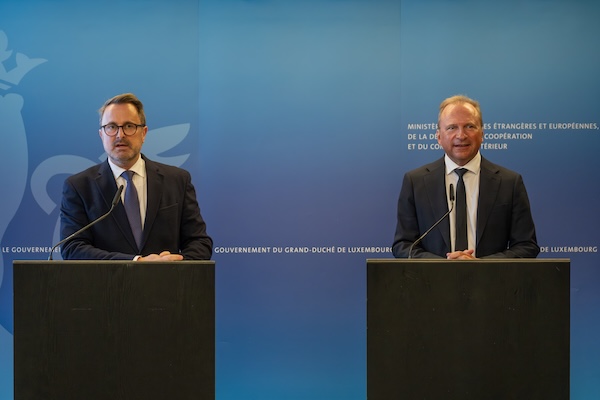
 (L-R) Xavier Bettel, Luxembourg’s Deputy Prime Minister, Minister for Foreign Affairs & Foreign Trade; Gilles Roth, Luxembourg's Minister of Finance;
Credit: Ali Sahib, Chronicle.lu
(L-R) Xavier Bettel, Luxembourg’s Deputy Prime Minister, Minister for Foreign Affairs & Foreign Trade; Gilles Roth, Luxembourg's Minister of Finance;
Credit: Ali Sahib, Chronicle.lu
At a press conference on Wednesday 7 January 2026, Luxembourg's Deputy Prime Minister and Minister for Foreign Affairs and Foreign Trade, Xavier Bettel, and the Minister of Finance, Gilles Roth, presented the government's plans to expand the Grand Duchy's diplomatic network.
The move aims to strengthen Luxembourg's international visibility, better promote its strategic interests abroad and adapt its external action to an increasingly complex geopolitical and geoeconomic environment. A key element of the strategy is the enhanced promotion of Luxembourg's financial centre through closer cooperation between diplomacy and financial expertise.
Luxembourg's diplomatic missions play a central role in implementing foreign policy, by assisting citizens abroad, supporting state institutions, businesses and civil society, and promoting the country's image. They also serve as an important instrument for development cooperation.
To improve coherence and effectiveness, foreign trade was integrated into the Ministry of Foreign and European Affairs at the beginning of the current government's term, with Luxembourg Trade and Investment Offices (LTIOs) fully integrated into the diplomatic network. Within the Grand Duchy, Luxembourg for Finance (LFF) plays a key role in promoting the financial centre.
Given the international focus of Luxembourg's financial centre, the government has decided to mobilise the expertise of the Ministry of Finance in a more structured and targeted manner within the diplomatic network. Financial experts recruited by the ministry will be seconded to selected diplomatic representations abroad, where they will identify opportunities in international markets, maintain regular dialogue with local financial authorities, promote the strengths of the Luxembourg financial centre and support stakeholders in their projects.
The two ministers noted that this arrangement is not entirely new, as Ministry of Finance staff are already seconded to the Permanent Representation to the European Union in Brussels. However, unlike other financial centres, Luxembourg has so far not been able to rely on an extensive network of experts dedicated to developing its financial sector.
Speaking to Chronicle.lu, Minister Bettel said: "When I became Minister of Foreign Affairs and Foreign Trade, I realised that I have very good diplomats all around the world, but the knowledge and all the information about the financial sector are not known by everyone. But I know that other countries are very active in the promotion of their financial centres".
"And so, I thought it was important to bring more knowledge and competences from the financial sector to the diplomatic circuit," he continued. "We have people now from the Ministry of Finance who will be also chosen by the Ministry of Finance to go to the embassy, LTIO or consulate general to strengthen the teams in this knowledge. This will maybe bring new companies but also maybe avoid that some companies will leave. So, for me, it's a win-win situation. It's good for me as chief of diplomacy, but it's also good for the Minister of Finance because if we stay attractive, it's good."
New diplomatic and consular missions planned between 2026 and 2028
Luxembourg’s economy is highly internationalised, with 61% of trade within the EU and 39% with the rest of the world, primarily North America and Asia. In an increasingly fragmented global trade environment, diversifying economic partnerships has become a strategic priority, according to the government.
Over the past two years, the opening of embassies in South Korea, Canada, Benin, Rwanda and Costa Rica represented a first step in strengthening the Grand Duchy's diplomatic network. With the announced reorganisation, Luxembourg plans to open seven new diplomatic and consular missions, strengthen several existing structures and close three representations. Implementation will take place gradually between 2026 and 2028 and may continue beyond that timeframe.
Luxembourg currently maintains 36 bilateral embassies, thirteen permanent missions to international organisations, six consulates general and ten LTIOs worldwide. In addition, five non-resident ambassadors are based in Luxembourg, covering eighteen countries.
Regional priorities
Europe will remain a key diplomatic priority. While no new missions will be opened, several representations - notably in London and Switzerland - will benefit from the support of financial experts.
Asked during the Q&A session about diplomatic relations with Russia, Minister Bettel said engagement remains limited but stressed that it would not be correct to close the embassy, describing such a move as politically complicated and emphasising the importance of maintaining dialogue. He later added that he would like to open diplomatic missions in both Israel and Palestine, once a two-state solution and peace are achieved.
The Americas: Relations with North America remain of strategic importance, the government said. Luxembourg currently has an embassy in Washington, DC, a consulate general in New York, another in San Francisco and, since 2024, an embassy in Ottawa.
The United States remains Luxembourg's main economic partner outside the EU. To strengthen and diversify this presence, the government is exploring the possibility of opening a consulate general in Austin, Texas - the second most populous state in the US and the eighth largest economy in the world.
In South America, Luxembourg plans to strengthen its presence in Brazil - where an embassy has been located in Brasilia since 2017 - by exploring the opening of a consulate general in São Paulo - the country's economic engine and main financial centre. The move is also expected to address the significant presence of Luxembourg nationals in Brazil.
Experts recruited by the Ministry of Finance are planned to be deployed to the three existing representations in the United States, as well as to Texas and São Paulo.
Later asked about current developments in the United States, the ministers underlined the importance of considering Luxembourg's economic realities and interests, noting that the US is a major trading partner for the Grand Duchy.
Asia is considered a major diplomatic and economic partner for Luxembourg - after the US, it is the Grand Duchy's main trading partner outside the EU. Following the opening of an embassy in Singapore in December 2025 (which also includes an LTIO), the government is considering opening consulates general in Mumbai (attached to the embassy in New Delhi) and, at a later stage, in Hong Kong. Both cities are major financial and commercial hubs.
Experts recruited by the Ministry of Finance will be deployed to these three representations.
Africa remains a major priority for Luxembourg. According to the ministers, the closure of three embassies in the Sahel region requires a reorientation of the Grand Duchy's presence in Africa.
The embassies in Niamey (Niger) and Bamako (Mali) closed at the end of 2025, while the embassy in Ouagadougou (Burkina Faso) is set to close at the end of February 2026. The ministers stressed that these closures do not represent a disengagement from the region, where support for civilian populations continues through multilateral organisations and civil society. The embassy in Dakar (Senegal) will continue to serve as a regional hub.
Asked to elaborate on the Sahel closures, Minister Bettel said these were "countries where we are not welcome".
Luxembourg is considering opening an embassy in Nairobi, Kenya, citing its role as a regional economic, financial and technological hub and the presence of UN agency headquarters. Through joint accreditation, this mission is expected to foster partnerships with other East African countries in the field of development cooperation.
The government is also examining the possibility of opening an embassy in Pretoria, South Africa, a country of major geopolitical importance as a G20 member and an economic engine for the region. Through joint accreditation, this mission would also strengthen ties with other Southern African countries.
Minister Roth explained that the financial experts would be recruited based on specific expertise, for positions advertised by his ministry. "They are recruited by the Ministry of Finance, but they will be seconded to embassies, which fall under the Ministry of Foreign Affairs. So, legally speaking, the experts are under the authority of the Ministry of Finance, but they are seconded and, within that secondment, under the responsibility of the ambassador in their respective jurisdictions," he said.
Minister Bettel noted that there will also be more non-resident ambassadors in future, to ensure diplomats do not spend their entire careers abroad but also time working in Luxembourg.