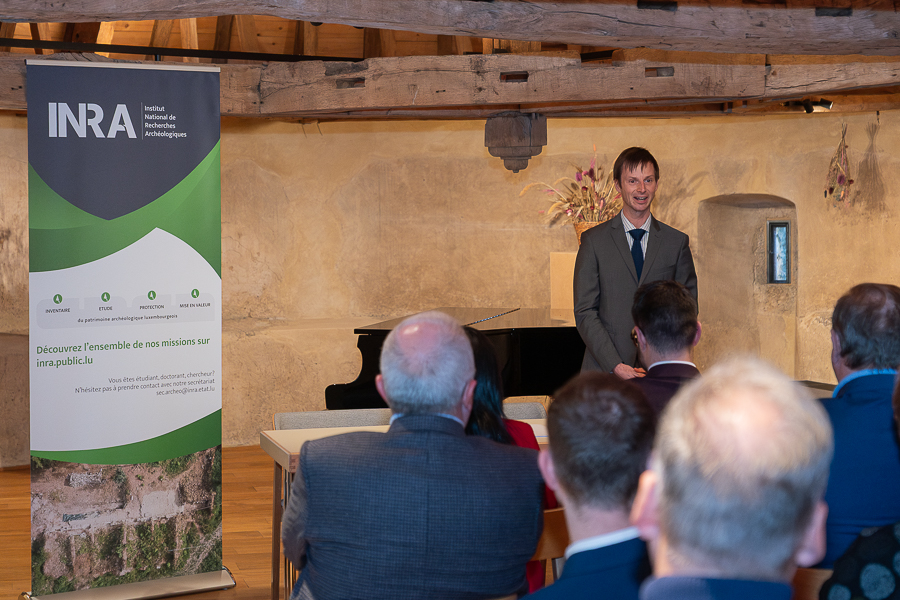
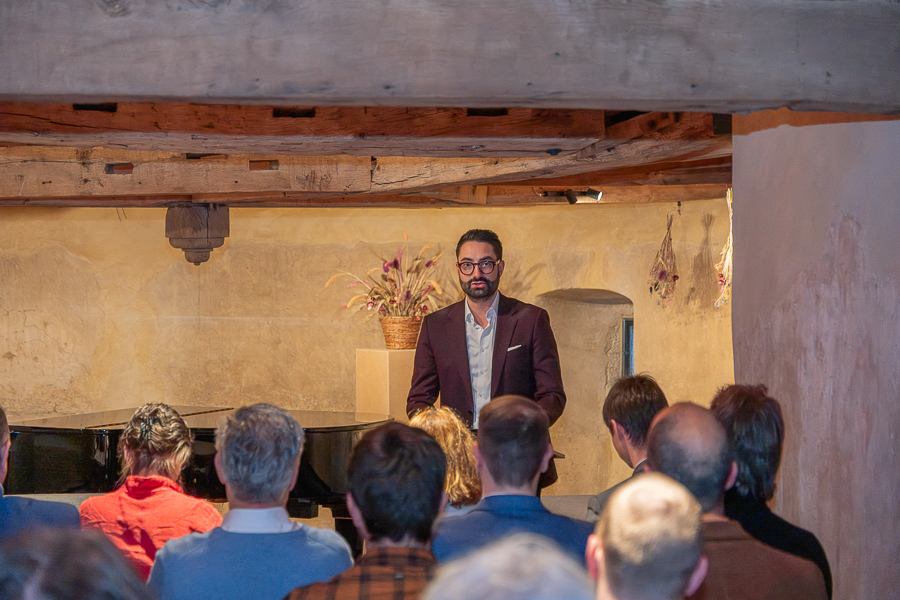
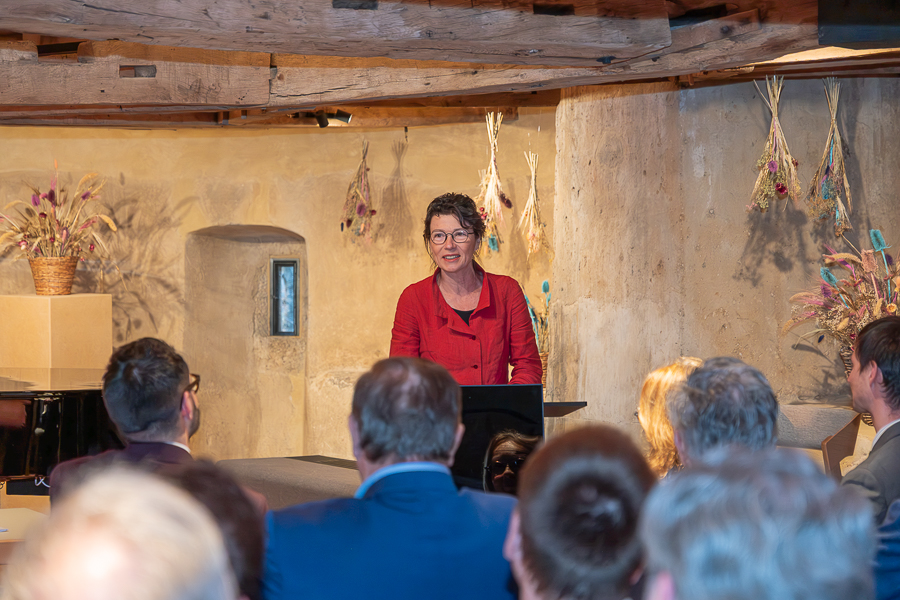
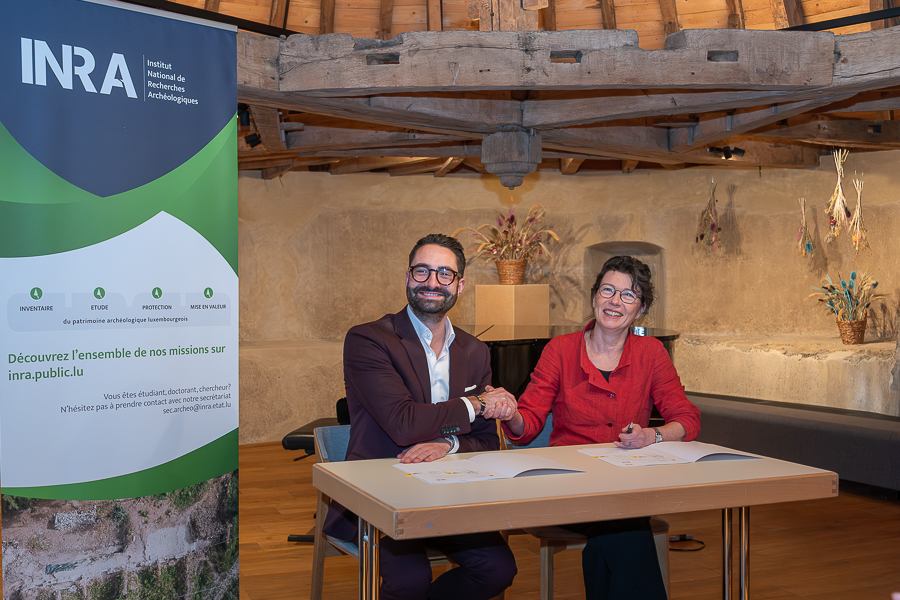
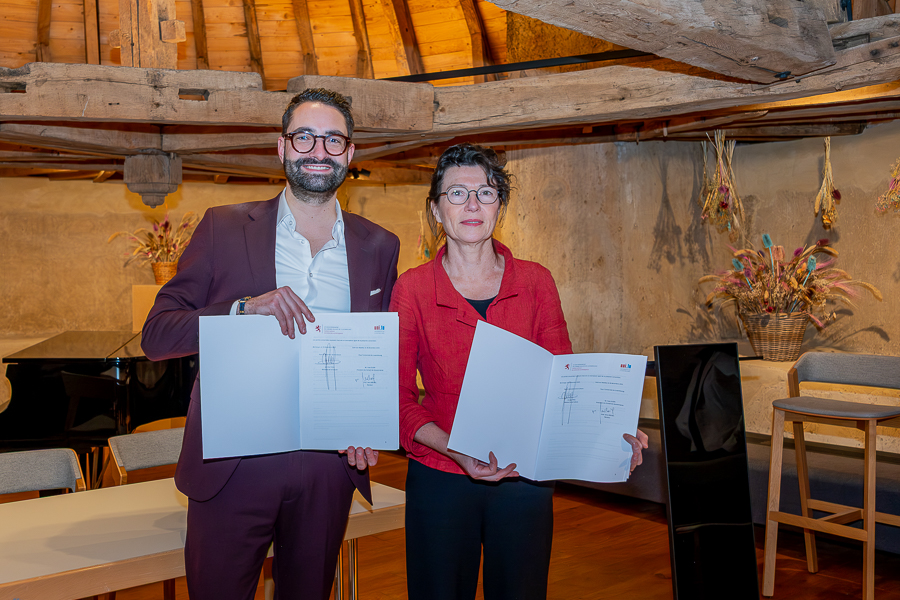
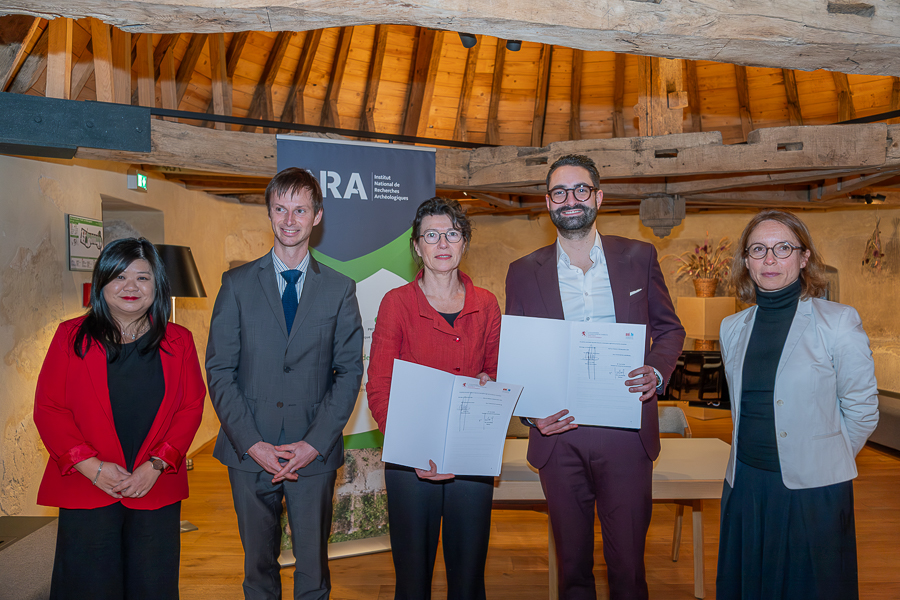


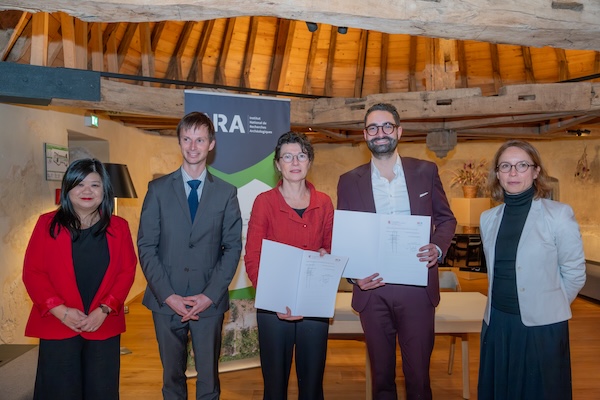
 (L-R): Mei Duong, INRA; David Weis, INRA; Simone P. Niclou, Uni.lu; Minister Eric Thill; Andrea Binsfeld;
Credit: Ali Sahib, Chronicle.lu
(L-R): Mei Duong, INRA; David Weis, INRA; Simone P. Niclou, Uni.lu; Minister Eric Thill; Andrea Binsfeld;
Credit: Ali Sahib, Chronicle.lu
On Thursday 18 December 2025, the Chateau d'Aspelt hosted the signing of a framework agreement between the National Institute of Archaeological Research (INRA) and the University of Luxembourg.
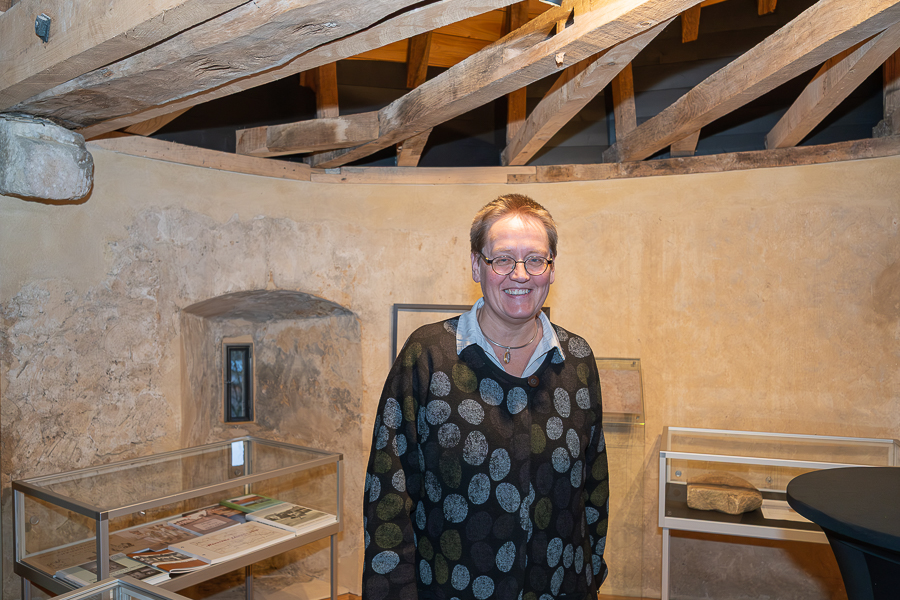
The relevant archaeological digs in Aspelt have uncovered parts of the former castle going back to the medieval period, with the chateau dating back to the 11th century, with the signing ceremony taking place on the 2nd floor of a 16th century tower that had been restored. The building is operated by the municipal offices and is used for weddings and other occasions. In the courtyard, the outline of the former castle walls can still be seen, as can the entrance to the former castle dungeons. Across from the main castle structure is a large building that houses a stage used for theatre productions.
In front of an audience of around 35 people, David Weis, INRA Director, welcomed everyone and explained about the five-year agreement, mentioning the research areas for the INRA from 2026-2030.
After the signature by Eric Thill, Luxembourg's Minister of Culture, and Dr Simone P. Niclou, vice-rector of the University of Luxembourg, both addressed the event.
Welcoming the progress made by INRA since the entry into force of the 2022 law on cultural heritage, Minister Thill emphasised that "the signing of this framework agreement with the University of Luxembourg is part of a dynamic process of consolidating and structuring archaeological research in the Grand Duchy. It provides a favourable environment for the emergence of new scientific approaches and the transmission of knowledge, particularly through the research priorities defined for the period 2026-2030, which constitute a major lever for deepening our understanding of the past and strengthening the link between heritage, research and society."
The first agreement of its kind concluded with a state cultural institute, according to the Ministry of Culture, this collaborative framework constitutes a decisive step for the development of archaeology in Luxembourg, promoting scientific and technical exchanges, developing joint research and analysis projects, and contributing to the training of archaeologists, students and young researchers in Luxembourg.
Minister Thill later commented: "This commitment to research, innovation and the preservation of our heritage is a key pillar in the development of a forward-looking archaeology and will help make our shared past even more tangible and accessible."
Talking with Chronicle.lu afterwards, David Weis explained: "INRA's first research priorities (2026-2030) in Luxembourg - the first framework of its kinds for a cultural institute in the Grand Duchy - are aimed at deepening our understanding of historical transitions, environmental interactions and the impact of human beings on cultural landscapes. We will also focus on the dynamics of land occupation and the influence of climate on human settlements. By leveraging digital technologies, we hope to enhance the efficiency and accuracy of archaeological research and make findings more accessible to the public. Our studies on ancient craft and industrial practices should, moreover, help in understanding the technological and economic development of societies, while better preserving, and presenting heritage sites, making them more accessible to a wider audience. These priorities ensure that our archaeological efforts are comprehensive, forward-looking and deeply rooted in both historical and modern contexts".
He added: "Through multidisciplinary approaches and collaborations with various institutions, including the University of Luxembourg, we aim to preserve our cultural heritage and inform current practices. Our goal is to create a sustainable and accessible archive of archaeological knowledge that benefits both researchers and the general public. This holistic approach ensures that we not only preserve the past but also use it to inform the future. We believe that by integrating advanced technologies and fostering international collaborations, we can achieve a more nuanced understanding of our shared history, which goes beyond romantic imaginations of our past and grounds 'our' story in a clear research framework. This commitment to innovation and preservation is essential for the development of future-proof archaeology in Luxembourg and to make sure archaeology and the study of our past in general matters to wider society".
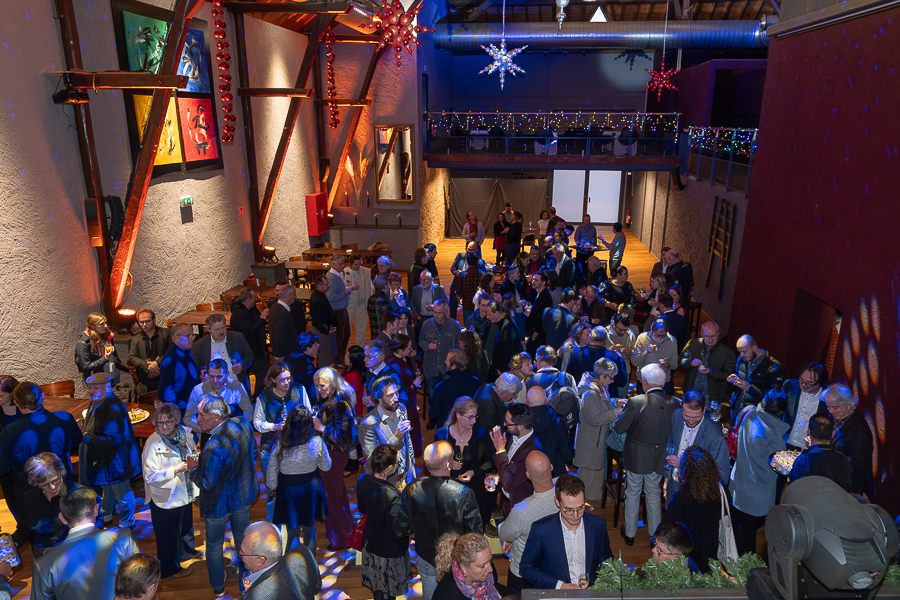
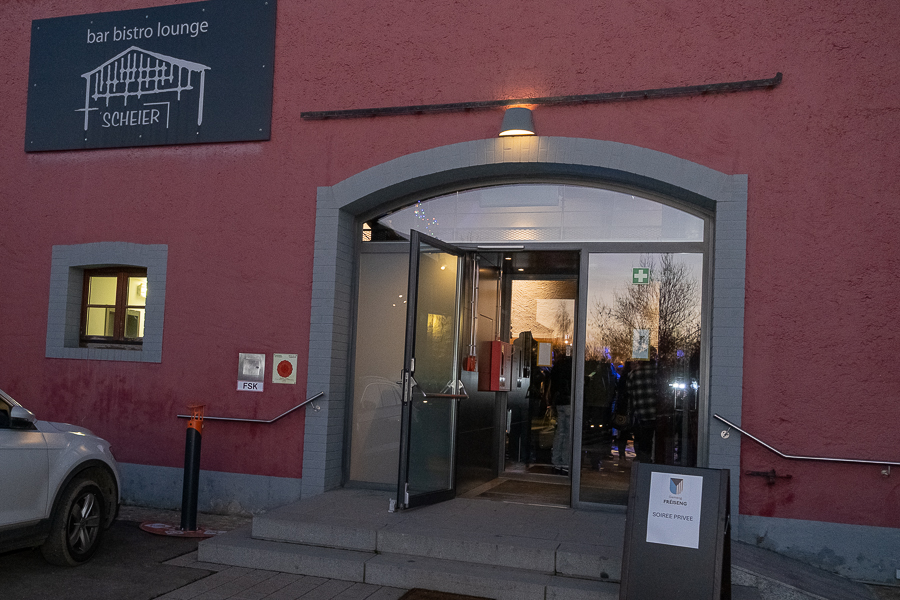
Afterwards, the INRA hosted a festive reception for around 50 people at the nearby restaurant Scheier in Frisange, a building that had been converted from farm buildings.
UPDATED to include Minister Thill's quotes.