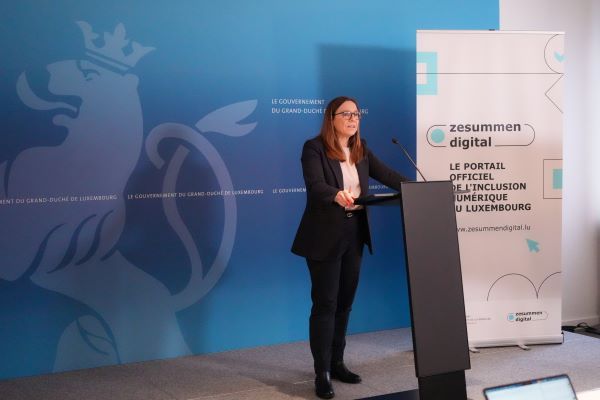
 Stéphanie Obertin, Luxembourg’s Minister for Digitalisation;
Credit: MinDigital
Stéphanie Obertin, Luxembourg’s Minister for Digitalisation;
Credit: MinDigital
On Wednesday 4 February 2026, Luxembourg’s Minister for Digitalisation, Stéphanie Obertin, presented the second National Digital Inclusion Action Plan (2026-2030), adopted by the Government Council (cabinet) on Friday 16 January 2026.
“This new Action Plan, developed in consultation with more than 30 public, private and non-profit stakeholders, consolidates existing measures and aims to better respond to the needs of the most vulnerable groups and to ensure that digital transformation benefits the entire population. We do not want to leave anyone behind,” Minister Obertin stressed.
According to the Ministry of Digitalisation, the new Action Plan revolves around six strategic levers, bringing together 36 sub-objectives and 249 initiatives. It is already being implemented by fourteen ministries.
The six strategic levers focus on:
-
coordinating the National Action Plan;
-
deepening digital skills;
-
strengthening motivation and digital confidence;
-
facilitating access to digital technology;
-
strengthening autonomy through digital tools;
-
keeping non-digital alternatives available.
The ministry noted that it will monitor progress through defined indicators and deliverables. A steering committee, made up of participating ministries and administrations, will oversee implementation and ensure strategic coherence. At the same time, the ministry will coordinate an interministerial working group that will meet regularly to exchange on digital inclusion in Luxembourg. An external specialist will also carry out an independent evaluation, with an interim report at mid-term and a final report after five years.
During her presentation of the National Action Plan, Minister Obertin highlighted several concrete initiatives already underway. These include AccessiLingua, a digital mandate and a mobile local service desk.
Developed through an innovation partnership with the GovTech Lab, AccessiLingua uses artificial intelligence (AI) to transform complex administrative texts into simplified versions in French and German. While the tool speeds up the creation of accessible content, certified “Leichte Sprache” or “Facile à lire et à comprendre” (easy to read and understand) versions still require human validation.
The digital mandate will allow people who struggle with digital tools to appoint a trusted person to carry out online administrative procedures on their behalf.
The mobile local service desk will complement the physical Guichet.lu counter in Luxembourg City. Operating from a bus, it will travel across the country and offer the possibility to complete administrative procedures online via dedicated terminals.