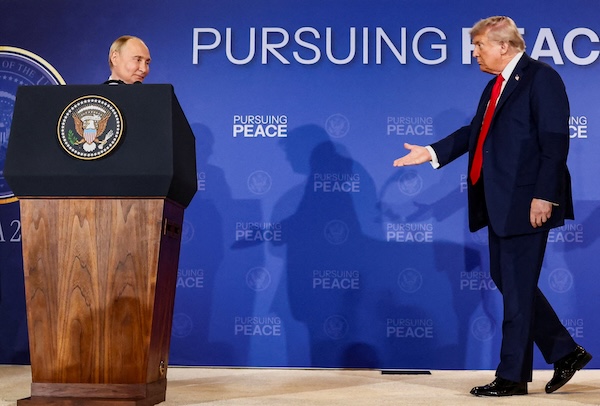
 US President Donald Trump walks towards Russian President Vladimir Putin during a press conference following their meeting to negotiate an end to the war in Ukraine, at Joint Base Elmendorf-Richardson, in Anchorage, Alaska, US, 15 August 2025;
Credit: REUTERS/Kevin Lamarque/ File Photo
US President Donald Trump walks towards Russian President Vladimir Putin during a press conference following their meeting to negotiate an end to the war in Ukraine, at Joint Base Elmendorf-Richardson, in Anchorage, Alaska, US, 15 August 2025;
Credit: REUTERS/Kevin Lamarque/ File Photo
WASHINGTON (Reuters) - US President Donald Trump on Friday 18 September 2026 signed the sweeping Russia sanctions bill into law, the White House said in a statement, paving the way for increased economic pressure on Russia over its invasion of Ukraine.
The legislation targets Russia's energy and defense industries, as well as its "shadow fleet" of tankers that evade existing sanctions, in order to deprive Moscow of funds used to pay for its war with Ukraine.
Critics say the legislation, which also levies tariffs on Russia's biggest trading partners, could herald trouble for other countries as well if they find themselves in Trump's crosshairs in the future because it also authorises the president to impose tariffs that could last well beyond his presidency.
The bill, now called the "Lindsey O. Graham Sanctioning Russia and Iran Act of 2026," to honour the South Carolina Republican who died in July, 2026 passed the House of Representatives on Wednesday 15 September 2026 and the Senate last month. Graham, a longtime Russia hawk, was a staunch backer of the legislation.