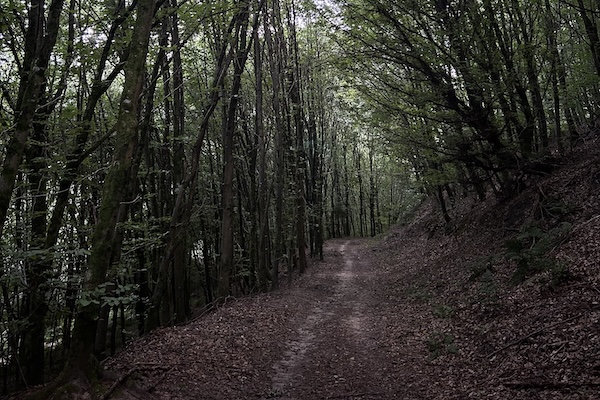
 Credit: Elza Osmane, Chronicle.lu
Having grown up in Latvia in Eastern Europe, where forests cover around half of the country, finding comfort in the wilderness has always felt natural. For the ancient peoples living in the territory of present-day Latvia who practised paganism, forests held both spiritual and practical significance.
Despite being very different from Latvia, Luxembourg also benefits from having roughly one-third of its territory covered by trees, offering similarly easy access to nature.
When I was working as a guide in Lapland, when leading people through the wilderness, even taking into account that tourists had chosen that particular place, I noticed many people being genuinely scared of the forest, of the unknown (to them). Some were afraid of animals, some of the possibility of getting lost, and a large part of the group could not even define the fear, explaining that they had already become too used to "city life". Others simply considered the forest to be a boring place, with not much entertainment or many things to see. Maybe these were simply too used to "screen life" and the digital world to notice the natural world around them...
As mentioned earlier, I have tried to get familiar with forests in different countries, involving diverse climates, fauna, etc. Having now settled in Luxembourg, I wanted to see closer the experiences, which can be found in the forests here. So far, I have always found some form of physical or mental benefit, as well as something new to observe, even in a forest I visit several times a week.
The forest through the seasons
I am a firm believer that any time of year is a good time for a forest visit, as each month and season has something different to offer (except during extremely windy weather, which can pose a danger and cause unnecessary stress). However, early autumn, particularly September and October, may have the most to offer. The landscape turns vibrant autumn colours, while cooler temperatures make walking more comfortable and the damp air brings out the rich scents of the forest.
There is also the possibility of finding mushrooms and late-season blueberries at this time of year, although so far I haven't been lucky enough to spot any edible mushrooms myself this year.
Forest harvests
Luxembourg allows small-scale harvesting for personal, non-commercial use. Berries can be collected freely for personal use, while mushroom picking is limited to 1 kg per person per day. Protected species and areas subject to specific conservation rules must, however, be respected.
Luxembourg has a lively mushroom scene, with groups like the Groupe de Recherche Mycologique (https://www.grm.lu/fr/) and natur&ëmwelt offering resources, guided walks and educational events. Those willing to forage independently must learn to distinguish edible species from toxic ones. The diversity of fungi includes at least 55 edible mushroom species authorised for collection, alongside various edible wild berries and fruits.
Early spring brings the first edible greens and herbs, including wild garlic and young nettles, while May sees more wild plants and blossoms appearing. By June, wild strawberries begin to ripen, followed by raspberries, blueberries and blackberries through July and August, while late summer and autumn bring the richest mushroom season, together with fruits such as elderberries, sloes and rose hips. Wintertime is also not entirely empty: rose hips and sloes can persist after frost, while certain fungi, including oyster mushrooms and velvet shank, may still appear during mild periods.
Forest animals
Wild animals are one of the reasons some people fear forests, although dangerous encounters in Luxembourg are rare. The forests are home to deer, wild boar, foxes, badgers and many smaller animals. Most are naturally afraid of humans, but they may become defensive if surprised, cornered or protecting their offspring. If this happens, it is better not to run, but to stay calm, keep your distance and slowly move away.
At the beginning of August, I spotted the back of a large adult wild boar from afar. Not going to lie, it did make my heart racing for a moment. Fortunately, I managed to turn back and leave without even being noticed.
Animal activity changes throughout the year. Spring and early summer are the time when animals have their young, while autumn can bring more activity due to mating and hunting seasons. Even without seeing an animal, it is possible to find signs of its presence through footprints, droppings, damaged plants or dug-up ground, often left by wild boar. Sometimes, even the smell can give away the presence of an animal nearby.
Health benefits
Overall, with the immersive experience the forest offers, it stands far from boring, in my opinion. Studies comparing time spent in forests with urban environments have found lower cortisol levels, pulse rates (wild boar encounters aside) and blood pressure, as well as increased activity of the parasympathetic nervous system – the body's "rest and digest" response.
When in the forest, without other distractions such as music, podcasts, meditation, keeping a journal or other activities, our senses become more engaged, creating an experience that can feel almost primal.
Japanese forest bathing
Trees and forests have held spiritual significance in different cultures and religions for centuries. In more recent times, another way of connecting with forests has developed centred around wellbeing.
In the 1980s, the term "technostress" emerged to describe stress associated with adapting to and using new technologies. Around the same time, Japan introduced "shinrin-yoku" (translated as forest bathing) through its Forest Agency in 1982. Rather than picking mushrooms or berries, hiking or exercising, the practice is about slowing down and experiencing the forest through the senses - its sounds, smells, sights and textures.
More than four decades later, the idea feels particularly relevant again. As AI has started to blur the lines between what is real and what is artificially created, the forest requires no scrolling and no verification. It simply asks us to pay attention to what is already there.
Perhaps it is also a reminder of our own place in nature. As Michel Leytem, Luxembourg's Nature and Forest Agency Director, noted on the occasion of the 2024 International Day of Forests: "We humans are only one actor among many in the forest."