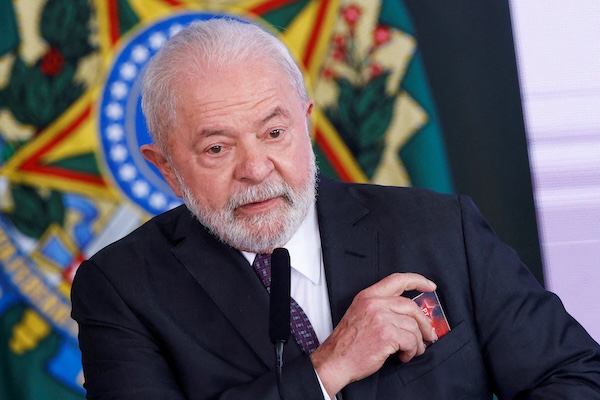
 Brazil's President Luiz Inacio Lula da Silva speaks during a ceremony of social welfare programme "Bolsa Familia" (Family Allowance) at the Planalto Palace in Brasilia, Brazil, 2 March 2023;
Credit: REUTERS/Adriano Machado
Brazil's President Luiz Inacio Lula da Silva speaks during a ceremony of social welfare programme "Bolsa Familia" (Family Allowance) at the Planalto Palace in Brasilia, Brazil, 2 March 2023;
Credit: REUTERS/Adriano Machado
SAO PAULO (Reuters) - On Friday 25 September 2026, Brazil's President Luiz Inacio Lula da Silva announced a ban on online betting operations in Latin America's largest economy and unveiled a new debt relief programme aimed at households, the latest in a series of measures introduced ahead of next month's election.
Opinion polls have shown Lula locked in a tight race with right-wing Senator Flavio Bolsonaro, eldest son of former President Jair Bolsonaro, ahead of the 4 October first-round vote.
The executive order bans online betting operations in Brazil, less than two years after the government kicked off a legal framework allowing the industry to operate. It takes immediate effect but must be approved by Congress within 120 days to remain in force.
The crackdown reflects growing concern within the government that rising spending on gambling has drained household budgets and contributed to record levels of indebtedness. Recent surveys showed roughly three-quarters of Brazilians support a complete ban on online betting.
"We are facing a public health issue involving online betting. It is a serious problem," said Finance Minister Dario Durigan during the announcement.
Durigan said that betting firms' websites will remain available for users to claim remaining funds until 5 October. App stores and network providers will be required to block these websites on 6 October, he added.
Senator Bolsonaro called the measure "populist, hypocritical and politically motivated" during a campaign rally in Rio de Janeiro on Friday.
Online betting was legalized in Brazil in 2018 under former President Michel Temer but remained largely unregulated throughout Jair Bolsonaro's administration. Lula signed legislation in 2023 establishing rules and explicitly authorizing online casino games in addition to sports betting.
Licensed operators have been allowed to offer services nationwide since January 2025 after paying concession fees and meeting regulatory requirements.
Officials have argued that betting losses have fuelled public dissatisfaction with the economy, despite record-low unemployment and relatively subdued inflation in the country.
The Finance Ministry estimates Brazilian households spend around 60 billion reais (€10.16 billion) annually on online betting, generating roughly 10 billion reais (€1.69 billion) in tax revenue.
JPMorgan said listed companies most exposed to Brazil include Evolution, which derives about 9% of sales from the country, Allwyn, whose Betano business contributes 6% to 7% of EBITDA, Entain and Flutter.
ANJL, an association representing the betting sector, said in a statement that the measure would push more than 30 million gamblers into illegal websites, adding it disrespects investments made in compliance with the law.
Debt relief programme
Lula also announced a new initiative aimed at reducing the burden of household debt, only months after relaunching a broad federally backed consumer debt renegotiation programme known as "Desenrola," which was unveiled in 2023.
The government said it will hold an auction in November to buy and restructure household debt, spending 15 billion reais (€2.54 billion) to acquire up to 150 billion reais (€25.41 billion) of delinquent loans at discounts of at least 90%. The programme is expected to cover about half of the debt stock deemed eligible.
Households would then be able to clear overdue obligations at the discounted value, with the full benefit of the write-down passed through to borrowers.
The initiative targets debts that have been overdue for two to 4.5 years, mainly credit card balances and unsecured personal loans. Planning Minister Bruno Moretti said the auction will cover debts of up to 10,000 reais (€1,694).
"This is a better Desenrola than the previous versions," Lula said. "In the earlier Desenrola, people had to approach banks individually. Now the government will purchase the debt and settle it on behalf of borrowers."
The measure had already been flagged by the government last week as part of Lula's election-year economic agenda.