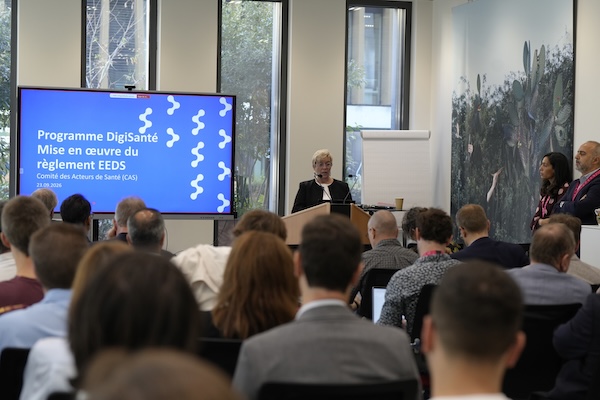
 Martine Deprez, Minister for Health and Social Security;
Credit: M3S
Martine Deprez, Minister for Health and Social Security;
Credit: M3S
On Wednesday 23 September 2026, Luxembourg's Ministry of Health and Social Security officially launched the Health Stakeholder Committee (CAS) as part of the DigiSanté programme.
The new governance body brings together representatives of hospitals, healthcare professionals, sector federations and networks, patient associations, public institutions and regulatory bodies, as well as stakeholders involved in digital health, research, innovation, rehabilitation and care, explained the ministry.
The committee aims to facilitate information sharing, strengthen dialogue on strategic priorities and ensure coordination between stakeholders involved in implementing DigiSanté. It will meet three times a year. Their first meeting focused on the programme, its governance and the committee's role in supporting upcoming work.
DigiSanté comprises 25 projects supporting Luxembourg's implementation of the European Health Data Space (EHDS), which entered into force in March 2025. The European framework aims to enable health data to circulate securely and interoperably for the benefit of patients and healthcare professionals.
According to the ministry, DigiSanté is expected to facilitate health data sharing between EU Member States, improve diagnosis and treatment and support continuity of care. It should also provide healthcare professionals with easier access to relevant data and create further opportunities for research, innovation and health policy.
Implementation will take place progressively, further explained the ministry, adding that the main implementing acts required for the European framework are expected to be adopted in March 2027. From 2029, exchanges of key health data are due to begin, alongside the application of most rules governing the secondary use of health data.
In Luxembourg, this will include the gradual introduction of a new-generation Shared Health Record (Dossier de santé partagé nouvelle génération - DSP-NG), ePrescriptions and eDispensing, as well as the exchange of medical imaging, laboratory data, discharge reports and electronic vaccination data.
Alongside its monitoring role, the CAS will provide expertise and feedback on DigiSanté projects. Its three annual meetings will allow members to follow progress, key milestones and challenges, while communicating practical issues encountered by different parts of the healthcare system.
Depending on individual projects, committee members may also be asked to provide support on specific issues or temporarily join project teams and contribute directly to their implementation.