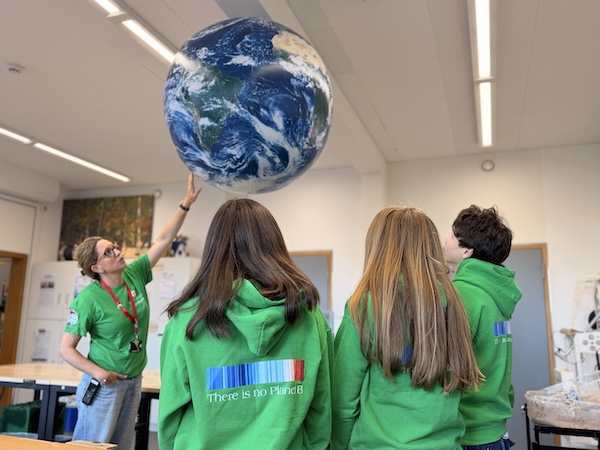
 Credit: St George’s International School
On Tuesday 6 October 2026, St George’s International School in Luxembourg-Hamm announced that its students will work with polar and space organisations this year to explore how lessons from hostile environments can help people use the planet’s finite resources more sustainably.
The school’s new sustainability theme "Ice, Space and Finite Resources" connects Antarctica, spacecraft and Earth through a shared challenge: limited resources. According to the school, in remote and extreme environments, efficient energy use, water recycling, food production and circular design are essential.
St George’s is collaborating with the International Polar Foundation (IPF), which established Princess Elisabeth Antarctica, the world’s first zero-emission polar research station. The school will also work with ESERO Luxembourg, a branch of the European Space Agency, on student workshops and staff training using satellite data to analyse Earth and Antarctica.
Through ESERO’s Climate Detectives programme, students will investigate environmental questions using Earth observation and Copernicus satellite data.
“Working directly with students allows ESERO to demystify complex space science and spark early curiosity about STEM careers,” said Frederic Conrotte, ESERO Luxembourg Manager and Science Communicator. “By connecting students with live EU satellite data, we hope to build vital problem-solving skills and empower young people to become the active environmental stewards and tomorrow’s scientific leaders,” he continued.
The programme will launch on Tuesday 13 October 2026 with a screening of 2050, directed by Eric Goens and Kristof Van Den Bergh. The documentary follows climate scientists living and working at Princess Elisabeth Antarctica and explores the impact of climate change on polar regions and the role humanity can play in shaping the planet’s future.
International Polar Foundation Managing Director Nicolas Van Hoecke and Science Liaison Officer Henri Robert will share insights into the work at Princess Elisabeth Antarctica and plans for the new Andromeda Earth Observatory. The proposed facility will combine science, technology and sustainability, including renewable energy and closed-loop approaches to water, energy and waste.
Throughout the year, students will design sustainable solutions for researchers living with limited resources in Antarctica and consider how their ideas could be adapted for future exploration of the Moon, Mars or deep space.
The screening of 2050 will be open to the public and take place at St George’s International School premises from 17:30 on Tuesday 13 October 2026, followed by a networking reception from 20:00. Prior registration is required.