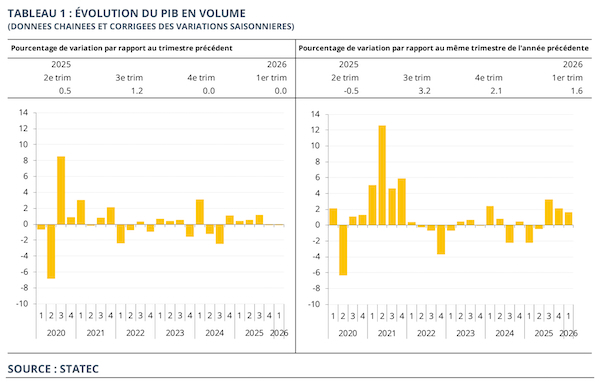
 GDP changes in volume (chained and corrected data of seasonal variations);
Credit: STATEC
GDP changes in volume (chained and corrected data of seasonal variations);
Credit: STATEC
According to STATEC, Luxembourg’s national statistical office, real Gross Domestic Product (GDP) grew by 0.0% in the first quarter of 2026 compared to the previous quarter and by 1.6% compared to the same period in 2025.
STATEC also revised annual real GDP developments for previous quarters as follows: +2.1% instead of +2.4% for the fourth quarter of 2025, the third quarter remains unchanged at +3.2%, and the second quarter is -0.5% instead of -0.6%.
STATEC noted that the quarterly series of GDP and the main aggregates are adjusted for seasonal variations.
GDP according to the "Production" approach
According to STATEC, in the first quarter of 2026, the added value of the entire economy decreased by 0.3% over a quarter. This decline in activity at the beginning of the year is the result of contrasting movements in the different branches. The most negative contributions come from the manufacturing industry and financial and insurance activities. Conversely, transport and storage, public administration, education and construction have contributed positively to the evolution of the added value of the global economy.
GDP according to the "Expenditure" approach
For the expenditure approach, STATEC reported that the situation is also contrasting. Investment (gross fixed capital formation) and final consumption expenditure of general government contributed positively to gross domestic product (GDP). This increase in investment stems mainly from an increased volume of expenditure on non-residential construction projects and the acquisition of metal products and machinery.
Conversely, STATEC said the final consumption expenditure of households and the external balance fell compared to the fourth quarter of 2025. In particular, households consumed fewer health and catering services, and made fewer purchases related to the car (both in terms of vehicles and maintenance and repair services). Exports (both exports of goods and exports of services) fell more sharply than imports.