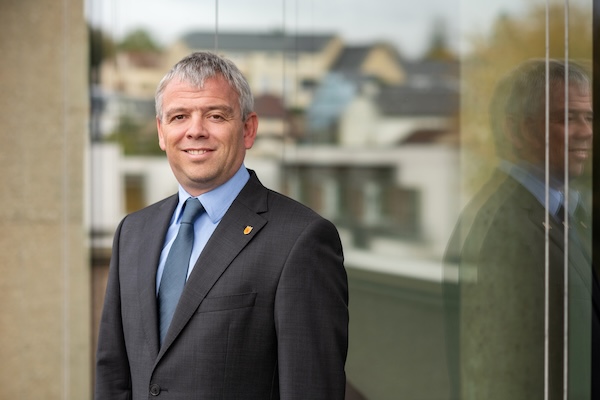
 Steve Reckel, Mayor of Mondorf-les-Bains;
Credit: Municipality of Mondorf-les-Bains
Steve Reckel, Mayor of Mondorf-les-Bains;
Credit: Municipality of Mondorf-les-Bains
The Grand Duchy of Luxembourg consists of twelve cantons made up of 100 municipalities. Each municipal council is elected directly by its residents in municipal elections held every six years. The municipality’s mayor is then appointed from among the elected members of the municipal council.
In this series, Chronicle.lu spoke to a selection of the country’s mayors to discuss the challenges within their municipality, their daily activities, how projects are prioritised and how they communicate with residents.
The third in this series features Mayor Steve Reckel who represents the municipality of Mondorf-les-Bains.
Chronicle.lu: What is the size of your municipality, in population and number of nationalities?
Steve Reckel: The municipality of Mondorf-les-Bains comprises three villages, Mondorf-les-Bains, Altwies and Ellange, and has a population of 5,569 residents representing 91 different nationalities.
Chronicle.lu: What are the main challenges currently facing the municipality (housing, mobility, infrastructure, environment, demographic growth, etc.) and how is the administration working to address them?
Steve Reckel: Mondorf-les-Bains is currently undergoing a significant transition phase, marked by major projects such as the renovation and expansion of the Mondorf Domaine Thermal, the construction of a velodrome with an integrated sports complex and indoor swimming pool, and the development of a new international school.
These initiatives will create new momentum and increase the municipality’s attractiveness, inevitably drawing more residents to the area. This growth will place additional pressure on the housing market. Our key challenge is therefore to manage this development in a balanced and sustainable way, ensuring that Mondorf-les-Bains retains its appeal while preserving its natural environment and quality of life.
Chronicle.lu: Please describe the daily activities undertaken by you, as mayor of the municipality of Mondorf-les-Bains and how you work in conjunction with the other members of your administration.
Steve Reckel: As mayor, my priority is to remain close to our residents and to continuously work towards maintaining and enhancing the attractiveness of our municipality. Mondorf-les-Bains prides itself on offering an exceptional quality of life, with abundant green spaces, forests, a renowned thermal park, and a strong wellness, medical, leisure and cultural offering.
Managing an administration of our size, 169 employees, including the music school and nursery, can be demanding. I place great importance on regular communication and open dialogue with our staff, ensuring that everyone’s perspective is heard. While I strive to be present and accessible on an almost daily basis, time constraints remain a constant challenge.
Chronicle.lu: Please describe the challenges of being mayor of Mondorf-les-Bains and what makes your municipality unique in Luxembourg.
Steve Reckel: The uniqueness of Mondorf is above all that we are the only city in the country which has a thermal spa and a casino.
Chronicle.lu: As mayor, how do you select and prioritise which projects the municipality will undertake?
Steve Reckel: Although I ultimately have the final responsibility, project selection and prioritisation are very much a collaborative process. Decisions are made through close cooperation between the municipal council and the administration, ensuring that projects reflect both strategic priorities and the needs of our residents.
Chronicle.lu: What are the key projects, developments and upcoming events that will shape life in Mondorf-les-Bains over the coming months and years?
Steve Reckel: Major ongoing and upcoming projects, including the construction of the velodrome with its sports complex and indoor swimming pool, the new international school, and the expansion of the thermal facilities, will significantly enhance our infrastructure and services. These developments will strengthen both our local appeal and our international reputation.
Chronicle.lu: How does the municipality communicate with residents and encourage them to become involved in local life and decision-making? Do you use English in such communications?
Steve Reckel: Our communication strategy is broad and multi-channel, including a municipal newsletter, a trilingual website, a mobile app with push notifications, social media platforms and digital information screens.
Beyond one-way communication, we actively involve residents in municipal life by organising public presentations and encouraging participation in local projects. English is used alongside other languages to ensure inclusivity and accessibility for our international community.
Chronicle.lu: Please describe any initiatives / projects the municipality has in place to strengthen community relations, integration and volunteering.
Steve Reckel: We offer a range of initiatives aimed at strengthening social cohesion and community engagement. Dedicated services support elderly residents through tailored activities and assistance.
For younger people, the supervised “Jugendstuff” provides a welcoming space for those aged ten to 30 to meet, exchange and participate in activities.
In addition, advisory commissions, such as the Commission for Social Cohesion and Equal Opportunities and the Commission for Intercultural Living Together, play an important role in fostering inclusion, integration, and active civic participation.