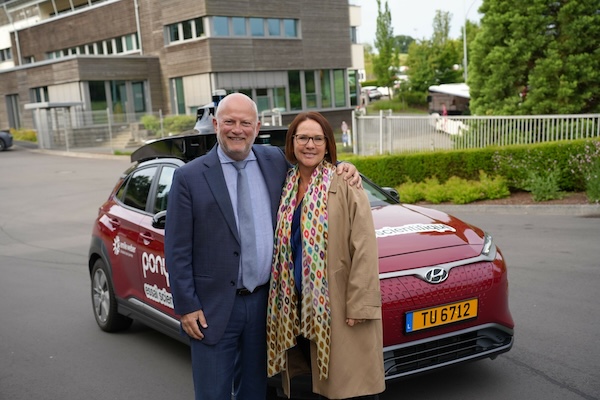
 Jean-Luc Crucke, Belgium's Minister for Mobility, Climate and Environmental Transition; Yuriko Backes, Luxembourg's Minister for Mobility and Public Works;
Credit: MMTP
Jean-Luc Crucke, Belgium's Minister for Mobility, Climate and Environmental Transition; Yuriko Backes, Luxembourg's Minister for Mobility and Public Works;
Credit: MMTP
On Monday 8 June 2026, Luxembourg's Minister for Mobility and Public Works, Yuriko Backes, and Belgium's Minister for Mobility, Climate and Environmental Transition, Jean-Luc Crucke, took part in a demonstration of automated driving technology at the premises of Voyages Emile Weber in Canach.
According to Luxembourg's Ministry for Mobility and Public Works, the two ministers, accompanied by Lucie Hoffmann, General Manager of Pony.ai Europe, travelled in automated vehicles developed by Pony.ai during a demonstration on public roads in Luxembourg, where the models are currently undergoing authorised scientific trials. The visit formed part of efforts to anticipate technological developments and harmonise regulatory frameworks at European level.
Luxembourg currently authorises scientific trials of automated vehicles under real-world conditions, reinforcing its role as a European testing ground for emerging mobility technologies. These pilot projects represent an important step towards safer, more efficient and better-integrated mobility systems. Through this initiative, Luxembourg aims to establish itself as a leading European hub for automated mobility, supported by an appropriate regulatory framework, strong public-private partnerships and a growing innovation ecosystem.
During the visit, Minister Backes presented the main elements of the "Automatiséiert Fueren 2028" strategy, unveiled in October 2025. Built around six key pillars, the strategy forms part of Luxembourg's broader objectives of economic diversification and attractiveness. It seeks to develop a dynamic ecosystem around intelligent mobility while ensuring the ethical and harmonious integration of automated technologies into society. Automated vehicles will be integrated into Luxembourg's multimodal transport system alongside existing modes of transport.
On the sidelines of the Transport Council meeting on Monday, Minister Backes also signed a joint declaration of intent as part of a European Commission initiative bringing together seventeen EU member states - Austria, Belgium, Croatia, Cyprus, the Czech Republic, Estonia, Finland, France, Germany, Greece, Hungary, Ireland, Italy, Luxembourg, the Netherlands, Poland and Sweden - to develop large-scale cross-border testing facilities for automated vehicles.
The initiative builds on earlier cooperation between Luxembourg, France and Germany, which launched a cross-border testing area for automated driving in 2017.
Originating from the European Automotive Action Plan, the initiative marks a significant step from experimentation towards the practical deployment of automated driving in Europe. It aims to harmonise approval, safety and operational rules in order to facilitate the integration of automated vehicles within the European market.
Aligned with the national "Automatiséiert Fueren 2028" strategy, the initiative further strengthens Luxembourg's position as a platform for innovation, testing and deployment of automated mobility solutions at European level.
For Minister Backes, "The signing of this declaration illustrates Luxembourg's commitment to more innovative, safe and sustainable mobility. By building on close cooperation with our European partners, we are taking a decisive step towards the gradual deployment of automated driving across Europe."
By supporting practical use cases, particularly in passenger transport and logistics, and by bringing together public and private stakeholders, the initiative is expected to enhance European competitiveness, improve road safety and contribute to the development of more accessible and sustainable mobility solutions.