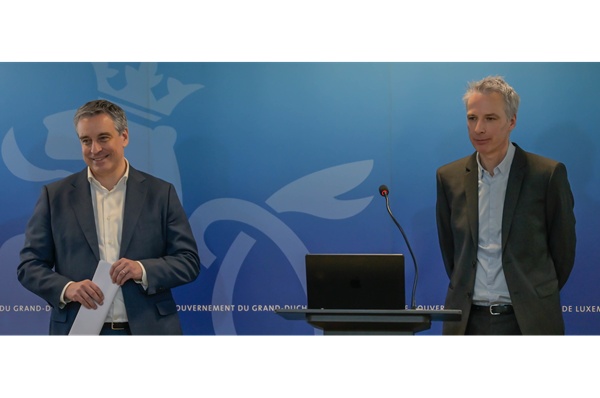
 (L-R) Claude Meisch, Luxembourg's Minister of Education, Children and Youth; Luc Weis, Director of SCRIPT;
Credit: MENJE
(L-R) Claude Meisch, Luxembourg's Minister of Education, Children and Youth; Luc Weis, Director of SCRIPT;
Credit: MENJE
On Friday 6 February 2026, Luxembourg's Minister of Education, Children and Youth, Claude Meisch, and the Director of the ministry's Department for the Coordination of Educational and Technological Research and Innovation (SCRIPT), Luc Weis, presented the new curriculum for primary education, which will be phased in starting with the 2026/2027 school year.
Luxembourg's Ministry of Education, Children and Youth noted that the curriculum defines the learning objectives and core competencies that students must achieve by the end of each learning cycle. The last comprehensive overhaul of the curriculum dates back to 2011. Since then, according to the ministry, educational and societal realities have profoundly changed: digital transformations, well-being issues, multilingualism and new expectations regarding citizenship and participation. The new curriculum aims to address these changes while providing teachers with a more accessible tool that better reflects their daily practices.
"With the new curriculum, we are modernising the framework of primary education without altering its fundamental principles. We are clarifying the educational mission of schools, strengthening the interdisciplinary nature of learning, and giving teachers a more accessible tool that better reflects their daily practices. This is a well-considered evolution, developed in collaboration with stakeholders in the field, to better prepare students for the realities of today's and tomorrow's world," stated Minister Meisch.
The new curriculum is intended to maintain continuity, retaining the disciplines (areas of development and learning), the core and advanced levels, assessment principles and timetables. The reform primarily aims to clarify the educational mission of schools. The curriculum is designed to guide, structure and equip teachers' daily paedagogical practice and to better support them in their mission.
One of the main innovations is reported as the explicit integration within the curriculum of seven cross-curricular themes linked to major societal issues for students in cycles 2 to 4:
- physical, mental and socio-emotional health (well-being, resilience, accident prevention, road safety);
- sexual and relationship education;
- sustainable development, the environment and responsible consumption;
- media, digital technology and artificial intelligence;
- economics, finance and lifestyle choices (finance, career guidance, professions);
- culture, arts and heritage;
- democratic citizenship and human rights.
These themes, already present in school practices, are now clearly defined and addressed more systematically. They are not the subject of a specific discipline, but are explored within activities linked to several areas of development and learning. 36 lessons are dedicated to these cross-curricular themes.
The new curriculum is accompanied by the digital platform plandetudes.lu. Starting in September 2026, a public version will be available in four languages, aimed at enhancing transparency and understanding of educational objectives. It will also offer a dedicated space for teachers, with concrete examples, teaching illustrations and educational resources developed by SCRIPT. Additional digital tools will be progressively added to the platform.
The ministry explained that the curriculum reform is based on an "unprecedented" consultation process, conducted between 2021 and 2025. Nearly 1,200 stakeholders from the education system and civil society (teachers, students, parents, unions, etc.) were involved, and more than 6,000 contributions were analysed. The main guidelines were defined in a White Paper published in 2023 and incorporated into the 2023-2028 government programme.
The new curriculum for cycles 1 and 2 will come into effect at the start of the 2026/2027 school year. Cycles 3 and 4 will follow at the start of the 2027/2028 school year. To support teaching staff, sixteen information sessions will be held across the country from February to June 2026.
According to the ministry, the work undertaken in primary education is part of a broader initiative. A White Paper process for secondary education was launched in January 2026 to pursue, in a participatory and coherent manner, the modernisation of Luxembourg's school curricula.