On Tuesday 14 April 2026, Luxembourg’s Minister of Education, Children and Youth, Claude Meisch, and the Minister of Mobility and Public Works, Yuriko Backes, informed members of parliament about the progress of preparatory work for a new sectoral plan for secondary schools looking ahead to 2050.
They also presented a new joint acceleration plan from the Ministry of Education, Children and Youth and the Ministry of Mobility and Public Works to support the development of new school infrastructure during a joint parliamentary committee meeting bringing together committees on education, mobility and housing.
The ministers recalled that investment in education and infrastructure for children and young people ranks among national priorities, in line with the 2023 to 2028 government programme. According to them, in view of sustained population growth, Luxembourg must anticipate future school needs today to continue to ensure equal access to quality education in every region of the country.
The ministries noted that the sectoral plan for secondary schools remains a key strategic tool in this context to anticipate infrastructure needs in secondary education and to ensure long-term planning.
Based on demographic projections from Luxembourg's national statistics institute Statec, the new plan will aim to anticipate the development of the school population by 2050 and respond to the need to increase capacity in secondary education. From an equal opportunities perspective, it will also aim to ensure accessible education in all regions of the country, so that every pupil can follow their chosen path without having to travel long distances, noted the ministries.
Furthermore, the ministries said that this territorial planning aims to improve mobility organisation by locating schools in line with existing transport networks and promoting more sustainable solutions. It will also enable the early reservation of the necessary land, in cooperation with the municipalities concerned, to ensure the feasibility of future projects.
As part of the work on the sectoral plan, Minister Meisch specified that the phase of identifying potential sites has begun, after which environmental assessments will be launched. Once completed, the formal procedure for the sectoral plan can begin. Its entry into force is planned for 2028.
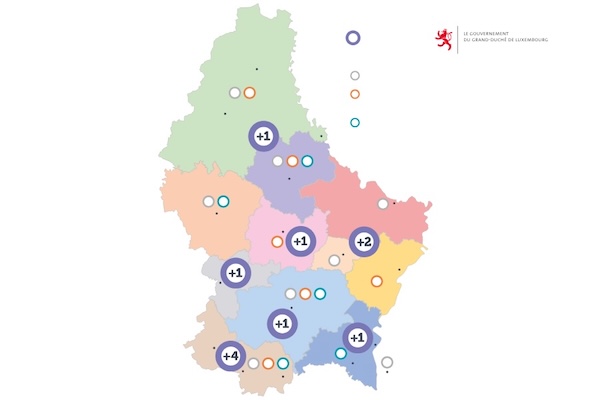
According to Statec, the creation of eleven new secondary schools nationwide is planned to respond to demographic growth and avoid a shortage of places.
These new secondary schools will be distributed evenly across the country’s regions, with one planned in Eisléck, one in Agglo-Centre, four in the South, two across the Jonglenster, Mëllerdall and northern Moselle areas, one in Mersch and surrounding areas, one in the southern Moselle region and one in the Steinfort area.
According to the ministries, alongside this long-term planning, short- and medium-term investments will address immediate capacity needs in secondary education through coordinated efforts between the Ministry of Education, Children and Youth and the Ministry of Mobility and Public Works. In the short term, temporary modular structures will increase available places, while in the medium term, new construction and extension projects will expand capacity. In total, seventeen projects are planned.
The total estimated cost of all current projects, including those under the acceleration plan, which will create approximately 500,000 m² of new space, is currently around €3.1 billion. The ministry commented that the cost of projects still in the planning phase has not yet been defined. Several projects will use alternative financing and delivery methods to meet the objectives set out in the coalition agreement.
During the committee meeting, it was recalled that the construction of public infrastructure, including secondary schools, falls under the responsibility of the Public Buildings Administration, under the supervision of the Ministry of Mobility and Public Works. In line with the coalition agreement, the Ministry of Education, Children and Youth will have greater autonomy in managing smaller-scale projects such as maintenance, conversions and renovations.
All these new infrastructures will meet clearly defined standards and will later be integrated into the assets of the Public Buildings Administration, noted the ministries.
Currently, the property portfolio allocated to the Ministry of Education, Children and Youth for secondary schools, managed by the Public Buildings Administration, includes schools across 65 sites, with a total gross floor area of approximately 1,220,000 m².
The ministries highlighted that over the past five years, nineteen projects relating to this portfolio have been completed, representing a total investment of €663,630,000. Among these, eleven projects created new space, providing nearly 170,000 m² of additional gross area, representing an increase of around 16% over the period. In addition, twelve sites were equipped with modular constructions during the same period.