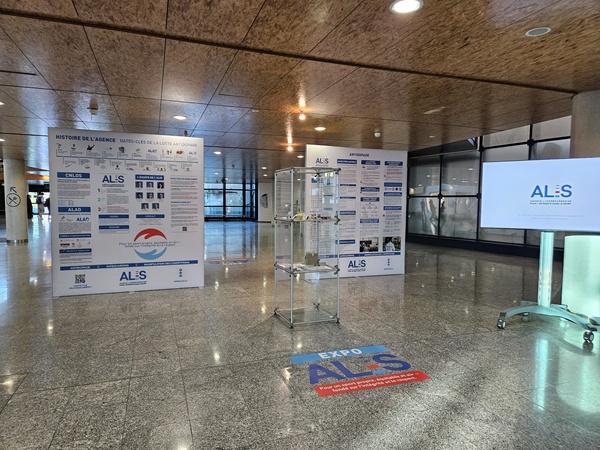
 ALIS exhibition at Coque, Luxembourg-Kirchberg;
Credit: Jazmin Campbell, Chronicle.lu
ALIS exhibition at Coque, Luxembourg-Kirchberg;
Credit: Jazmin Campbell, Chronicle.lu
The official launch ceremony of the Luxembourg Agency for Integrity in Sport (Agence Luxembourgeoise pour l'Intégrité dans le Sport - ALIS) took place on Wednesday 1 April 2026 at the Coque national sports and cultural centre in Luxembourg-Kirchberg.
Previously known as the Luxembourg Anti-Doping Agency (Agence Luxembourgeoise Antidopage - ALAD), the newly rebranded ALIS has an expanded mandate covering not only anti-doping but also safeguarding in sport and the fight against competition manipulation.
ALIS Board Vice-President Marie-Paule Hoffmann delivered the welcome address, after which Luxembourg's Minister of Sport, Martine Hansen, underlined the government's ambition to promote "clean, safe, fair and transparent sport". She thanked all those involved in the agency's work and wished ALIS success in its expanded role, noting that the new framework provides greater clarity for ensuring integrity in sport.
ALIS Director Loïc Hoscheit explained that the transformation had been in preparation for two years. Presenting the agency’s new identity, including an updated logo and website, he emphasised continuity in its core values of rigour, transparency and integrity. The new website also includes tools for reporting concerns confidentially and anonymously, reflecting the agency’s aim to be transparent and open.
ALIS will operate across three main missions.
The first is the fight against doping, structured around five key pillars: education, testing and controls, therapeutic use exemptions (TUEs), results management and investigations. Loïc Hoscheit noted that the anti-doping landscape is becoming increasingly complex, citing issues such as governance, "judicialisation", contamination cases and the upcoming "Enhanced Games". He also highlighted preparations for the new World Anti-Doping Code, due to come into force in January 2027, as well as the importance of international cooperation and public health considerations, also looking ahead to the 2029 Games of the Small States of Europe.
The agency's second mission focuses on safeguarding in sport, particularly the prevention of abuse and violence. ALIS identified four forms of interpersonal violence: physical, psychological, sexual and neglect. The agency stressed that safeguarding is essential not only to protect athletes’ physical and mental well-being, but also to maintain trust, participation and the reputation of sports organisations.
Recent findings indicate that safeguarding remains a challenge in Luxembourg. According to an ALAD/OKAJU study on the safety of children and young people in sport, only 28.6% of national federations had a protection policy in place. ALIS aims to improve this significantly through education and awareness-raising, reacting to claims of abuse (encouraging everyone to report incidents of violence), supporting victims, and drawing up reports and recommendations.
The third mission addresses the manipulation of sports competitions, including match-fixing, spot-fixing and points shaving. While Luxembourg may be less exposed due to its size, the ALIS director emphasised that such risks are part of a global and increasingly sophisticated ecosystem, particularly linked to illegal betting markets. According to the agency, illegal sports betting represents a vast global market, estimated at around $170 billion, and poses significant risks related to corruption and manipulation. New trends such as prop bets, micro-betting, cryptocurrency-based betting, betting exchanges, esports betting, gamification and prediction markets further complicate the landscape. Loïc Hoscheit highlighted the need for coordinated action at both national and international levels, involving regulators, law enforcement, sports organisations and international bodies.
He also outlined ALIS's priorities, including strengthening regulations, expanding education efforts, increasing transparency, monitoring advertising, enforcing sanctions and supporting at-risk athletes, alongside continued international cooperation.
He thanked his team and partners, welcoming the support of the "entire sports movement". ALIS currently has a team of eight staff members and is based in Strassen.
The official presentation, held in the Coque amphitheatre, brought together sports sector professionals and journalists, who were also invited to view an exhibition retracing the agency's development over the years.
The evening concluded with a reception for attendees.