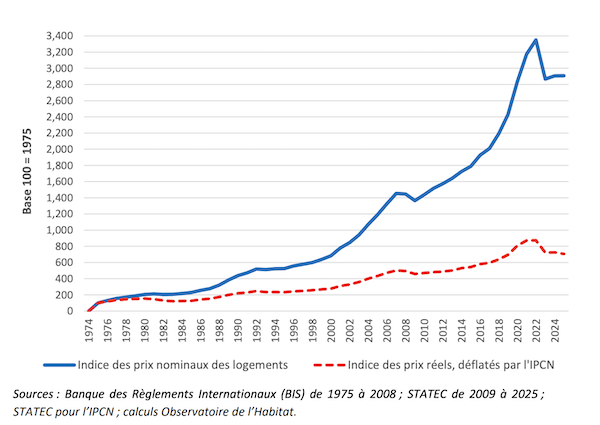
 Residential property price index over the long term (1975-2025);
Credit: BIS/STATEC
Residential property price index over the long term (1975-2025);
Credit: BIS/STATEC
On Friday 17 April 2025, Luxembourg’s Housing Observatory (Observatoire de l’habitat), under the supervision of the Ministry of Housing and Spatial Planning, has published three analytical reports (Nos. 21, 22 and 23) as part of ongoing work to support the reform of rental law, particularly regarding the regulation of residential rents.
Analytical Report No. 21 focused on updating the method for calculating “invested capital”, a key component used to determine the legal rent ceiling, currently set at 5% of the revalued capital. While this mechanism remains a cornerstone of rent regulation, the report highlighted structural limitations in its application. In particular, current coefficients tend to underestimate the value of properties acquired long ago, resulting in significant disparities between comparable dwellings and limiting the effectiveness of rent caps.
The analysis was based on a harmonised series of residential property prices covering the period 1974 to 2025. It highlighted a significant long-term increase in prices, which have risen more than 29-fold in nominal terms, alongside increased volatility, particularly following the market downturn that began in 2022 amid rising interest rates.
The report explored alternative methods for revaluing invested capital, including approaches adjusted for inflation and incorporating smoothing mechanisms. Simulations suggested that limiting annual variations to ±7% could provide a balanced solution, improving alignment between theoretical and market rents while reducing short-term fluctuations.
Analytical Report No. 22 presented the results of an expert consultation conducted between July and November 2025 using the Delphi method. The study identified areas of consensus and divergence regarding the objectives and implementation of rent caps. Experts expressed strong or moderate agreement on around 60% of the 81 statements evaluated.
According to the report, a three-step approach to reform could be considered. In the short term, measures such as improving access to information and strengthening controls could be prioritised. In a second phase, housing characteristics such as size, quality and energy performance could be incorporated into modelling work. More contentious issues, including the role of invested capital as a criterion for rent caps, are likely to require political decisions.
Analytical Report No. 23 outlined the design and initial results of a large-scale “rent cadastre” survey conducted by the Luxembourg Institute of Socio-Economic Research. The survey targeted 30,000 multi-property owners identified using pseudonymised data provided by the Administration du cadastre et de la topographie.
The objective of the survey was to better understand rent levels across different areas and housing types, based on criteria such as size, age, equipment and location. Respondents were asked to provide information on their properties, rental conditions and rent levels.
Despite the sensitive nature of the topic, the response rate was considered satisfactory. Respondents were predominantly men aged 55 and over, of Luxembourg nationality and residing in the country. The results will be analysed further in a series of reports to be published in 2026 and presented at a seminar on the rental housing market scheduled for 9 June 2026.
Together, the three reports aimed to provide a stronger empirical basis for adapting Luxembourg’s rental framework to current housing market conditions.
The full reports (in French) are available on logement.lu: Analytical Report No. 21, Analytical Report No. 22 and Analytical Report No. 23.