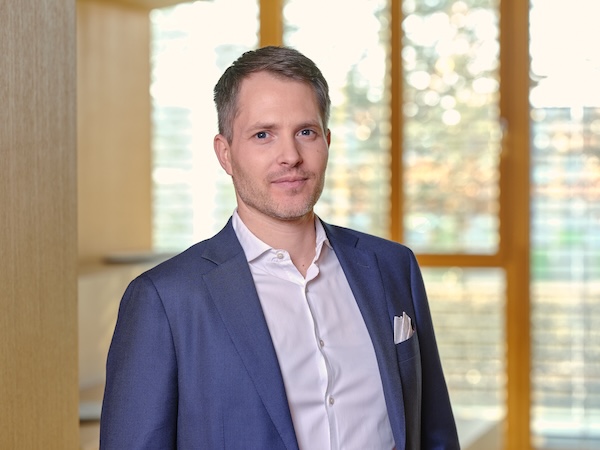
 Björn Ebert, Financial Services Leader of PwC Luxembourg;
Credit: PwC
On Thursday 22 October 2026, PwC Luxembourg highlighted growing pressure on the asset management industry, as shrinking profit margins, rising infrastructure costs and outdated technology systems pose increasing challenges for firms, according to its latest global report.
According to PwC's global report, “Asset Management Infrastructure: Rethinking the Industry's Piping”, profit per unit of assets under management (AuM) has fallen by 19% since 2018 and is projected to decline by a further 9.1% by 2030. The findings are based on a survey of 150 asset managers and 50 infrastructure providers worldwide.
The report examines how firms can modernise their technology and data systems while managing costs and regulatory requirements globally and in Luxembourg.
Björn Ebert, Financial Services Leader at PwC Luxembourg, highlighted the growing influence of infrastructure providers. "Seven in ten infrastructure providers expect to take a bigger slice of the pie, which tells you where the power in this industry is quietly shifting," he said.
The global survey found that 67% of asset managers reported that fee compression was affecting their ability to invest in infrastructure upgrades. Only 23% allocated most of their technology budgets to developing new capabilities, while 29% spent more than 70% on maintaining existing systems.
Artificial intelligence (AI), reportedly, is another area of concern. Data fragmentation was identified by 24% of respondents as the biggest barrier to scaling AI, while 17% cited legacy systems and processes. Nevertheless, 67% considered AI and machine learning infrastructure a technology investment priority.
Market data was also identified as a major expense, with 58% of asset managers ranking it among the most costly infrastructure components relative to the value delivered. Regulatory compliance and reporting systems followed at 47%, while 46% cited core technology platforms.
"Infrastructure has quietly become one of the most consequential strategic decisions an asset manager makes. The firms that pull ahead won't be those that own the most technology, but those that decide deliberately what to build, what to buy, and where a partner can do it better," said Peter Pollini, Financial Services Industry Leader at PwC United States (US).
The findings also point to a changing relationship between asset managers and external service providers, an issue relevant to Luxembourg's fund servicing industry.
Globally, 70% of infrastructure providers expect to capture a larger share of asset management revenues over the next five years. Among emerging competitors, 68% identified hyperscale cloud providers as a credible threat, followed by AI-focused data and analytics platforms at 54%.
Asset managers are increasingly considering a combination of internal and external services. Hybrid infrastructure models were preferred by 44% of respondents, compared with 21% favouring the purchase of capabilities, 18% opting for partnerships and 13% preferring in-house development.
"The industry's profits per dollar managed have fallen by almost a fifth, and the bill for the pipes keeps rising," said Roland Kastoun, Global Asset and Wealth Management Advisory Leader at PwC US. "The managers who survive the next five years won't be the ones with the flashiest AI but rather the ones who fixed the so-called boring stuff first," he continued.
PwC identified four emerging infrastructure models: infrastructure orchestrators; digital and tokenisation platforms; specialist modular providers; and integrated asset managers.
The report also found that 19% of asset managers aspire to become infrastructure builders by 2030, potentially offering their own technology platforms to other firms. Meanwhile, 34% of infrastructure providers view this development as a credible competitive threat.
The full report is available on the PwC Luxembourg website.