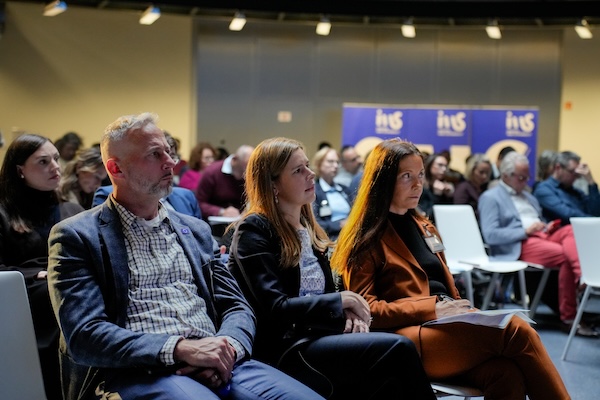
 Dennis Wernerus, European Commission representative; Elisabeth Margue, Minister Delegate to the Prime Minister for Media & Connectivity; Claudine Kariger, Advisor & Coordinator of Digital Skills at the Department of Media, Connectivity & Digital Policy;
Credit: SMC
On Wednesday 21 October 2026, Luxembourg's Ministry of Labour and Department of Media, Connectivity and Digital Policy (SMC) reported on government initiatives aimed at supporting companies and employees in adapting to changes in work and skills needs brought about by artificial intelligence (AI), following the conference "Skills in the AI Era: Preparing People and Organisations", organised together with IMS Luxembourg on Tuesday 20 October 2026.
According to the organisers, the conference focused on the transformation of work and evolving skills needs in the era of AI. Particular emphasis was placed on the NTAC project, with its initial results and feedback from participating organisations presented.
Since 2024, the Ministry of Labour and the SMC have been working with the Luxembourg Bankers' Association (ABBL) to better support companies in assessing and developing their employees' digital skills. This approach is based on PIX, a gamified digital skills self-assessment service that helps identify existing skills and plan further skills development. The "New Tech Adaptation for Companies" (NTAC) project, launched in 2025 with IMS Luxembourg, has complemented this approach by providing support and mentoring to eleven participating organisations.
The initial results show a good level of proficiency in basic digital skills, particularly in data processing and collaboration. However, further efforts are needed in information searching, the responsible use of digital tools and document sharing.
The NTAC project will continue in 2027 and 2028, extending the collaboration with PIX and allowing new interested organisations to participate. Organisations wishing to obtain further information about participation arrangements can contact IMS Luxembourg.
Beyond the NTAC project, the conference also addressed broader transformations in the labour market linked to AI, notably through the presentation of the initial results of the OECD's 2026 survey of employers and employees. These results show that although AI is already widely used in companies, its integration into working practices often remains limited. In Luxembourg, 45% of companies that have adopted AI reported having recruited staff over the past twelve months, while 14% reported a reduction in their workforce.
According to the organisers, these findings highlight the importance of anticipating changes in occupations and skills and supporting employees and companies in adapting to new technologies. This approach forms part of the implementation of the national artificial intelligence strategy and aligns with discussions held within the framework of KI-Dësch, particularly regarding the consequences of AI for the world of work and the skills of tomorrow.
Luxembourg’s Minister Delegate to the Prime Minister for Media and Connectivity Elisabeth Margue stressed: "Making full use of AI requires appropriate skills. That is why skills development and lifelong learning are a central pillar of our national artificial intelligence strategy."