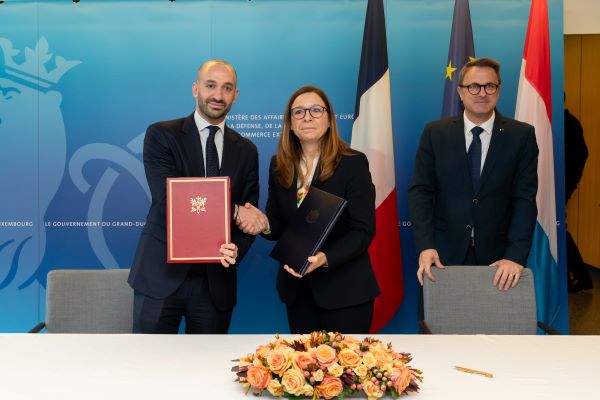
 (L-R) Benjamin Haddad, French Minister Delegate for Europe; Stéphanie Obertin, Luxembourg’s Minister for Research and Higher Education; Xavier Bettel, Luxembourg's Minister for Foreign Affairs and Foreign Trade;
Credit: © SIP / Emmanuel Claude
(L-R) Benjamin Haddad, French Minister Delegate for Europe; Stéphanie Obertin, Luxembourg’s Minister for Research and Higher Education; Xavier Bettel, Luxembourg's Minister for Foreign Affairs and Foreign Trade;
Credit: © SIP / Emmanuel Claude
On Thursday 11 December 2025, the Luxembourg and French governments signed an amendment to the additional protocol relating to scientific and university cooperation.
According to Luxembourg’s Ministry of Research and Higher Education, this marks an important step in Luxembourg medical training, by integrating the University of Reims Champagne-Ardenne as a new partner university. It thus joins the four French universities already involved in the cooperation: the University of Lorraine; the University of Strasbourg; the University Paris Cité; and Sorbonne University.
The amendment was adopted during the eighth meeting of the Franco-Luxembourg Intergovernmental Commission for the strengthening of bilateral cooperation. It provides for an increase in the annual quota of students from the University of Luxembourg’s bachelor’s degree in medicine who may be admitted to the first year of advanced medical training at partner universities in France, rising from 25 to 34 students. The change is intended to offer greater flexibility for Luxembourg students wishing to continue their medical studies in France, while also enabling the University of Luxembourg to increase the intake capacity of its bachelor’s degree in medicine.
In order to guarantee the stability of the system, a new operational agreement aims to define the terms of execution of the cooperation, with each French university committing to host at least five Luxembourg students in the second year of medical studies and three students in the first year of advanced medical training each year. The precise distribution is entrusted to a Franco-Luxembourg Harmonisation Commission.
Besides that, the Grand Duchy of Luxembourg has updated the financial arrangements and will now also contribute to the costs of clinical training for students entering from the first year of medical studies at the University of Luxembourg, in addition to the contribution already provided for students from the bachelor’s degree in medicine.
Luxembourg’s Minister for Research and Higher Education, Stéphanie Obertin, recalled that this long-standing cooperation had experienced a difficult episode this summer, when Sorbonne University did not take in any Luxembourg students into the second year of medical studies. Although all students were eventually reassigned to other French partner universities, this decision created legitimate uncertainty among them.
The dialogue between the minister, the President and the Dean of the Faculty of Health of Sorbonne University, as well as the Rectorate of the Grand Est academic region, resulted in a “sustainable” solution, which is expected to offer greater visibility and security to medical students.
Minister Obertin emphasised: "As a doctor by training, I am particularly attached to the quality of medical education and to the safety of the path of our students. The amendment signed today strengthens not only cooperation between France and Luxembourg but also ensures better planning for the training of our future doctors. The uncertainties encountered this summer have shown the importance of a clear framework and constant dialogue; I am pleased that we have been able, together, to lay the foundations for an even stronger collaboration."
The minister also reaffirmed Luxembourg’s ambition to continue developing its range of health training: creation of the bachelor’s degree in medicine, new specialisations, training in nursing sciences and ongoing projects for the opening of a master’s degree in medicine by 2029/2030.
The ministry confirmed that even in the long term, international cooperation will remain essential with neighbouring countries and especially with France, given the diversity of medical specialisations.
In addition to the 34 places available after the first year in the French partner universities, Luxembourg can also count on the support of its other neighbours:
- Belgium with a maximum of fifteen places, which are reserved each year for students who have passed their first year at the University of Luxembourg;
- Germany with three places that are guaranteed after the first year;
- Luxembourg with a maximum of 42 places, which are now available at the University of Luxembourg for students progressing to the second year.
This represents a total of 94 places available after the first year of medical studies.
For further studies after the third year of the bachelor’s degree in medicine at the University of Luxembourg, 42 places are reserved for Luxembourg students, with 34 places in France and eight in Belgium.
EO