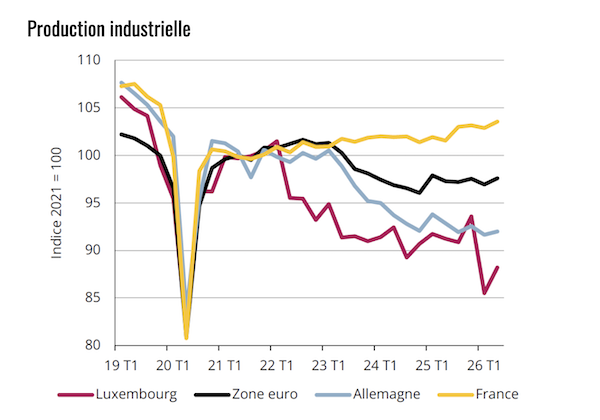
 Industrial production (index 2021 = 100);
Credit: Eurostat / STATEC
Industrial production (index 2021 = 100);
Credit: Eurostat / STATEC
On Tuesday 22 September 2026, Luxembourg’s national statistics institute, STATEC, published a report indicating that Luxembourg’s industrial production fell by approximately 5% year-on-year in the first half of 2026, widening the unfavourable gap with the European trend already observed in recent years.
According to STATEC, this result was well below the 0.4% increase recorded across the euro area over the same period. It was partly linked to a 12% decline in the production of capital goods, which has historically been highly volatile and had increased by approximately 5% in 2025.
However, the decline mainly resulted from a sharp fall in the manufacture of metal products, down 24% compared with 0.4% in the euro area, and in the steel industry, down 13% compared with an increase of approximately 1% in the euro area.
Although these two areas contributed to the improvement in the industrial confidence indicator over recent months, this improvement was not yet visible in the production figures. The indicator reached a low point in January 2026 and has since tended to recover, reflecting more favourable assessments of order books and production expectations.
Not all areas of Luxembourg industry experienced such unfavourable developments. Of the eighteen categories included in the data, eleven recorded an increase in production compared with the previous year, particularly the manufacture of glass, refractory products and ceramics, transport equipment and the extractive industries.
As in Luxembourg, industrial confidence across the euro area also improved in recent months, reaching its highest level in two and a half years in August 2026 and coming close to its long-term average. However, STATEC noted that current tensions in energy markets and production chains could interrupt this improvement. Industrial companies in both Luxembourg and the euro area also revised upwards their expectations regarding selling prices, although to a much lesser extent than in 2022 and 2023.
Industrial Employment Decline Put into Perspective
Industrial production has been more affected in Luxembourg than in the euro area in recent years. Between the beginning of 2023 and the second quarter of 2026, industrial employment fell by 1.5% in Luxembourg, compared with 0.4% in the euro area. The decline was greater in manufacturing, where employment decreased by 3.3%, representing the loss of almost 1,100 jobs, compared with a decline of 1.3% in the euro area.
STATEC nevertheless noted that the reduction in Luxembourg’s industrial workforce should be put into perspective. Germany, for example, recorded a fall of more than 4% since the beginning of 2023, despite a smaller decline in production than Luxembourg. Moreover, job losses in Luxembourg were mainly concentrated in 2024, when employment fell by 0.9%. This was followed by a decline of 0.3% in 2025 and an increase of 0.2% in the first half of 2026.
The report added that energy and water production and distribution, sanitation and waste management, which are also classified as industrial activities, created jobs over the same period. The decline was therefore concentrated mainly in manufacturing.
Luxembourg Life Insurance Driven by French Market
France has further consolidated its position as the leading market for Luxembourg life insurance. Premiums from France increased by 32% in 2025, following growth of 56% in 2024, and now represent 52% of the total premium income of Luxembourg insurance companies.
According to STATEC, several factors could explain Luxembourg’s attractiveness to French investors, including international mobility and the portability of contracts, open architecture, access to sophisticated investment solutions and mechanisms protecting policyholders in the event of an insurer’s failure. The search for legal and asset security may also play a role, particularly since the adoption of France’s Sapin 2 law in 2016, which, in certain exceptional circumstances, allows operations involving French life insurance contracts to be temporarily restricted.
Italy retained second place despite a 28% decline in premium income in 2025, following an increase of 25% in 2024. Belgium continued to record growth, with an increase of 10%. Luxembourg residents accounted for 5% of premium income, with premiums increasing by 3% year-on-year.
The trend remained favourable in the first half of 2026, with life insurance premiums collected in Luxembourg increasing by 11% year-on-year. This growth was supported by both unit-linked products, up 9%, and guaranteed-return products, up 17%.
Decline in Construction Employment Slows
Following the construction crisis, the sector employed approximately 4,700 fewer people in spring 2026 than at the end of 2022, representing a decline of 9%. However, employment has tended to stabilise over recent quarters, falling by a further 0.1% quarter-on-quarter in the second quarter of 2026. The slight recent decline was mainly attributable to specialised construction activities.
Within this category, installation work proved relatively resilient during the crisis, probably benefiting from demand linked to the energy transition, including the replacement of heating systems and the installation of photovoltaic panels and electric vehicle charging stations. Following three consecutive quarters of growth after two years of decline, employment in this area is now approaching its pre-crisis level.
The gaps remained more pronounced for finishing work and demolition and site preparation, with employment approximately 12% below its level in the fourth quarter of 2022. While demolition and site preparation recorded an encouraging quarterly increase of 1.4% in the second quarter, the downward trend continued in finishing work. Compared with the end of 2022, employment fell by between 300 and 400 people in each of the main categories: floor and wall covering work (-16%), painting work (-15%) and joinery work (-8%).
Fuel Prices at the Pump Rise Again
STATEC also reported that higher oil prices had quickly affected petroleum product prices in Luxembourg. Within two weeks, diesel prices increased by 30 cents per litre (+16%), petrol prices by seventeen cents (+9%) and heating oil prices by 29 cents (+21%). This was also expected to place further upward pressure on inflation, as petroleum products represent 5.2% of household consumption expenditure.
If Brent crude oil remained at $100 per barrel until the end of 2026, its average price for the year would stand at slightly more than $90 per barrel. This would be slightly above the central assumption in STATEC’s latest inflation forecast, published on 5 August, which assumed an average price of $83 in 2026. It would nevertheless remain below the forecast’s high scenario of an average price of $114, which envisages a further wage indexation in the fourth quarter of 2026.
New Car Registrations Rise in First Half of 2026
New passenger car sales in Luxembourg started the year relatively slowly, falling by 1% year-on-year in the first quarter. Registrations subsequently increased by 11% in the second quarter. Overall, registrations rose by 5% year-on-year during the first half of 2026, close to the 5.3% increase recorded across the euro area, reaching their highest level since 2019.
The recovery in car sales was relatively widespread across euro area countries, with Slovakia (-3.6% year-on-year in the first half) and the Netherlands (-3.0%) among the exceptions. In these countries, tax incentives for vehicle purchases were significantly tightened, whereas they were generally relaxed elsewhere, particularly for less polluting vehicles.
The electrification of the vehicle fleet continued, with fully electric new cars accounting for 20.7% of the European market, compared with 15.6% one year earlier, according to the European Automobile Manufacturers’ Association (ACEA), while hybrid models accounted for approximately 37%.
The full report is available on the STATEC website.